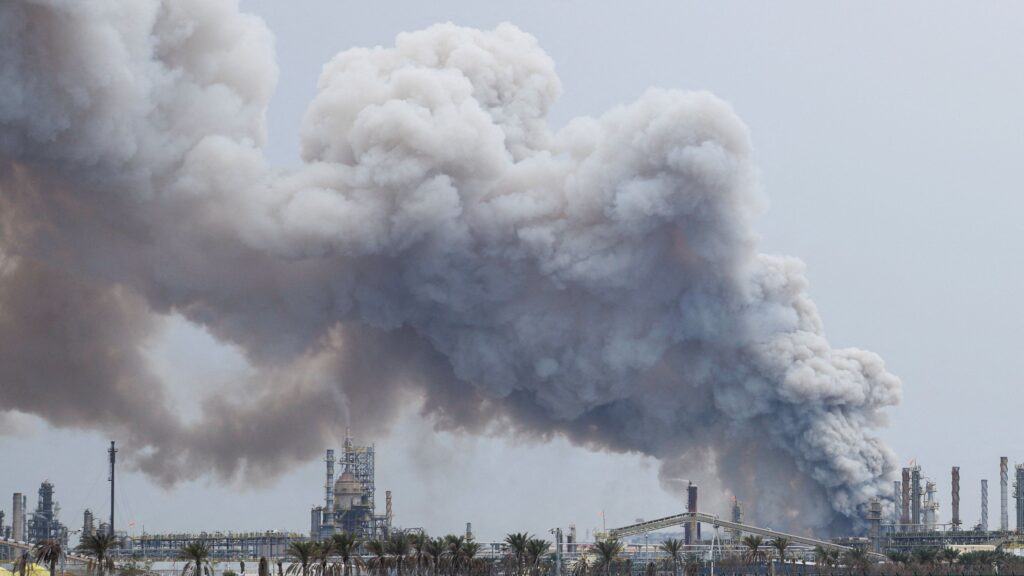
Oil prices soared above $100 a barrel on Monday as the U.S.-Israeli war with Iran entered its 10th day and fears of a prolonged conflict sent shock waves through global energy markets, with multiple Iranian retaliatory strikes reported overnight across the region.
Global markets reacted sharply to the hostilities, with steep losses first hitting markets in Asia, where economies such as China rely heavily on oil imports from the Middle East. In Europe, the Stoxx Europe 600 fell more than 2 percent in early trading, while London’s FTSE 100 dropped more than 1.5 percent and Germany’s DAX declined more than 2.5 percent. U.S. futures also signaled a weaker open on Wall Street.
Iranians are expected to gather nationwide on Monday afternoon to pledge allegiance to new Supreme Leader Mojtaba Khamenei, a hard-line regime insider deeply intertwined with the Islamic Revolutionary Guard Corps whose rise sends a strong message of defiance against the United States.
Hours after Iran named its new supreme leader, the IRGC announced more missile strikes across the region. On Monday, Israel said it had launched a new wave of “wide-scale” strikes across Iran, targeting Tehran, Isfahan and sites in the country’s south. The Israeli military also said it hit Iranian-backed militant group Hezbollah’s infrastructure in Beirut. Videos shared on social media showed plumes of smoke rising from the Lebanese capital’s southern suburbs.
Several Persian Gulf states reported intercepting missiles and drones headed toward key infrastructure sites. Saudi Arabia’s military said it shot down four drones bound for the Shaybah oil field. The Kuwait National Guard said it downed a drone near “a protected site,” while Qatar’s armed forces said they intercepted missiles.
Turkey’s Defense Ministry said an Iranian ballistic missile was shot down after entering Turkish airspace, neutralized by NATO air defenses in the eastern Mediterranean. It was the second such interception in a week.
Global markets brace for energy disruption
The price for a barrel of Brent crude, the international standard, spiked to $119.50 early Monday but later was trading close to $103 as refineries in the gulf came under attack and concerns mounted over shipping disruptions in the Strait of Hormuz, the narrow choke point through which a fifth of the world’s oil transits daily.
Bahrain’s national oil company, Bapco, declared force majeure on its operations Monday after an attack, meaning that it is not able to deliver on its obligations because of events beyond its control.
President Donald Trump called surging oil costs a “very small price to pay.”
“Short term oil prices, which will drop rapidly when the destruction of the Iran nuclear threat is over, is a very small price to pay for U.S.A., and World, Safety and Peace. ONLY FOOLS WOULD THINK DIFFERENTLY!” Trump posted Sunday on Truth Social. A day earlier, he said he was conscious of prices and could tap into the Strategic Petroleum Reserve.
IMF Managing Director Kristalina Georgieva warned Monday that a prolonged conflict in the Middle East could push global inflation higher.
“My advice to policymakers in this new global environment is, ‘Think of the unthinkable and prepare for it,’” Georgieva said, speaking at a conference hosted by Japan’s Finance Ministry.
The French Finance Ministry said Group of Seven leaders will convene Monday to assess the economic fallout from the conflict. The meeting, chaired by France, comes after French Finance Minister Roland Lescure said he had discussed the situation with U.S. Treasury Secretary Scott Bessent and other counterparts.
Iran rallies behind new supreme leader
Iran announced a nationwide gathering Monday to pledge allegiance to Mojtaba Khamenei — the 56-year-old second son of Ayatollah Ali Khamenei, who was killed in Tehran on Feb. 28 — as the new supreme leader. The country’s Islamic Propagation Coordination Council called on the public to gather “simultaneously across the country” at 3 p.m. local time for an oath of allegiance, according to the state-run Islamic Republic News Agency.
Trump has made clear that this appointment is a nonstarter for Washington — saying that any new supreme leader would need U.S. approval and that Mojtaba Khamenei would be “unacceptable” — leaving little room for a diplomatic off-ramp as the two countries remain locked in open conflict. Before the announcement, Trump said the new supreme leader “is not going to last long” without U.S. approval, and Israel’s military vowed to target any successor to the late ayatollah.
Iranian Foreign Minister Abbas Araghchi said Mojtaba Khamenei’s election will guarantee the country’s “national sovereignty and territorial integrity.” In a separate statement, Iranian President Masoud Pezeshkian said that the younger Khamenei’s rise marks “a new era of dignity and power for the Iranian people,” according to state media.
Lebanon says it’s ready to resume talks with Israel
The Israel Defense Forces said it launched a targeted raid in southern Lebanon overnight, aimed at dismantling Hezbollah infrastructure. Israeli forces renewed their assault on Lebanon last week after Hezbollah fired projectiles into Israel in a show of support for Iran.
Amid the overnight strikes, Lebanese Prime Minister Nawaf Salam told the French newspaper L’Orient-Le Jour that his government was ready to resume negotiations with Israel “in any format” but that Israel has not responded in kind.
Lebanese President Joseph Aoun said Israeli attacks would not achieve their objectives and echoed his country’s readiness to talk. “I informed the major powers and the United Nations of Lebanon’s full readiness to resume negotiations and discuss the necessary security measures to stop Israel’s dangerous escalation,” he said during a meeting with the ambassadors from Denmark, Sweden and Norway.
Lior Soroka, Ellen Francis, Heba Farouk Mahfouz and Siham Shamalakh contributed to this report.
The post Iran rallies around new leader after 10 days of war as oil prices spike appeared first on Washington Post.