As the Supreme Court considers a case that could weaken the voting power of Black Americans, thousands of people gathered in Selma, Ala., over the weekend to celebrate the 61-year-old law that the court is scrutinizing and to reckon with its uncertain future.
Last year, after the court signaled that it would revisit a key provision of the Voting Rights Act, organizations across the South began a broad campaign to educate voters about the potential impact.
If the court, which holds a 6-3 conservative majority, strikes down the provision in question, Section 2, a number of majority-minority congressional districts that were created to help voters of color elect their preferred candidates could be eliminated. Many are in Republican-controlled states in the South.
“This is a critical moment,” said Cliff Albright, co-founder of Black Voters Matter Fund, a nonpartisan voting rights group that is helping lead the education campaign. “Basically the very existence of the act is being questioned.”
On a cloudy Sunday afternoon, voting rights advocates, Democratic leaders and some who were on the front lines of the civil rights movement marched across the Edmund Pettus Bridge to mark the anniversary of Bloody Sunday, a violent episode in which protesters were attacked 61 years ago. Outrage and horror over the brutality captured in images helped to galvanize support for and then passage of the Voting Rights Act in 1965.
But with that very legislation being threatened, the weekend of panels, church services and the bridge crossing collectively served as an urgent call to action.
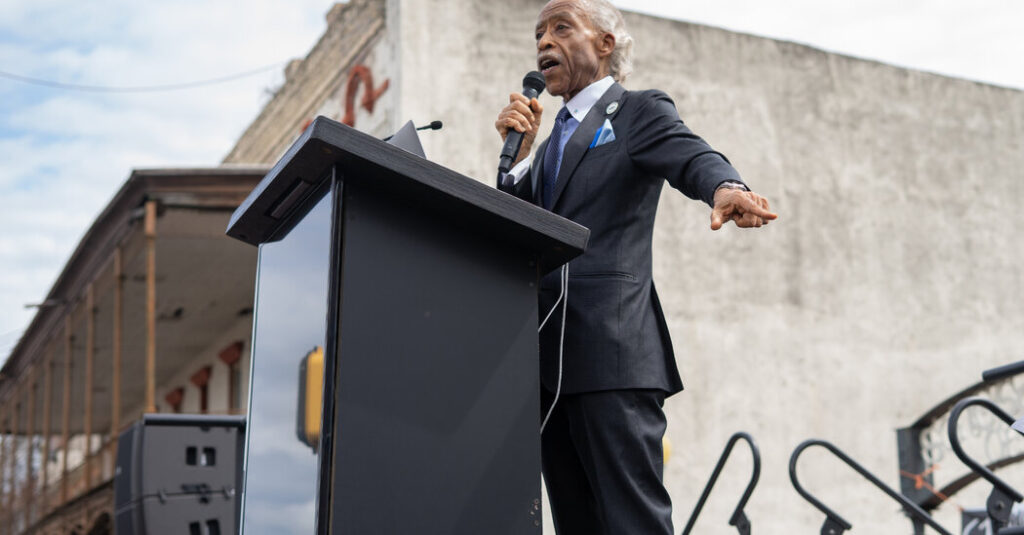
Addressing a crowd that packed the street at the foot of the bridge, the Rev. Al Sharpton said that this year’s march was about continuing, rather than commemorating, the fight to protect voting rights. National figures widely viewed as potential presidential candidates — Pete Buttigieg, the former Transportation secretary; Gov. JB Pritzker of Illinois; and Gov. Wes Moore of Maryland — were in attendance and spoke.
“We cannot sit here and act like we are walking down memory’s lane,” Mr. Sharpton said. “We are here in the drill room practicing for the fact that we going to have to do a lot more marching and a lot more registering voters and a lot more turning out.”
Black wreaths still hung outside near the bridge to honor the passing of those who had fought for civil rights in Selma and elsewhere in the South. Several people wore shirts commemorating the Rev. Jesse Jackson, whose Chicago funeral was on Friday.
For months, civil rights and voting rights groups, individually and collectively, have sounded the alarm while acknowledging they might have to look for new ways to protect and build minority voting power.
They have protested on the steps of courthouses, held rallies on the campuses of historically Black colleges and universities, hosted presentations at churches and supported the introduction of state voting-rights bills that parallel or build upon the federal law.
In October, about 300 people traveled on buses from seven Southern states to protest in front of the Supreme Court while the justices heard oral arguments related to the case. They held signs that read, “Your Voice is Your Vote and Your Power,” “Protect Our Vote” and “Support the Voting Rights Act.”
The Voting Rights Act, among the most consequential statutes of the civil rights era, dismantled systemic voter discrimination and outlawed barriers such as literacy tests that existed primarily in the South.
Those safeguards have been challenged repeatedly. But the biggest blow came in 2013, when the Supreme Court struck down a provision that required nine Southern states with a history of Black voter suppression to get federal approval before making changes to their voting laws.
The new challenge is rooted in Louisiana v. Callais, a redistricting case that is focused on the constitutionality of the state’s congressional map, specifically the creation of a second majority-Black congressional district in 2024.
The group of Louisiana voters who sued argue that the state’s new congressional map amounts to racial gerrymandering. A lawyer for the plaintiffs told the justices that race should no longer be a factor in drawing voting maps, effectively questioning the protections afforded under Section 2 of the Voting Rights Act.
“If it was ever acceptable under our colorblind Constitution to do this, it was never intended to continue indefinitely,” the lawyer, Edward D. Greim, argued at the October hearing.
Some of the justices appeared receptive during the arguments.
“This court’s cases, in a variety of contexts, have said that race-based remedies are permissible for a period of time — sometimes for a long period of time, decades in some cases — but that they should not be indefinite” Justice Brett M. Kavanaugh said at the time.
The court is expected to issue a ruling by the end of June.
The stakes are high. A New York Times analysis estimated that striking down Section 2 could open the door for redistricting that could net Republicans as many as a dozen seats across the South. Another study by Fair Fight Action and Black Voters Matters Fund calculated that Republicans could gain up to 19 seats.
Democratic lawmakers in Republican-led states, including Georgia, Alabama and Mississippi, are pushing back by introducing state-level voter rights legislation inspired by the federal law. Similar laws already exist in nine other states, according to the National Conference of State Legislatures.
In January, State Representative Zakiya Summers of Mississippi, a Democrat, filed a bill that would ban any suppression or dilution of minority voters and create a Mississippi Voting Rights Commission.
Though the measure died in committee in February, Ms. Summers viewed it as an initial step on what will very likely be a long road to passing a state-level version of the Voting Rights Act.
“We don’t have enough members to really carry this bucket of water,” she said of her party. “So we are using this as a way to do more advocacy. We will absolutely bring this bill back next year.”
For now, voting rights groups in Mississippi have turned their focus to educating voters about the case before the Supreme Court and its potential impact. In Jackson last week, a small group gathered to hear about the case and other voting rights issues at a forum held by Mississippi Votes, a nonpartisan youth group.
Hannah Robinson, a student at Jackson State University studying political science, said that the Supreme Court case had come up in her classes, and that she had started leading a push to engage her classmates in voting.
And in Alabama on Sunday, some people participating in the Annual Selma Bridge Crossing Jubilee said they felt buoyed by being there and what felt like a renewed commitment to protecting voting rights.
“It was a way to infuse hope,” said Vedna Lacombe-Heywood, 51, who traveled from Massachusetts to take part. “My cup has been filled.”
Audra D. S. Burch is a national reporter, based in South Florida and Atlanta, writing about race and identity around the country.
The post Voting Rights Groups Raise Alarms About Case Before the Supreme Court appeared first on New York Times.