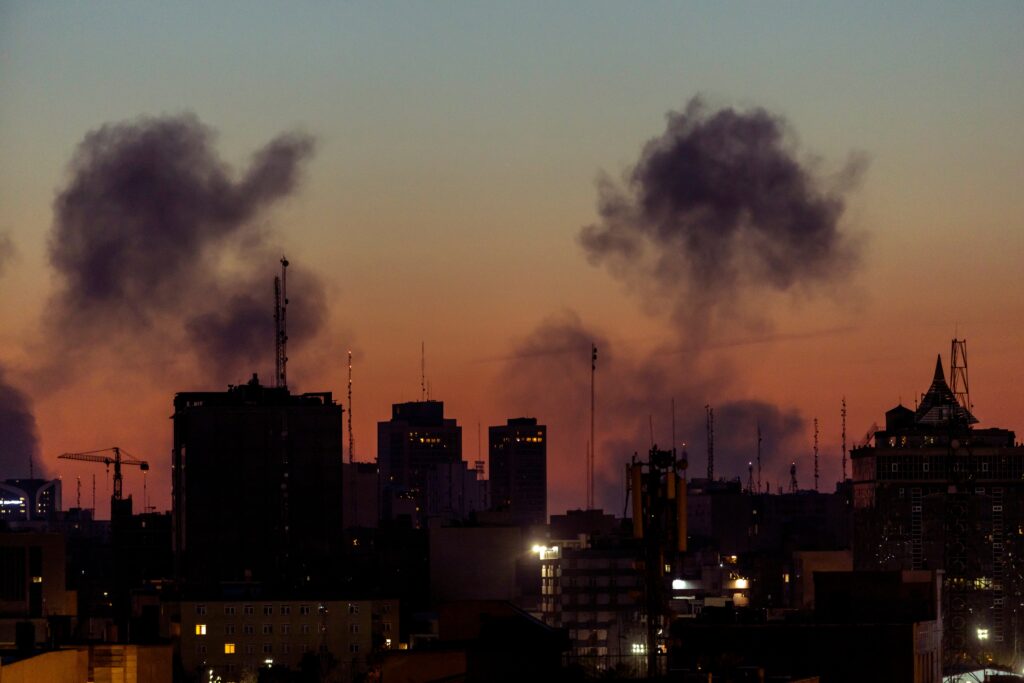
The Middle East first came to dominate U.S. defense policy in the 1970s — the decade of the Arab oil embargo, the Iran hostage crisis and the Soviet invasion of Afghanistan. Back then, the United States was dependent on Middle Eastern oil, leading President Jimmy Carter to announce a new doctrine in 1980: “An attempt by any outside force to gain control of the Persian Gulf region will be regarded as an assault on the vital interests of the United States of America, and such an assault will be repelled by any means necessary, including military force.”
To back up his words, Carter created the Rapid Deployment Joint Task Force. In 1983, that unit morphed into U.S. Central Command, the military nerve center now directing Operation Epic Fury against Iran.
These days, the United States is energy-independent, so you would think the Persian Gulf would not matter as much to U.S. leaders. But Trump administration officials are now citing the lack of U.S. dependency on foreign oil as a reason it’s easy to attack Iran. Interior Secretary Doug Burgum said in October that because “we don’t get any oil anymore out of the Strait of Hormuz,” the U.S. now has the “freedom” to use military power without worrying about the consequences at the pump. (That theory is now being tested: U.S. gasoline prices rose 14 percent last week.)
While the rationales shift, the U.S. remains mired in Middle East quicksand despite decades of efforts to disengage. In 2011, President Barack Obama announced a pivot to “the vast potential of the Asia-Pacific region,” after “a decade in which we fought two wars that cost us dearly, in blood and treasure.” In 2016, Donald Trump argued that “our current strategy of nation-building and regime change is a proven, absolute failure” and vowed to focus on the home front. More recently, he’s been obsessed with the Western Hemisphere.
So much for that: We are now expending more blood and treasure in the pursuit of yet another war of regime change in the Middle East.
Trump is right that Iran has an evil regime and a 47-year record of hostility toward the United States. But it was hard to argue, even before the current bombing, that the Islamic Republic constituted a major threat to the U.S. (as opposed to Israel). Iran’s nuclear program may not have been “totally obliterated” by American air strikes in June, as Trump claimed, but it was definitely set back. There was no “imminent” threat from Iran to justify the war Trump launched on Feb. 28 out of the blue — and the cost of waging it (financed with deficit spending at a time when the national debt is already close to $39 trillion) is likely to hamper U.S. efforts to compete with much more significant adversaries, notably Iran’s allies Russia and China.
Russia is already benefitting from the Iran war. The rise in oil prices (over $100 a barrel on Sunday from $73 a barrel on the eve of war) and Trump’s decision to relax sanctions on India for buying Russian oil will help bankroll the Russian war machine. The U.S. is also rapidly burning through limited stockpiles of missiles, especially air-defense interceptors, that are badly needed in Ukraine. President Volodymyr Zelensky has said more Patriot missiles were expended in just three days of fighting with Iran than have been used by Ukraine since 2022. Imagine how much Ukrainian energy infrastructure — and how many Ukrainian civilians — might have survived the winter if Trump had sent more Patriots to Ukraine rather than to what one journalist dubbed a “war of whim” with Iran.
The initial success of the U.S. bombing campaign may have some deterrence effect against China by showcasing U.S. military might, but the guided missiles being rapidly expended are also needed to defend Taiwan — and will take a long time to replenish.
More broadly, all the energy and attention the U.S. is pouring into the Middle East is a further distraction from the rising economic and military challenge from China. During the early 2000s, while the U.S. was focused on the post-9/11 wars, it was hit by the “China shock” — a surge of cheap Chinese imports that helped cost some 2 million manufacturing jobs. Economists David Autor and Gordon Hanson now warn that we are about to experience a second China shock that could be even more disruptive than the first.
While Trump has been bombing various countries, imposing tariffs, discouraging foreign students from coming to America and cutting research funding, China has been making massive investments designed to dominate the industries of the future. The Australian Strategic Policy Institute reports that China now leads the United States in research on 66 of 74 frontier technologies, including artificial intelligence, superconductors, quantum computing and optical communications. China is already manufacturing roughly 70 percent of the world’s electric vehicles, 80 percent of smartphones, 80 percent of lithium-ion batteries and 90 percent of drones. Last year, roughly half of all vehicles sold in China were EVs or hybrids. The comparable figure for the U.S. is 22 percent — and it is likely to decline after Congress repealed the EV tax credit.
China is also charging ahead in military power. The Pentagon reports that Beijing “continues to make steady progress” toward Xi Jinping’s goal of being “able to fight and win a war on Taiwan by the end of 2027.” China has the world’s largest navy and is rapidly expanding its ballistic missile and nuclear forces. China is even challenging America’s undersea dominance by building submarines that can launch nuclear strikes from close to the U.S. mainland.
Meanwhile, the Trump administration is spending tens of billions of dollars to bomb the Iranian regime to smithereens.
It’s too soon to tell who will win the war between the United States and Iran. But, at this point, my money would be on Russia and China.
The post There are two winners in Iran. Neither one is America. appeared first on Washington Post.