As the war in Iran spirals beyond its borders, Ukraine has sent interceptor drones and a team of drone experts to protect U.S. military bases in Jordan, President Volodymyr Zelensky said in an interview with The New York Times.
The United States made the request for help on Thursday, and the Ukrainian team left the next day, Mr. Zelensky said. It was expected to arrive in the Middle East soon.
“We reacted immediately,” Mr. Zelensky said on Friday evening during a train ride I took with him from eastern Ukraine to the capital, Kyiv. “I said, yes, of course, we will send our experts.”
The White House did not respond to a question about whether the United States had asked for Ukraine’s help.
The U.S.-Israeli war in Iran risks redirecting world attention away from the war in Ukraine. But it has also given Kyiv an opportunity to use its hard-won expertise and advanced technology on a new front. The country has eagerly offered to help U.S. forces and their Middle Eastern allies defend against the sorts of Iranian-designed attack drones that Russia has been using in Ukraine for years.
Kyiv is hoping to score points with the United States in American-brokered peace talks. The relationship remains fraught. On Thursday, President Trump again said he viewed Mr. Zelensky as more of an impediment to a peace deal than President Vladimir V. Putin of Russia, who ordered the invasion. Mr. Trump has been much more solicitous of Moscow than his predecessor was.
As Ukraine cooperates with the United States in the Middle East, Kyiv hopes to draw a contrast with Moscow. U.S. officials say that Russia has provided intelligence to Iran during the war, including satellite imagery showing the locations of American warships and military personnel. Mr. Zelensky said he had also seen intelligence showing that drones now swarming out of Iran had Russian components. The Times could not verify that claim.
The Ukrainian leader said he wanted to help Middle Eastern nations but also needed to balance those requests with Ukraine’s needs at home, as the war there has dragged into a fifth year.
The war in Iran could cut off flows of defensive weapons that Ukraine badly needs. Kyiv has offered to trade its interceptor drones to Middle Eastern countries for more powerful systems that Ukraine needs to contend with Russian ballistic missiles. Ukraine has also said it will assist Middle Eastern countries in exchange for diplomatic help in pushing Russia toward a cease-fire.
Mr. Zelensky noted that some Middle Eastern countries had “very strong relations with Russia.”
“That’s why I said, Look, so maybe they can speak with Russians and Russians will make a pause,” he said, adding, “In this case, of course, we can help the Middle East to defend them.”
No one knows more about fighting the long-range one-way attack drones now streaming out of Iran than Ukraine.
One of those drones killed six U.S. service members at a command center in Kuwait last week. While Iran’s initial volley of ballistic missiles has now slowed as the United States and Israel pummel the Iranian military, the volume of drones has not.
Russia was an early adopter of the Iranian drones, known as Shaheds, and has modeled its own version on the original Iranian product.
Early on after the Russian invasion, Ukraine sometimes used expensive missiles or even more expensive Patriot interceptors to knock down Shaheds. That quickly proved untenable.
A Shahed costs up to $50,000 to produce. An American-made Patriot interceptor missile costs more than $3 million.
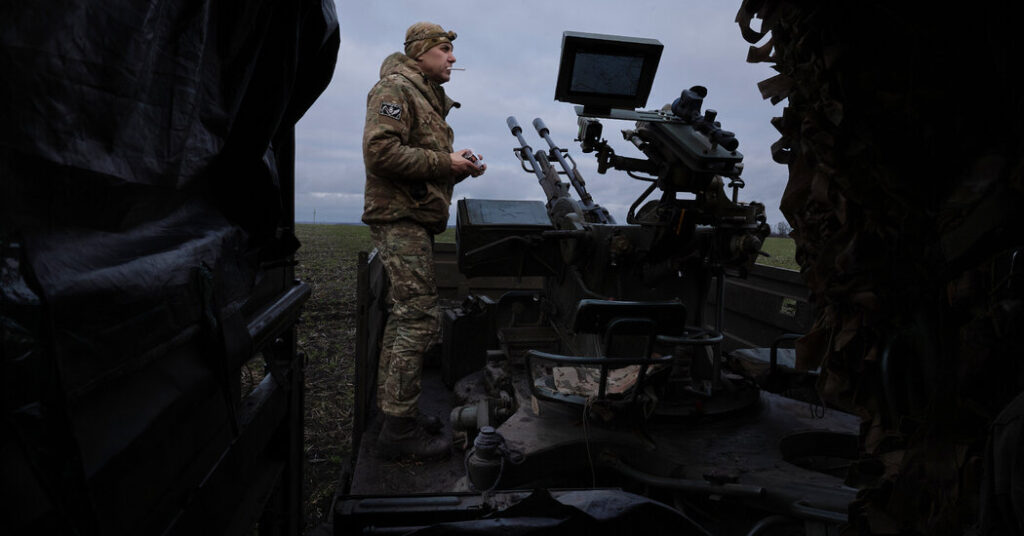
So Ukraine adapted, using heavy machine guns, less expensive rockets fired by F-16s, electronic jammers and new interceptor drones built in Ukraine.
Ukraine can now destroy most Russian one-way attack drones, according to daily numbers put out by the Ukrainian Air Force and analyzed by The Times. In February, Russia sent about 5,000 one-way attack drones and decoys into Ukrainian cities, according to The Times’s analysis. Ukraine downed about 87 percent of them.
In the days after the U.S.-Israeli war in Iran started, Mr. Zelensky said, he and his team fielded calls from leaders in Bahrain, the United Arab Emirates, Jordan, Kuwait, Qatar and Saudi Arabia looking for help.
During the interview with The Times on Friday, Mr. Zelensky said another team of Ukrainian experts would travel to the Middle East to help nations evaluate how they could protect themselves from Iranian drones, besides simply firing off expensive Patriot interceptors.
Those missiles are in short supply. Just 620 of the most advanced Patriots were delivered to militaries in 2025, and that was a record level.
In the first few days of the Iran war last week, Middle Eastern countries burned through more than 800 Patriot missiles, according to Mr. Zelensky and Andrius Kubilius, the European commissioner for defense and space. That barrage was used to counter more than 2,000 one-way Iranian attack drones and more than 500 ballistic missiles.
Dmytro Lytvyn, an adviser to Mr. Zelensky, said that in the entire four years of the war in Ukraine, Kyiv had received only about 600 advanced Patriots.
Maria Varenikova contributed reporting.
Kim Barker is a Times reporter writing in-depth stories about the war in Ukraine.
The post Ukraine Helps U.S. Mideast Bases With Stopping Drones appeared first on New York Times.