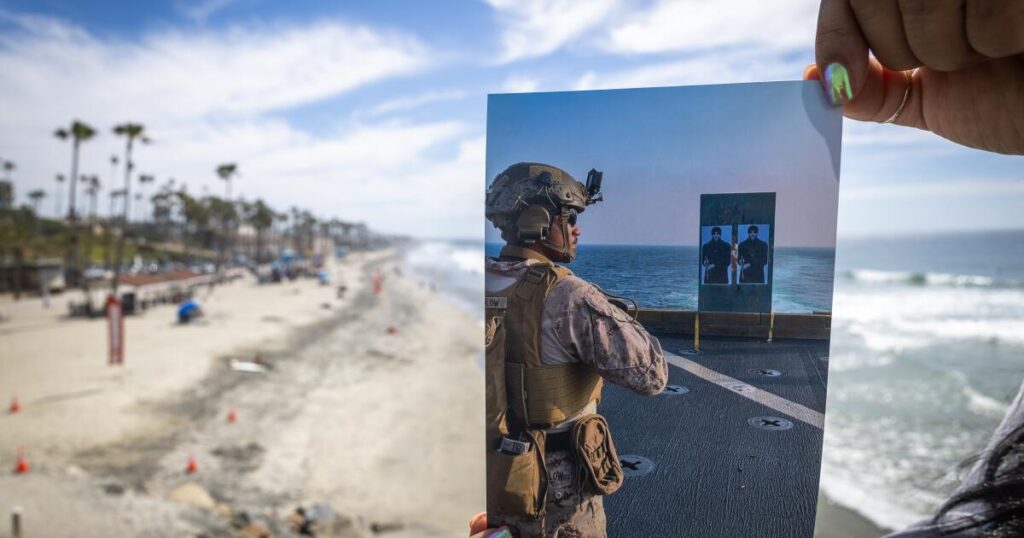
TWENTYNINE PALMS, Calif. — Brandi Jones and her boyfriend were both 22 when he first deployed to Iraq with a Twentynine Palms-based infantry Marine unit in 2004.
The next year, they married and prepared a will, knowing another deployment could occur at any time. When her husband returned to Iraq in 2009, their children were 2 and 4.
Seventeen years later, Jones’ husband is still an active-duty Marine. And when she learned on Feb. 28 that the U.S. and Israel had attacked Iran, killing Supreme Leader Ayatollah Ali Khamenei, an old fear overwhelmed her: Could he be deployed again — and could her children lose their father — in yet another conflict in the Middle East?
“I thought, ‘If their dad deploys again now and doesn’t come home, at least they got to know him and he got to see them grow up,’” said Jones, who now lives in Monterey County and is the organizing director for the Secure Families Initiative, a nonprofit that advocates for military families and veterans.
The escalating conflict has sent a chill through military communities across California, which is home to more than 157,000 active-duty military personnel — more than any other state. For some service families, the images of missile strikes and talk of deployment readiness have resurrected the fear and uncertainty of Iraq and Afghanistan — so-called forever wars.
“Families are saying, ‘What is the mission?’ They wonder, what is the timeline?” Jones said. “And, of course, everyone is fearful that it will be years and years.”
In fact, a Californian was among the first American service members to die in the war.
Chief Warrant Officer 3 Robert M. Marzan, 54, of Sacramento was killed in Kuwait on March 1 in a retaliatory drone strike by Iran, according to the Pentagon and his family. He was among six U.S. Army Reserve soldiers killed in the attack on Port Shuaiba.
Marzan was assigned to the 103rd Sustainment Command in Des Moines — a unit tasked with supplying troops with food, fuel, ammunition and equipment — and deployed to Kuwait to support the war effort. After serving for more than 30 years in the military, he was in the final two months of his last deployment, according to his family.
Military bases across California have tightened security since the conflict began, requiring more stringent visitor identification, checks at gates and warning of traffic delays. Naval air stations in the Central Valley city of Lemoore and El Centro in Imperial County canceled public air shows planned for this month out of safety concerns.
The San Diego-based USS Abraham Lincoln is one of two known U.S. aircraft carriers engaged in the conflict, along with the Virginia-based USS Gerald R. Ford.
One photo published by the Pentagon shows a fighter plane preparing to launch from the flight deck of the Lincoln at an undisclosed location at sea. A crewman directing the aircraft wears a large Los Angeles Dodgers sticker on his yellow helmet.
On March 1, the military’s U.S. Central Command refuted Iranian claims that it had struck the carrier, writing in a social media post: “The Lincoln was not hit. The missiles launched didn’t even come close.”
In an interview Friday, U.S. Rep. Scott Peters (D-San Diego), whose district includes the Lincoln’s home port, Naval Air Station North Island, said military families in San Diego are under “a lot of stress.”
San Diego is home to one of the largest concentrations of post-9/11 veterans in the country, and many are uneasy about deploying troops to Iran after decades of war in the Middle East, he said.
“It’s not like they’re calling us up and complaining. That’s not what they do,” Peters said. “They sign up for this mission. They know that sacrifice is part of it. But that doesn’t make it easy.”
Peters said he was disturbed by social media videos posted by the White House, including one that mixed airstrike footage from the Iran war with scenes from “Top Gun,” “Superman,” “Iron Man,” and the television show “Breaking Bad.”
“It’s war. It’s not a war game,” he said. “The feeling you get is that this is very entertaining for them, that they’re feeling very muscular. But this is a really costly thing for the country and the families that put their lives on the line and their spouses and their brothers and sisters. In San Diego, you won’t see people making fun of this.”
In Oceanside, home to Marine Corps Base Camp Pendleton, Shalena Critchlow, 42, said that when she first learned of the attack on Iran, she felt guilty because she was relieved that her 24-year-old son had recently completed his service with the Marines and would not be deployed.
Her sons were born in 2002, 2003 and 2009. All they know is wartime, she said.
Critchlow, a regional organizer for Secure Families Initiative, was 17 when she married her ex-husband, who joined the Marines right out of high school and was deployed multiple times to Iraq and Afghanistan. In the years after 9/11, Oceanside was covered in yellow ribbons meant to support the troops. As a young mom with a husband overseas, she would drive onto base every day crying.
In recent days, Critchlow has been speaking with young military spouses, preparing them for the realities of deployment.
“What I’m hearing is confusion, frustration, being scared, worried. … Everyone is kind of looking for comfort. People are looking for transparency,” she said.
At the Apollo Depot Military Outlet in downtown Oceanside on Friday, Sam Esparza, 32, was stocking a display case with pins and checking inventory. He said he grew up watching his dad help service members at the store, which opened in 1972.
Esparza said business started ramping up about two weeks ago, before news of the military action in Iran. His regular customers did not mention anything — not a surprise from clientele who know not to share classified information — but Esparza has been around long enough to sense that the Marines who were coming in to replace gear like sleeping bags and warm clothing were preparing to ship out.
“Right before everything was happening, I had buddies telling me, ‘Hey, we’re not gonna see you for a while,’” he said. “Then you wake up and see the news and realize where they’re going.”
Often, Marines stop by the shop after a meal and a few drinks at a bar nearby, he said.
“They’re happy, but you get a sense there’s a seriousness behind it,” he said. “They’re just trying to enjoy the time they have here.”
In Twentynine Palms, City Manager Stone James said local leaders are working to understand the potential needs of the Inland Empire community and its military families in the event of a mass deployment.
The mood, he said, is “upbeat, given the fact that we have just eliminated a regime that has slaughtered tens of thousands of their own people and repressed women’s rights and dignity and humanity.”
But around town, some locals said they were uneasy, and uncertain, about what the war could mean for their community and loved ones.
“It’s not just troop deployment to us. It’s our neighbors and our families,” said Mike Usher, an Air Force veteran who owns the gastropub Grnd Sqrl, which serves a lot of Marines and has seen a noticeable drop in customers the last few days.
On Thursday, Combat Barber II, a staple for Marines seeking high-and-tight haircuts, did not receive a single customer in the first six hours it was open.
Business has been down over the past year, but the past week was especially slow, said barber Leena Nguyen, who has worked there for 26 years. The barbershop also saw a decline back in 2003, when Twentynine Palms Marines were first sent to Iraq, Nguyen said.
“When they get ready to go to war, we’re slow,” she said.
At Eddie’s Alterations, which specializes in tailoring military uniforms, owner Eddie Benitez believes customers may be reluctant to leave the sprawling Marine base because of stepped-up security measures.
Still, he said, the war is in its early stages, and business has not declined as much as it did in 2009, when troops surged to Afghanistan and turned Twentynine Palms into a veritable ghost town.
Benitez’s concerns about the Iran conflict go far beyond his business. He was 1 when his father, a Navy sailor, went missing in action during the Vietnam War. Now, his daughter is stationed at Nellis Air Force Base near Las Vegas, and some of her colleagues have already been deployed.
“I’m worried,” he said.
Next door, at Caveman Kyle’s American Art Tattoo Studio, artist Derrick Seymour said he expects business to increase if troops are mobilized.
Twentynine Palms is the primary training base for Marines slated for deployment for the Middle East, with its harsh desert climate and mock villages meant to simulate combat conditions overseas. Ahead of any mobilization to the region, there tends to be an influx of Marines from across the country, said Seymour, who grew up there.
Before a mass deployment, the shop tends to see an uptick in military motivational, or “moto,” tattoos, which often feature unit numbers or slogans. And when troops return, artists are busy inking tributes to fallen comrades.
“I remember in the late 2000s, during the first Iraq invasion, we were doing a lot of the boots and Kevlar memorials,” Seymour said.
At the Virginian, a dimly lit dive bar with dollar bills plastered to the wall, bartender Joshua Roche was pouring beers Thursday for a rowdy group that included one active-duty and two retired Marines.
He said he does not sense much anxiety among his clientele.
“They’re just like, we’re f— ready to go,” he said.
Wigglesworth reported from Twentynine Palms, Branson-Potts reported from Los Angeles, and Fry reported from Oceanside.
The post ‘What is the mission?’ With Iran, California military families fear another ‘forever war’ appeared first on Los Angeles Times.