Aliens have invaded the news again. Last month, two US presidents weighed in on the topic in rapid succession, managing to make a public that was already obsessed with extraterrestrials even more so.
First, Barack Obama sparked a furor by saying aliens are “real” during a podcast lightning round. He later clarified that he simply meant this in the sense that it’s very likely that there is life somewhere in the vast universe, but the accidental media frenzy seemed to inspire President Donald Trump to announce in a Truth Social post that his administration would “begin the process of identifying and releasing Government files related to alien and extraterrestrial life, unidentified aerial phenomena (UAP), and unidentified flying objects (UFOs).”
The whole episode is yet more proof that aliens are a rare focus of fascination shared by people across myriad backgrounds.
“Whenever a high-ranking official—and you can’t get much higher than a president and a former president—even touches on the subject in a passing comment,” it’s “riveting,” says Greg Eghigian, a professor of history and bioethics at Penn State University who studies UAP and abduction stories.
It also raises the inevitable question: What is in those files?
A Defense Department official tells WIRED that the All-domain Anomaly Resolution Office (AARO), a branch of the Pentagon tasked with tracking UAP, is coordinating with the White House and federal agencies “to consolidate existing UAP records collections and facilitate the expeditious release of never-before-seen UAP information.”
“We welcome the president’s initiative to supercharge these efforts and make more UAP information available to the public as soon as possible,” the official says.
While we won’t know what’s in the files until their release, it’s possible to speculate a bit about the likely content based on the many past government disclosures on the subject. But the bigger mystery may be whether any released material could ever satisfy the public’s insatiable curiosity about the possibility of discovering or contacting lifeforms from beyond Earth.
“This is a very fundamental existential question that we all have,” says Anamaria Berea, an associate professor at George Mason University who served on NASA’s UAP Independent Study Team. “Is it just us, or are there some others out there? If they are out there, are they friendly or not? This is existential to our humanity. It’s beyond science.”
What Do People Want to Be in the Files?
The answer to the above question is: aliens. Alien spaceships. Alien bodies. Alien anything. The suspicion that the US government is holding back this type of blockbuster revelation has been prevalent for decades. More recently, it has been revived by testimonies before Congress that have speculated on the existence of nonhuman biological or technological materials held by the government, an idea explored by the recent documentary The Age of Disclosure.
The lore around an alien cover-up could set expectations high for the new release—and, possibly, yield yet another anticlimax in the absence of clear evidence.
“Unless you are going to actually release real data—by real data I mean the spaceship or the alien body that these congressional testimonies so far have said existed—then it’s just going to be more smoke and mirrors,” says Adam Frank, a professor of astrophysics at the University of Rochester who specializes in the search for extraterrestrial life.
Indeed, even a bonafide spaceship or alien body might not pass muster, given the extraordinary depth and variety of theories across subcultures. What if it’s not the right kind of spaceship? What if it’s viewed as misdirection—some plot to tamp down interest?
“Even some sort of really remarkable and extraordinary revelation would certainly not satisfy the social-media-verse,” says Eghigian. “‘Hey, is this another hoax? Is this another game that the government is playing with us? What else are they keeping from us?’”
“I don’t foresee almost any way for this thing to be definitively resolved in terms of the public interest,” he adds.
What’s Likely in the Files?
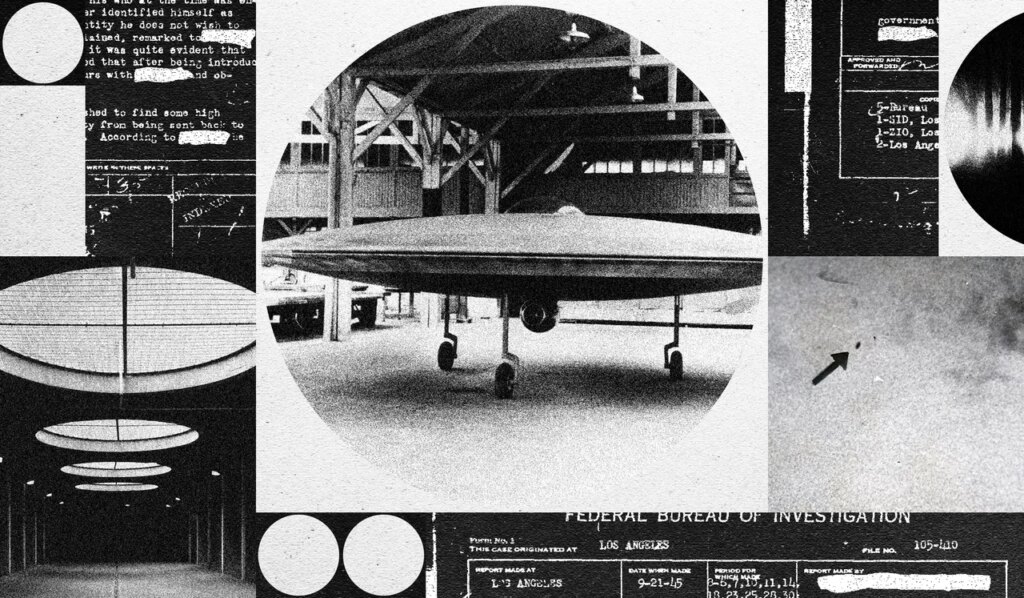
If history is any guide, a new release would center on UAP sightings and the government programs that track and study them. Since the first major UFO craze in 1947, the US government has periodically released documents and reports from internal teams, such as Project Blue Book, which covered the years from 1947 to 1969, the 1994 Roswell Report, and the more recent declassification of the Pentagon UAP videos, which had previously been leaked. Many of these files contain eerie visuals of UAP that have defied explanation.
UAP “can be a number of things,” says Berea. “It’s not like they are all in one bucket. Many of them actually are, in time, cleared up. Some of them, maybe, were balloons, airplanes, or some atmospheric phenomenon that we don’t know about. Then, yes, there is a small category where it is still not clear what they are.”
The tantalizing mystery surrounding those unexplained sightings excites the imagination, though government releases have repeatedly specified that there is no evidence these phenomena are extraterrestrial in origin, including recent reports from the AARO.
Sometimes, government disclosures about UAP include juicy admissions, such as lies to citizens about the nature of some sightings. One famous example is the CIA report in 1997 that said the Air Force had made “misleading and deceptive statements to the public in order to allay public fears and to protect an extraordinarily sensitive national security project.”
To that end, a new release may contain information about the government’s approach to internally evaluating UAP or records about its public posture toward the topic—or, more broadly, government campaigns of deception.
It’s also possible that new files will contain previously unreleased visuals of UAP, or more detailed information about existing UAP sightings, such as radar data. But much of this material will not be eligible for declassification if the Pentagon deems it a risk to national security. For example, the government does not divulge sensitive locations of military assets or insights into how some military operations are conducted.
“Classifying stuff, a lot of times, is not about the information, per se,” says Eghigian. “By revealing that material, you may reveal something about the way something was found out or something was seen. You’re revealing something about technology, or information processing, and oftentimes that is the concern about classifying material.”
“I think in all likelihood, what we’ll see is what we typically see,” he adds. “There’s maybe going to be some new nuggets in there, but I think a lot of people are going to come away very, very unsatisfied.”
What’s Probably Not in the Files?
In addition to files about UAP and UFOs, Trump ordered the release of any files related to alien life. The bad news is that—if we are judging by past releases—there will probably be nothing new about aliens in these files. The good news is that this is because alien-related research is already available in endless volumes of studies and documents, as there is no reason to classify it in the first place.
“There’s a huge amount of work that the government has done, all of which is actually transparent about the study of life in the universe,” Frank says. “There are a lot of documents people can go find about what the government knows, or think it knows, about extraterrestrial life.”
Because the scientific search for aliens has transpired out in the open for decades, it’s unlikely that any government files would divulge a scientific finding, such as a detection of an artificial optical beacon from some far-off star system, or the discovery of an otherworldly machine drifting through the solar system.
Indeed, as we’ve seen in recent years, the debates between scientists over, say, the origin of interstellar objects, or the assessment of possible biosignatures, are hashed out in a highly public manner. That’s one reason that Berea thinks the odds of a large conspiracy about aliens would be hard to maintain over decades, especially within the scientific community.
“It’s not like all the reports come from the US government,” she says, noting that governments of the United Kingdom, France, and Brazil, among others, have released documents related to UAP. “It’s not a US-specific phenomenon. You find it all over the globe. It would be really, really hard to believe that there is such a global conspiracy.”
When Are We Going to Find Aliens?
The current search for alien life encompasses a vast array of projects, including surface missions on our neighboring worlds, surveys to spot alien artifacts in our solar system, and telescopes that could spot signs of life, perhaps even civilizations, in other star systems. Many scientists are also developing new ways to investigate UAP and possible technosignatures in an effort to constrain explanations for the most enigmatic sightings.
Any one of these ongoing projects could finally fill in that most irresistible data point in the universe—the existence of life beyond Earth. Or, and this is as hard for me to write as it may be for other alien lovers to read, we simply may not ever know if aliens are “real,” in Obama’s words, either here in the solar system or out in the vast cosmic wilds. Nevertheless, the search continues.
“If these files don’t actually give us the spaceship or a biological sample,” Franks says, “you’re going to have to actually go out and do the science anyway.”
The post Don’t Expect Big Surprises in the Government’s Alien Files appeared first on Wired.