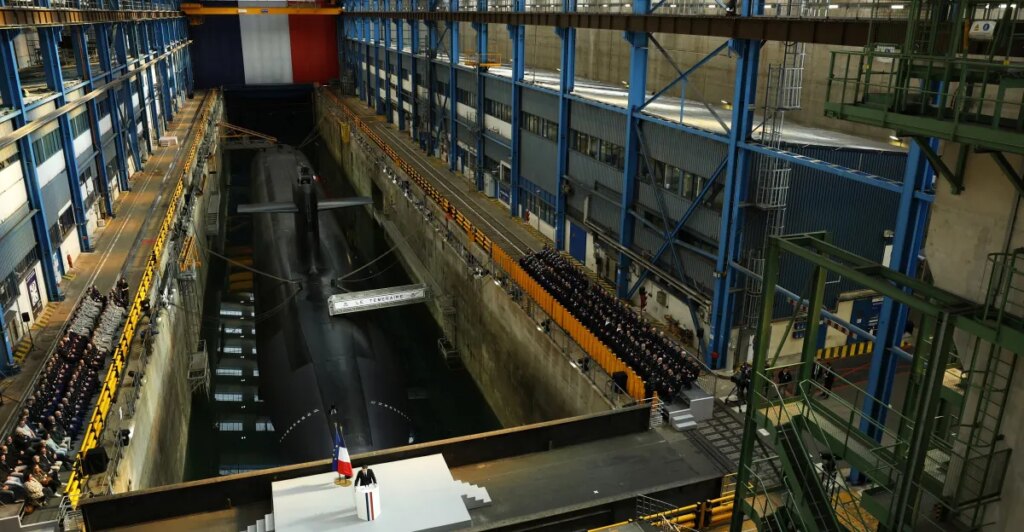
The landmark speech given by French President Emmanuel Macron this week — with a nuclear submarine serving as a dramatic backdrop — announcing the expansion of France’s nuclear arsenal, didn’t get that much attention in the United States. That’s understandable: There’s a lot going on in the news, not least of which is the ongoing war in Iran.
But while not directly related — the Macron speech had been planned for some time — the two stories are examples of the same phenomenon: In today’s world, thanks in large part to the policies of Donald Trump’s administration, nuclear weapons look more attractive than ever. This holds true for America’s allies as well as its adversaries.
Nuclear lessons from Iran
In Iran, the world is watching as two nuclear-armed powers, the United States and Israel, are overwhelming the defenses of a country that infamously maintained a nuclear enrichment program for years but never actually built a weapon.
This is now the second time in a year that Iran has been attacked during negotiations with the US over its nuclear program, with scheduled meetings on the calendar at the time the bombs started falling. This time, the regime itself, not just its nuclear program, is in danger of destruction.
For years, Iran had deliberately maintained its status as a “threshold” nuclear state. Officially, Iranian officials maintained that they were not seeking a nuclear weapon and that Supreme Leader Ayatollah Ali Khamenei had issued a fatwa, or religious ruling, against one. At the same time, Iran has enriched a uranium stockpile with little plausible purpose other than a nuclear weapon, which is currently unaccounted for.
As the former head of Iran’s nuclear program put it in 2024, “It’s like having all the parts to build a car: we have the chassis, the engine, the transmission, everything.”
By almost building a bomb, Iran, a signatory to an international treaty that prevents it from acquiring nuclear weapons, could avoid the diplomatic costs of actually building one while negotiating concessions from its adversaries, and maintaining the threat of actually building a weapon if it were ever attacked.
This turns out to be a disastrous miscalculation. Iran’s nuclear program resulted in years of economic sanctions, which, combined with the government’s own mismanagement, created a dire economic crisis that contributed to mass protests against the government. And with Iran’s conventional defenses underperforming over the last two years — its missiles have been unable to overwhelm Israel’s air defenses and its “axis” of allies if the Middle East has been badly degraded — the Trump administration came to agree with Israel that it was easier to deal with Iran’s nuclear program with military force rather than diplomacy.
Some countries might conclude it’s not even worth trying to get nuclear weapons, given the risk. But there is a counterexample. As the bombs fell on Iran this week, North Korean dictator Kim Jong Un took a relaxed televised tour of a cement factory this week, praising employees for what he called the “high spirit of the powerful working class.” North Korea first tested a nuclear weapon in 2006 and is today believed to have around 50 warheads in its arsenal, enough fissile material to build dozens more, and long-range missiles that can theoretically reach the United States. The brief period of “fire and fury” threats from Trump’s first term notwithstanding, the world has tacitly accepted North Korea as a nuclear power, and no one seems too anxious to risk military action to disarm it.
North Korea developed its program quickly, weathering years of crippling sanctions. In previous rounds of negotiations, North Korean officials have pointed to the fates of Libya and Iraq, two governments that gave up attempts to build a nuclear weapon and were later overthrown in US-led military operations.
As Carnegie Endowment nuclear analyst Ankit Panda wrote this week, “Whatever the costs of this approach—and they were substantial!—nobody is bombing North Korea today. … Pyongyang and Tehran will present two parables for the next proliferator; it seems pretty clear which approach has more appeal.”
The good news for the US and its allies is that with Iran’s nuclear capabilities even more degraded by this war, even if the regime survives, there aren’t any other US adversaries known to be developing nuclear weapons. It won’t necessarily stay that way, particularly if current trends in US foreign policy continue. Trump is already publicly discussing which country he will invade next, and leaders of some of those countries may decide they need something more than conventional weapons to avoid the fate of Nicolás Maduro or Ayatollah Ali Khamenei.
Macron throws down the gauntlet
At the moment, the countries most likely to build up their nuclear capabilities, or acquire new ones, are America’s allies, as Macron’s speech demonstrated this week. Speaking during a visit to the Île Longue submarine base in Brittany, Macron announced that France would expand the number of nuclear weapons in its arsenal — currently 300 — but did not specify a number.
He also said that for the first time, France would allow the deployment of its nuclear-armed aircraft to other European countries, though it would maintain full control over the decision to use these weapons.
France is the only state in the European Union with its own nuclear weapons (since Britain’s departure), though several countries host American weapons on their soil. Most European countries are members of NATO, meaning that in theory they are protected by the US nuclear “umbrella.” But as Vox has reported, Russia’s invasion of Ukraine, combined with Trump’s dismissive attitude toward America’s mutual defense commitments under NATO, has sparked a debate on the continent about whether European countries need a nuclear deterrent of their own. These concerns reached a fever pitch in January when Trump was openly threatening to use military force to seize Greenland from Denmark, a fellow NATO member state.
The past week has probably not reassured Europeans worried about America’s reliability as a security partner. Though neither government supported the US-Israeli attack on Iran and both have questioned its legality, both the United Kingdom and France have moved forces closer to the Middle East in response to Iran’s retaliatory strikes throughout the region. Iranian missiles have landed in Cyprus, an EU member state, and Turkey, a NATO member. Trump has lashed out at the government of Spain for refusing to allow its bases to be used for attacks on Iran, threatening to cut off all US trade with the country and suggesting it should be kicked out of NATO.
France has always been the country most skeptical of US security guarantees. In the 1960s, French President Charles de Gaulle skeptically asked President John F. Kennedy if the US would really be willing to “trade New York for Paris.” In his speech, Macron didn’t mention Trump, specifically, but argued that “Europeans have become used to their security depending on rules made by others,” whereas the current era requires new rules “rooted in our security interests and those of our continent.”
France may not be the only European country making nuclear plans. Polish Prime Minister Donald Tusk suggested this week that his country, on the front lines of Russia-Europe tensions, may soon seek nuclear weapons of its own.
The new nuclear world
Last month’s lapsing of the last US-Russia arms control agreementwas yet another sign that the world has entered a new nuclear era. One in which the number of weapons, led by China’s growing arsenal, is increasing — as is the use of nuclear threats for coercion, as seen in Vladimir Putin’s rhetoric in Ukraine. Decades-old arms control agreements are falling by the wayside, and advanced technology could add destabilizing new dynamics.
In the past, the US has often worked to stop new countries from acquiring nuclear weapons. That includes adversaries, but also allies like South Korea and Taiwan. Now, US foreign policy may be creating a world where nuclear weapons look more attractive than ever.
“When you look at what’s happening in Europe with the Macron speech, this war against Iran, the Maduro raid, the Ukraine conflict, the prospects of conflict in East Asia, you do see a world where publics in the countries that perceive threats to their national security are going to be talking about the bomb a lot more,” Carnegie’s Panda told Vox. (One example: Some 74 percent of South Koreans favor the country building a nuclear weapon of its own.)
The more countries that have these weapons, the more likely it is that either deliberately or through miscalculation, one of them will actually use one.
The post The dangerous lesson countries may take from the Iran war appeared first on Vox.