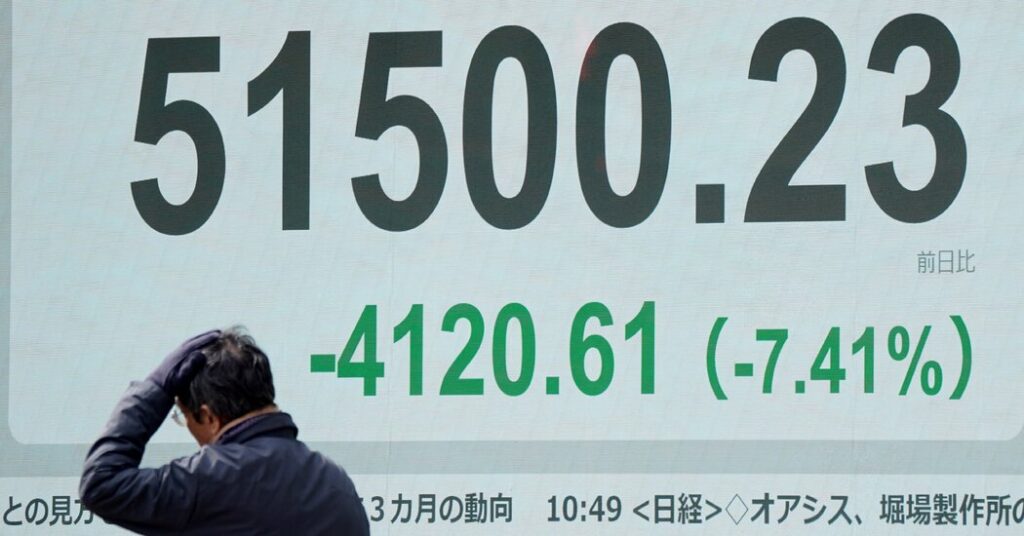
Markets in Asia tumbled again on Monday as escalating tensions in Iran and surging oil prices spurred a fresh wave of selling across the region.
The benchmark index in South Korea dropped 8 percent, while stocks in Japan fell about 7 percent. Taiwan’s Taiex index declined about 5 percent, while Hong Kong’s Hang Seng fell more than 3 percent.
U.S. stock futures, which give traders the chance to bet on the market before exchanges open, were also sharply lower.
In recent weeks, stocks in Asia have been hit by twin challenges. Investors have sold riskier artificial intelligence stocks, which have inflated valuations in the region. They are also factoring in new fears about the impact of surging energy prices on economies that are large importers of fuel, including oil and natural gas.
Global investors had heaped huge sums of money into Asian technology stocks this year, betting the sector offered better value than its potentially overstretched counterpart in the United States. Markets in the region have been among the best-performing this year.
The economies of Japan, South Korea and Taiwan are among the world’s most vulnerable to disruptions in the flow of natural gas and oil from the Middle East. Japan, in particular, imports around 90 percent of its oil through the Strait of Hormuz, while South Korea depends on the Middle East for about 70 percent of its crude imports. About 60 percent of Taiwan’s oil and a third of its natural gas arrives by ship via the strait.
Stocks across sectors were broadly lower in Asia on Monday. The sell-off was particularly acute among the chipmakers and suppliers that had led the A.I.-driven rally.
In Japan, semiconductor material producer Nitto Boseki plunged more than 18 percent. In South Korea, memory-chip giants Samsung Electronics and SK Hynix were both down by around 10 percent. Taiwan Semiconductor Manufacturing Company, which makes chips for Apple and Nvidia, was down nearly 5 percent, and Foxconn, the Taiwanese electronics manufacturer that makes Nvidia’s A.I. servers, was down about 6 percent.
Oil Prices: The price of West Texas Intermediate crude oil futures, the U.S. oil benchmark, at one point exceeded $110 per barrel, the highest price seen in more than three and a half years. The spike followed reports that the closure of the Strait of Hormuz had prompted a growing number of countries in the region to cut oil production.
Test of tech optimism: The market volatility is a test for investor optimism about A.I., which buoyed related stocks to record highs last month. While many investors said the widening crisis in the Middle East did not change their fundamental outlook on A.I., a prolonged conflict that interrupts the supply of energy to import-dependent Asia could disrupt the production of chips.
River Akira Davis covers Japan for The Times, including its economy and businesses, and is based in Tokyo.
The post Surging Oil Prices Tank Stocks in Asia appeared first on New York Times.