The moment that split Steve Nikoui’s life into a before and after was when three Marines walked up his driveway to notify him that his 20-year-old son had been killed in Afghanistan.
Mr. Nikoui, who lives in Southern California, was recently pulled back into that painful memory, as he watched a mother on TV describing the same knock on the door after her own child was killed, this time during the conflict in Iran.
“My heart really went out to her and the families,” said Mr. Nikoui, whose son Kareem was killed during the American withdrawal from Afghanistan in 2021. “That is the beginning of your new life, a life that you never asked for, never dreamed about. Now it’s here.”
“Every day I just think about Kareem, the life he would’ve led, the things he would’ve done,” Mr. Nikoui added.
Since the United States and Israel launched coordinated attacks on Iran last month, at least seven American service members have been killed. Before Iran, the last reported deaths of U.S. service members occurred in December, when an attack in central Syria killed two Army soldiers and a civilian interpreter.
The Trump administration has said the war could last for weeks and that more American deaths are expected.
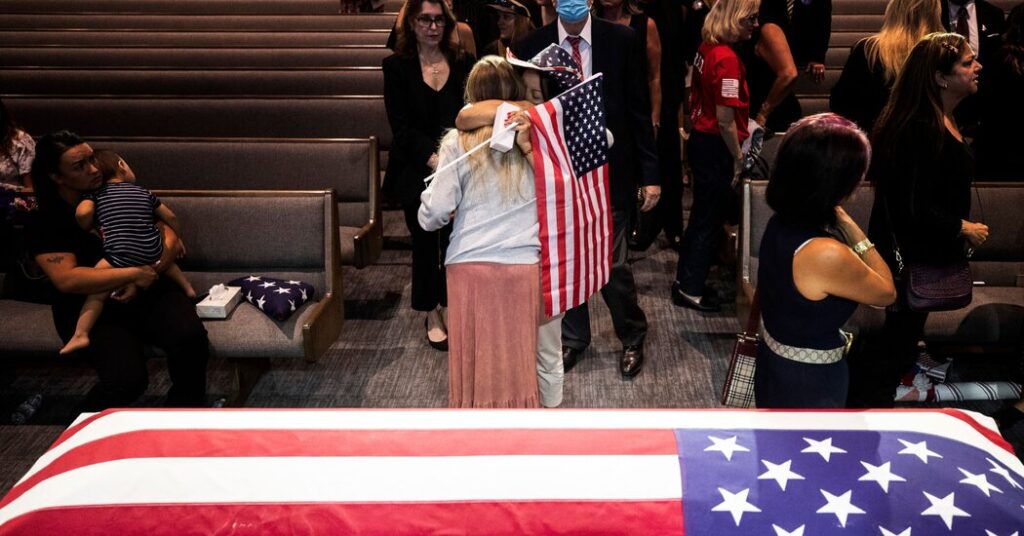
The news of those deaths can be emotionally overwhelming, not only for the families of the fallen, but for those who have previously lost loved ones in the armed services.
The pained voices of grieving parents, the flag-draped coffins, the smiling faces of the dead that circulate on social media — these can can reignite the pain of past losses, which many families are still processing years later.
Tori Manning, 31, said she has been thinking this past week about her older brother, Marine Corps Staff Sgt. Darin T. Hoover, who also died during the U.S. withdrawal from Afghanistan. Ms. Manning, who lives in Mountain View, Mo., said she had to reimagine how to live her life since his death.
“I didn’t know a life without him,” Ms. Manning said. “He was my older brother. I came into this world knowing him, and him being my protector, the one I always ran to. I try not to watch the news as much anymore, because I know what they’re feeling — their whole world is falling apart.”
Roxane Cohen Silver, a psychology professor who studies responses to trauma at the University of California, Irvine, said that she would expect the war in Iran to bring back strong emotions for veterans and for those who lost loved ones as far back as the Vietnam War.
“What we’re talking about now really is a constant bombardment of media images and media stories about the current military losses, so its pervasive, it’s everywhere,” she said. “These kinds of experiences stay with one for one’s lifetime, so they can be reactivated at any point.”
On Saturday, President Trump was at Dover Air Force Base in Delaware as the bodies of six of the American service members killed in the war were returned to the United States. He met with the families, and watched as, one by one, six silver cases draped in star-spangled flags emerged from the hull of a military cargo plane.
Mr. Trump won’t rule out the possibility of ground troops in Iran, and since the war began last Saturday, he has spoken more matter-of-factly about the likelihood of American casualties. “Sadly, there will likely be more before it ends,” he said in a video he posted online. “That’s the way it is. Likely be more. But we’ll do everything possible where that won’t be the case.”
Jake Guidry, 40, said news of the deaths in Iran immediately brought him back to the “horror” of his family’s own experiences when his half brother died in Afghanistan. And he recalled how strange it was to have his family’s tragedy play out for public consumption.
“The spectacle of it all can really rip something very intimate away from you,” he said. “Understand that grief is a long, winding process and it will kind of weave in and out of your life.”
M. Guidry’s brother, Marine Corps Lance Cpl. Jared M. Schmitz, was killed during the chaotic exit of the United States from Afghanistan in 2021 under President Biden. Eleven Marines, a Navy medic and an Army staff sergeant died during the withdrawal.
Paula Knauss, 57, has been remembering her son, Army Staff Sgt. Ryan C. Knauss, 23, who was among those killed. She said she was proud of all that he sacrificed. She said she felt for the families of the people who had lost their lives in the conflict with Iran, but she wanted those families to feel proud of their loved ones as well for defending their country.
“These men and women are examples of the best of us, and when I think about the fact that my son, he gave his life so others could live — that’s the highest calling you could have,” she said. “Thank God we have men and women who have that kind of heart in our nation, to rise up and say, ‘Send me. I’ll go.’”
Ms. Knauss, who lives in the Tampa Bay area, said she had leaned on the military community since her son’s death. Members of his battalion have become like her own children. “They call me Mom,” she said.
Jodi Halpern, a psychiatrist and professor of bioethics at the University of California, Berkeley, said that while grief can be isolating, connecting with others who have shared experiences can be healing. That is often the case with military families, who grow close as they weather tragedies.
Finding solace in those shared experiences can also make the news of war deaths particularly poignant, since it can feel like it’s happening within your community, Ms. Halpern said. But she emphasized that those bonds are ultimately healing and help people move through the grieving process.
Ms. Manning, who lost her older brother, said that four and a half years out, she doesn’t believe that time heals all wounds. But she said she can cope a little better with the loss of her brother, who she remembered as wise beyond his years.
“He just brought a light to this world,” said Ms. Manning. Time, she said, “ doesn’t take it away, and I don’t know if it makes it less painful. Maybe you just get stronger as a person in how you deal with it.”
Soumya Karlamangla is a Times reporter who covers California. She is based in the Bay Area.
The post Pain of Combat Deaths Doesn’t Fade Over Time, Families Say appeared first on New York Times.