After a bout of fierce ground fighting between Israeli forces and the Iran-backed militant group Hezbollah, the residents of a village in eastern Lebanon gathered on Sunday to bury their dead.
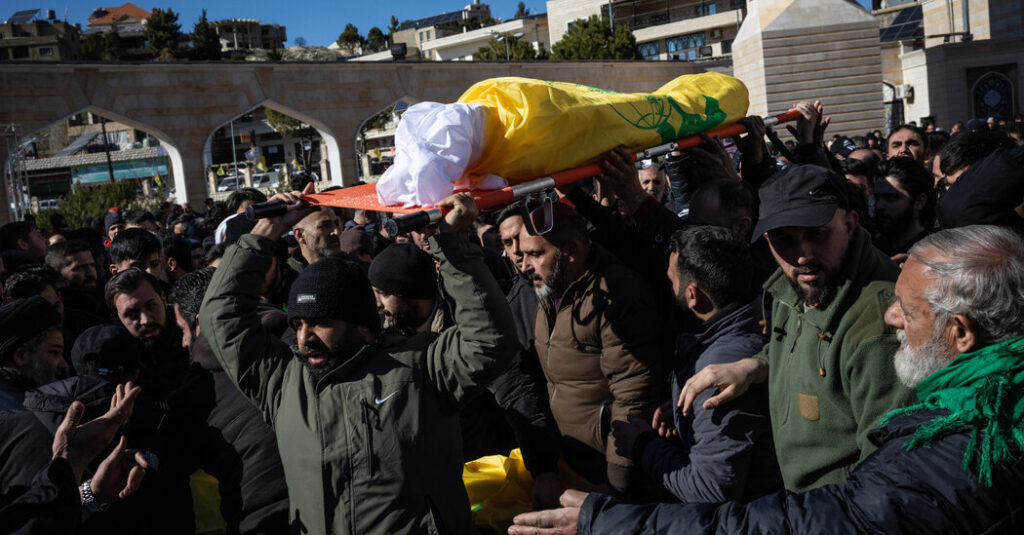
At one of the funerals in the village, Nabi Sheet, men carried eight bodies — most identified as Hezbollah fighters — through the streets, some draped in the group’s yellow-and-green flag. Women dressed in black shouted in anguish.
“Have you ever seen a village that stood up to Israel as our village did?” said Hiba Kanaan, 27, one of the mourners. She said she had briefly fled the village with her 3-year-old son to escape the violence while her husband stayed on to fight.
By Sunday, she had returned to mourn her neighbors who were killed.
The fighting in Nabi Sheet began overnight between Friday and Saturday. Israel sent in special forces by helicopter, and once the commandos landed, they were confronted by residents and armed fighters in the village, according to Lebanese state media.
On Saturday, Hezbollah said that it had targeted the Israeli force with rockets.
The Lebanese military said that three of its soldiers had been killed in the clashes.
By Saturday, the center of Nabi Sheet was littered with debris, mangled cars and destroyed shops. There was a massive crater in the center of the village — one car had been blown to the upper floor of a destroyed apartment block.
On Sunday came the funerals.
Ms. Kanaan said the villagers had died trying to defend their land.
“They protected us,” she said.
Her village, near Lebanon’s eastern border with Syria, is one small part of a widening regional war that started on Feb. 28 when the United States and Israel attacked Iran.
On Monday, Lebanon became a new front when Hezbollah fired rockets into Israel, shattering a fragile truce in place for more than a year.
Israel has hit back hard, focusing on what it has said were Hezbollah targets in southern Lebanon; the outskirts of the capital, Beirut; and the eastern Bekaa Valley. On Sunday, Lebanon’s Health Ministry said that almost 400 people had been killed in the country so far.
Israel’s heavy bombardment carried over the weekend. The Israeli military on Sunday said that it had carried out more than 100 strikes across Lebanon over the previous day. Also on Sunday, Israel hit a hotel in central Beirut, killing at least four people, the Lebanese Health Ministry said. Israel said it had attacked commanders of the Quds Force, the arm of Iran’s Revolutionary Guards Corps that oversees the country’s regional proxies.
At a small cemetery in Nabi Sheet on the grounds of the mosque, men used shovels, a jackhammer and pickaxes to dig graves on Sunday. Women, anguished, held pictures of loved ones. Israeli fighter jets thundered overhead, a reminder that there was no end in sight to the renewed warfare.
As one mass funeral ended, another convoy of cars, a few men on motorbikes firing Kalashnikov assault rifles in the air, headed down the street for another funeral. Mourners recounted seeing the fighting close at hand.
“We were face to face with them,” said Naiime Mousawi, a woman from the village dressed in black, said of the Israeli forces.
Some of the mourners shouted “Death to America” and “Death to Israel” as men carried the corpses through the streets. “There is no God but Allah,” others chanted.
“We will stand here and support each other to the end, and we will not abandon our country,” said another mourner, Rima Hamze. “Nor will we leave our village.”
She called Israel “delusional” and appealed to God to have mercy on the dead Hezbollah fighters.
“We are not here to bow,” she said. “We will not kneel.”
The final burial on Sunday was for Ali Abed al Hussein al Khaffeji, a Hezbollah fighter whose body was placed on the ground with his face uncovered.
His brothers wept and clung to him until their relatives dragged them away. His infant child was placed briefly on his chest as family members explained to the crying child that he was “your father.”
And his widow knelt, crying and holding portraits of them together, as men passed her husband overhead and lowered him into the ground.
Abdi Latif Dahir reported from Beirut, Lebanon, Reham Mourshed reported from Damascus, Syria, and Aaron Boxerman reported from Jerusalem.
David Guttenfelder is a Times visual journalist based in Minneapolis.
The post Lebanese Villagers Bury Hezbollah Fighters, Praising Their Defiance of Israel appeared first on New York Times.