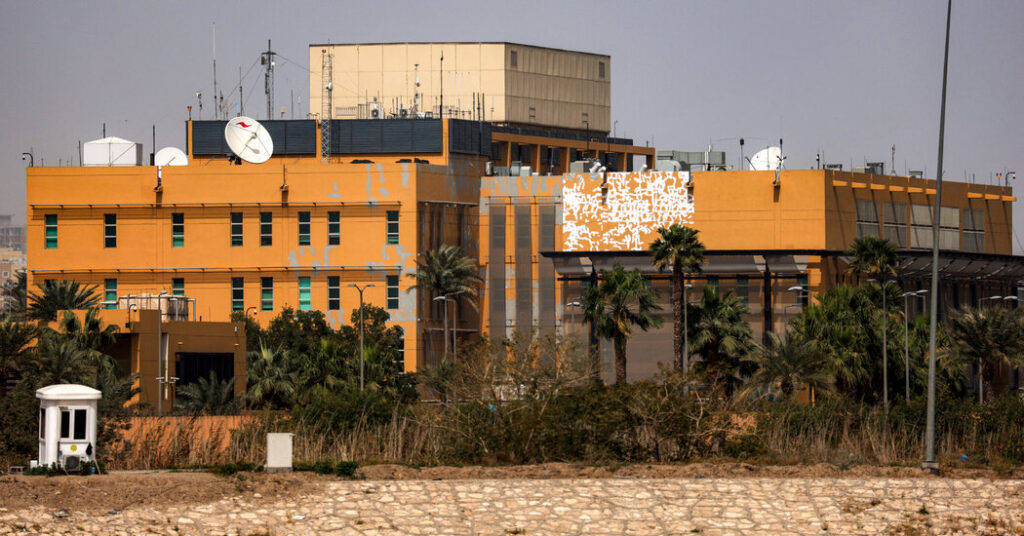
The U.S. Embassy in Baghdad was targeted in a rocket attack over the weekend as Iraq found itself being drawn deeper into the war engulfing neighboring Iran and the Persian Gulf region more broadly.
There were no casualties in the attack on Saturday night, and it was not immediately clear who was behind it. Two rockets were intercepted, one landed on the edge of the embassy grounds and another landed inside the grounds, according to an Iraqi security official who spoke on condition of anonymity to discuss sensitive military issues.
The attack appeared to have activated an air defense system near the embassy, according to video posted to social media and verified by The New York Times.
Iraq, which has close ties to both Iran and the United States, finds itself once again caught between two allies. The Trump administration has stepped up pressure on Iraq’s leaders in recent months to distance themselves from Iran politically and to rein in Iraqi militias linked to Iran.
Prime Minister Mohammed Shia al-Sudani of Iraq ordered military and security commanders to pursue the perpetrators, adding that “targeting diplomatic missions and embassies operating in Iraq is an act that cannot be justified or accepted under any circumstances.” He added that such attacks affect the stability of the entire country.
Iraq is home to a number of politicians and militias with close ties to Iran. The headquarters of one of those Iraqi militias, known as Kataib Hezbollah, was hit with airstrikes on Feb. 28, the first day of the war, killing three militia members and wounding others.
Neither the U.S. Central Command nor the Israeli military claimed responsibility for the Feb. 28 strikes. But the Popular Mobilization Forces, the umbrella group of Iraq’s more than two dozen militias, blamed the “Zionist-American forces.”
Kataib Hezbollah, along with other Iran-allied armed groups in Iraq, immediately threatened to retaliate against the United States and Israel.
A leader in the group’s operations command, speaking to The New York Times, at the time threatened to soon begin attacking American bases in response.
Since then, the group and other Iraqi militias have used drones to attack a U.S. base in Iraq’s semiautonomous northern Kurdistan region. They said this was in defense of Iraq’s sovereignty and in support of Iran, according to a statement.
They have also struck Kurdistan’s airport, oil and gas facilities and at least two bases used by Iranian Kurdish armed groups based there.
By Friday, the militias claimed to have carried out 28 attacks against “enemy bases and interests.”
Iraqi officials and members of the Iranian Kurdish militant groups told The Times this past week that the C.I.A. had previously given small arms to the Iranian Kurdish forces based in the Iraqi Kurdistan region as part of a covert program to destabilize Iran. Those groups were now readying to enter Iran, these sources said, adding that Iranian officials had pressured the Iraqi government to prevent them from crossing the border.
Last week, the deputy prime minister of Iraqi Kurdistan, Qubad Talabani, said that his region was neutral and “not a part in the regional conflict.” Despite such declarations, however, the conflict is increasingly spilling over into Iraq.
Barbara Leaf, a former assistant secretary of state for Near Eastern affairs at the State Department, said that when she saw reports of the first strikes on Kataib Hezbollah, “I thought, well, that’s pretty shrewd.” Ms. Leaf, now a diplomatic fellow at the Middle East Institute, said she assumed the United States carried out the strikes on the Iraqi militia.
“They’re taking the opportunity to just knock a few things off the board while they’re at it,” she said. “It kind of makes the point, which is a good one, that if they think they have sanctuaries anywhere in Iraq any longer, they don’t.”
The U.S. government considers Kataib Hezbollah a terrorist organization and has repeatedly targeted it with airstrikes in Iraq. The group was founded after the 2003 U.S.-led invasion of Iraq and the rise of anti-American sentiment in the country and broader region.
Since then, the group, along with other Iraqi militias, has come under the formal supervision of Iraq’s national security forces, but Kataib Hezbollah continues to maintain significant independence and remains under Iran’s influence.
Earlier this year, President Trump threatened to withdraw U.S. support for Iraq if the nomination of Nuri Kamal al-Maliki as prime minister went ahead.
Mr. al-Maliki formerly served as prime minister, with U.S. backing. But over the course of his two four-year terms, he was seen as increasingly aligned with Iran and was accused of pushing policies that favored Iraq’s Shiite majority.
Falih Hassan contributed reporting from Baghdad.
Raja Abdulrahim reports on the Middle East and is based in Jerusalem.
The post U.S. Embassy in Baghdad Targeted as Iraq Gets Drawn Deeper Into Regional War appeared first on New York Times.