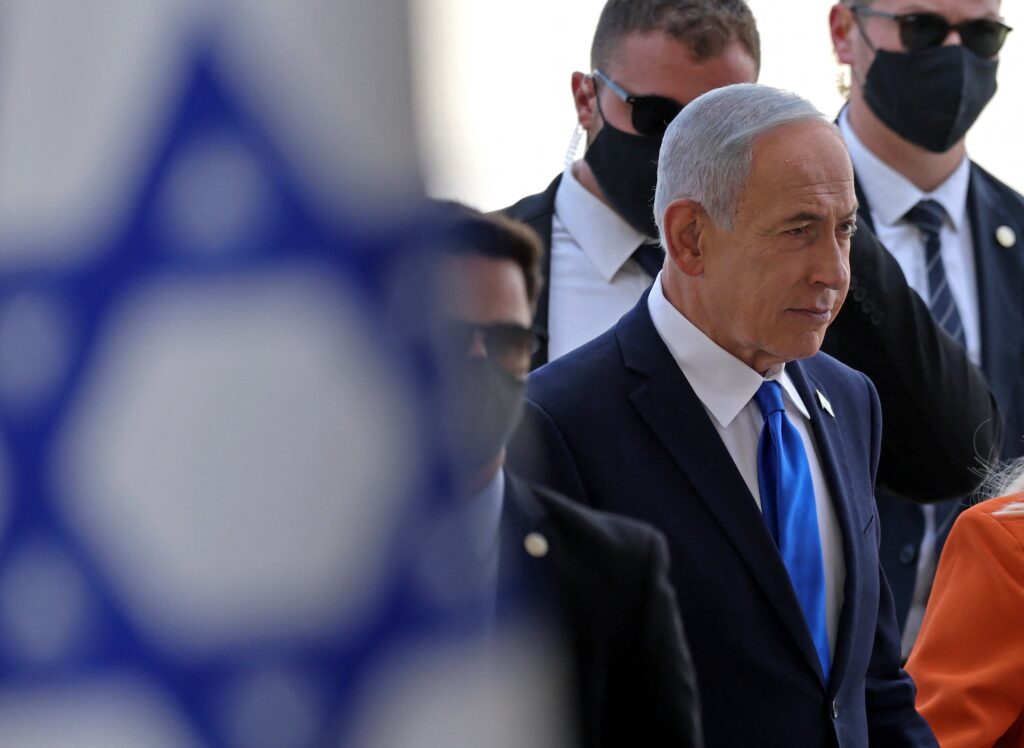
JERUSALEM — For Prime Minister Benjamin Netanyahu and the Israeli right, President Donald Trump has been something close to a prophetic fulfillment.
Through five years in the White House, Trump answered some of their biggest prayers. He moved the American Embassy to Jerusalem, recognized Israeli sovereignty over the Golan Heights and ripped up the Iran nuclear deal. U.N. funding for Palestinian refugees was gutted. Jewish settlers in the West Bank, once condemned by Washington, are now getting their own U.S. passport office.
And the morning of Feb. 28 brought the biggest yet. A full-scale attack on Iran by the largest buildup of U.S. forces since the Iraq War was something Netanyahu had beseeched American presidents — Republican and Democratic — to carry out for decades.
It was also, by a wide margin, the most consequential bet these two political high rollers have taken together. The ongoing — and widening — war has already reshaped the region in ways neither fully controls, at the risk of making them architects of a Middle East catastrophe.
But it’s back home where the outcomes may mean — or cost them — the most personally.
For Netanyahu, the risk is that Trump’s involvement won’t be enough to reverse his anemic electoral hopes. The prime minister — who will face traumatized Israeli voters this year while still trying to escape accountability for the catastrophic security failures of the Oct. 7, 2023, Hamas attack — is betting the war will prove to be the latest lifeline in a political career defined by magic-trick comebacks.
Netanyahu, behind in the polls, is expected by some analysts to call an early election in hopes of benefiting from a surge of popular support for decapitating Iran’s leadership.
“This is the biggest thing Bibi has ever gotten from Trump,” said Gayil Talshir, a political scientist at Hebrew University in Jerusalem. “Everything else can be forgotten, because this is the big one.”
For Trump, with congressional midterms on the horizon, the war strains a political base built on hostility to foreign entanglements, and it comes with gas prices already climbing. Many in his camp fault the president for letting Netanyahu drag him into what Tucker Carlson, the pro-MAGA podcast host and commentator, called “Israel’s war.”
Trump-Netanyahu are an seen as more of an odd couple than Roosevelt-Churchill, Clinton-Blair or other wartime duos. At the heart of their hot-and-cold partnership is a frequently asked question of who is really driving whom.
Carlson isn’t the only one who sees a U.S. president skillfully worked by a master manipulator who has spent 30 years learning how to get Washington to do what Jerusalem wants.
In Israel, however, the view is different. Netanyahu regularly touts his relationship with Trump, reeling off the unprecedented policy shifts in Israel’s favor that Trump has delivered. But the same president who has given more than any prime minister dared to dream has also made Netanyahu swallow things many thought he never would.
In the Gaza ceasefire agreement, for example, Trump demanded a role for the Palestinian Authority in postwar Gaza governance, involved Qatar and Turkey over Netanyahu’s furious objections, and personally ordered a halt — on social media, of course — to Israeli bombing while its jets were airborne. They turned around.
Trump has also put the brakes on Israeli desires to formally annex parts of the West Bank more than once. And he forced Israel to accept at least a potential, heavily conditioned “pathway to Palestinian self-determination and statehood” in the future, cracking a decades-long cornerstone of Netanyahu’s political identity.
“No one but Trump could have made him do that,” said Yohanan Plesner, president of the Israel Democracy Institute. “It’s a popular narrative in the U.S. to say that Trump is abiding by all of Netanyahu’s desires. When you look at the picture from the Israeli standpoint, it’s almost the opposite.”
For now, the two are working hard to project unity.
Netanyahu has made the rounds of American television, praising Trump on Fox News as “the strongest leader in the world.” Trump on Thursday repeated his calls for Israeli President Isaac Herzog to grant Netanyahu a preemptive pardon on his corruption charges — something Herzog says he does not have the legal authority to do.
The partnership, however, has had moments of tension and unpredictability.
This past June, when Trump ordered strikes on Iranian nuclear facilities, some analysts said Netanyahu had played Trump. In that case, Netanyahu had agreed to a 60-day window for nuclear negotiations with Tehran. When the deadline expired without a deal, Israel launched massive military strikes.
Trump initially stayed out of what he called a “unilateral” attack. But as Israel efficiently hammered the facilities, he ordered American bombers and bunker-busting munitions into the fray. By the end, Trump was claiming credit for a triumph, declaring — inaccurately — that Iran’s nuclear program had been “obliterated.”
The current war followed a similar arc, and the same question: Did Netanyahu change Trump’s mind, or did Trump get there on his own?
Through the fall and winter, Trump insisted publicly that he preferred a negotiated settlement with Iran. Netanyahu, increasingly alarmed that Trump might succeed, flew to Mar-a-Lago and to the White House — his seventh visit in Trump’s second term, more than any other world leader — to push for military action.
A key component of Netanyahu’s drive for war came during visits to the White House in December and February, according to two U.S. and Middle East officials and an adviser to Trump, who spoke on the condition of anonymity to discuss highly sensitive diplomacy.
Netanyahu made clear his desire to attack Iran’s ballistic missile program in the coming weeks. The prime minister said Israel would be willing to strike Iran with or without U.S. involvement, though he wanted Trump to green-light the operation, the people said.
Netanyahu’s determination to initiate hostilities led Trump to believe an Israeli attack was inevitable and that the best course of action was to involve U.S. military power to ensure its success, said two people familiar with this thinking.
“It was a false premise because the United States could have told Israel ‘no,’” said the adviser to the president. “But it was a clever tactic, and it shifted the momentum in favor of military action.”
Netanyahu in late February called Trump with a specific piece of intelligence: Ayatollah Ali Khamenei and his inner circle would be gathered at a single known location in Tehran on a Saturday morning. Israel was ready. Trump decided to go for it.
“Trump felt like he didn’t have a choice,” said one of the people familiar with the president’s thinking.
The ongoing war to destroy the Iranian regime, and the killing of its supreme leader, Khamenei, has made Trump a hero in Israel.
“Trump has bigger support in Israel than in any place in the world now, including the Bible Belt in the United States,” said Talshir. “Israelis see him as basically their president.”
Netanyahu is hoping to harness Trump as he fights for political survival. Under Israeli law, elections must be held by Oct. 27. And after years of war, grief and grinding internal division, Netanyahu enters the campaign in a precarious position. Polls consistently show his coalition short of the 61 Knesset seats needed to form a governing majority.
Among large swaths of the Israeli public — particularly families of Oct. 7 victims and the hundreds of thousands who poured into the streets to protest his proposed judicial overhaul — he remains the subject of searing anger that no military victory has managed to lift.
“In Israel, we are deeply immersed in identity politics,” Plesner said. “No matter what happens, it’s very difficult to move Israelis from their entrenched positions.”
Netanyahu, however, has spent his career defying premature political obituaries written for him — surviving corruption indictments that have wound through Israeli courts for years, coalition collapses, an electoral exile that lasted three years before his return to power in 2022, and Oct. 7, the most catastrophic security failure in Israel’s history.
Each time, he has found a way to reframe the moment, shift the terrain, outlast his opponents. Now, with the Iran war as his backdrop and Trump as his most powerful surrogate, he will try again.
Where Netanyahu once worked to delay elections as long as possible, hoping to buy time for his legal situation and coalition arithmetic to improve, many analysts now expect him to move in the opposite direction — calling a vote as early as June, when a surge of public support for the Iran operation might be cresting.
In the past, Netanyahu has draped whole skyscrapers with photos of him posing with Trump. Now, his government has awarded Trump the Israel Prize — the country’s highest cultural honor — and invited him to a ceremony in April. It would be a living tableau of the alliance that Netanyahu will argue no other Israeli leader could have forged or sustained.
Whether it works is another matter. Even without winning a majority, Netanyahu could scrape together enough support to deny one to other factions. A unity coalition with Netanyahu once again in the top job is still possible, Plesner said.
Netanyahu is already Israel’s longest-serving prime minister. The war in Iran, waged with Trump, could be the last chapter of his political life, or the one that saves him again.
Hudson reported from Washington. Lior Soroka in Tel Aviv contributed to this report.
The post For Israel’s Netanyahu, Trump grants prayers — with caveats appeared first on Washington Post.