Before Israel and the United States launched the war on Iran, a very different violence had become increasingly visible in Israeli society — a bloody crime wave in Palestinian Israeli cities and towns.
A Palestinian citizen of Israel has been killed at least once every day on average since the year began. On Feb. 11 and 12 alone, six people were killed in separate incidents, including a woman in the north and the son of a former mayor in the south. These murders are largely the result of Arab organized crime and gun violence. That they continue unabated is the fault of the state.
Palestinian citizens account for about 80 percent of documented murders in the country although they make up only about 20 percent of the population. Last year, 252 Palestinian citizens died in crime-related killings.
The nature of the Israeli state and its laws provide the context for understanding the crime wave. Israel’s founding definition as a Jewish state created structural discrimination against Palestinian citizens. From the creation of Israel in 1948 until 1966, the government imposed military rule over Palestinian citizens. They were stripped of rights enjoyed by Jewish citizens, from land and resource allocations to shares in the national budget. In the years since, Palestinian citizens have faced discriminatory legislation, exclusion from politics and the banning of cultural and political symbols.
Palestinians’ exclusion from Jewish Israeli society was made even more explicit in the 2015 elections, when Prime Minister Benjamin Netanyahu told voters that Arabs “are heading to the polling stations in droves,” thus using their right to vote as citizens as a form of incitement. In 2018 the passage of the so-called nation-state law further codified Israel as a Jewish state.
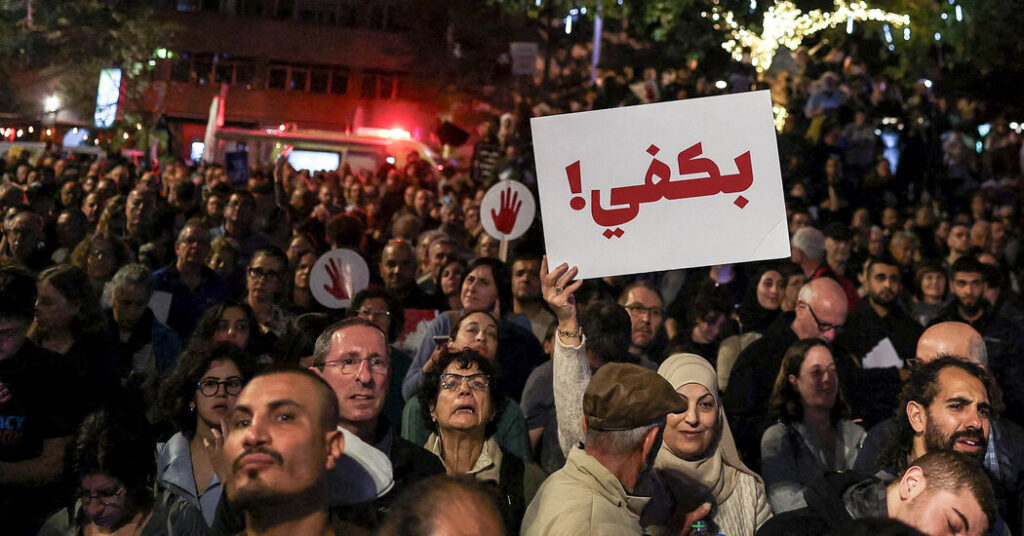
Though Israel’s president and police commissioner both called the violence against Palestinian Israelis a national emergency, there is no national plan in sight to stop it. On Jan. 31, tens of thousands of Palestinian and Jewish Israelis marched in Tel Aviv to raise awareness about the violence. They also demanded that Arab politicians unite to boost voter turnout. Many hope to oust Mr. Netanyahu’s government, and with it, Itamar Ben-Gvir, the national security minister, who holds authority over the police, and who is seen as carrying out a calculated policy to enable Arab organized crime rather than fighting it.
It has been all too easy to ignore this crime spree, even if it should have alarmed any Israeli who cares about the rule of law. Palestinian citizens of Israel are everywhere and yet nowhere. They account for at least 25 percent of the country’s physicians, 49 percent of its pharmacists and 27 percent of its hospital nurses. They are bus drivers, waiters, teachers and professors. Jewish Israelis come into contact with them all the time. Yet Palestinian Israelis live with deep-seated segregation and institutional inequalities when it comes to basic rights, services, housing, security and the economy. That has enabled organized crime groups to step into the vacuum, taking advantage of Palestinian communities. Because only about 2 percent of mortgages are given to Palestinian citizens, they are often forced to turn to loan sharks.
In war, that discrimination becomes terrifying: Nearly half of Palestinians in Israel, more than half a million citizens, live in homes without safe rooms or protected spaces. The largest Arab municipality in Israel, Rahat, is home to some 80,000 people but does not have a single public shelter.
Murders of Palestinian citizens are far less likely to result in indictments than are murders of Jews; while 65 percent of murder cases with a Jewish victim in Israel are solved, only 15 percent of cases involving Palestinian victims result in the successful prosecution of a perpetrator. In Israel, high crime rates in Palestinian communities are often given a racist, determinist spin: Many Jewish Israelis call such criminality an immutable product of Arab mentality and culture — which effectively absolves the state of responsibility for these citizens. Until recently, Palestinian citizens were focused on a fight for greater integration into Israeli politics and society. But now they are making the most basic civic demand: personal security.
The crime epidemic is believed to be largely driven by a network of Palestinian Israeli crime families that the state has long failed to rein in. These families engage in protection rackets, loan sharking and arms and drug trafficking across Palestinian cities and towns in Israel. Murder rates have soared since the Netanyahu coalition took power at the very end of December 2022 and put Mr. Ben-Gvir, a man with a criminal record of incitement to racism against Palestinians, in place. During his tenure, more than 770 Palestinian citizens have been killed in crime-related incidents, more than in the previous eight years combined. (Mr. Ben-Gvir has insisted he has invested resources to tackle the crime wave.)
“There is an understanding that they are trying to push us to leave the country,” Aida Touma-Suleiman, a Palestinian Israeli member of the Knesset, told me. “If in the West Bank the state uses settlers to ethnically cleanse Palestinians, inside Israel they are using organized crime groups.”
She described an atmosphere of persecution and fear. “We have tried, as Palestinians, to expand the scope of our citizenship and develop civic relations with the state, but in recent years, it is clear the state is not interested.”
The police force has grown increasingly politicized under Mr. Ben-Gvir. In 2023 he defunded an effective program from a previous government to combat crimes in Arab communities.
The mistreatment of Palestinians in Israeli prisons has also increased on Mr. Ben-Gvir’s watch. He has also forced the demolition of Palestinian homes in Israel where tens of thousands of Bedouin citizens live in so-called unrecognized villages — areas where the Israeli state has not provided basic services like running water and electricity. Mr. Ben-Gvir claims the demolitions are to deter illegal construction, and to show those who live in these villages who really owns the land on which they dwell. He has also instructed the police to crack down on freedom of expression and protest, with Palestinians arrested for social media posts critical of the government.
“In Arab media, crime and violence are the top story every single day,” said Mohammad Magadli, a Palestinian journalist who hosts an Arabic-language radio news show and provides political commentary in Hebrew for Channel 12. “In Hebrew media, it doesn’t exist.” Mr. Magadli told me he believes nearly every Palestinian citizen has lost someone or knows someone who lost someone to the violence. He himself has lost three friends. Palestinian journalists face constant threats from crime groups not to report on the issue.
Mr. Magadli said the main problem is illegal firearms, many of which are stolen from Israeli military bases. A smaller number are smuggled from neighboring countries.
The desperate situation that Palestinian citizens find themselves in has led the four main Arab parties in Israel to declare that they will once again join as a single list for the 2026 general elections expected this fall. It is clear that Palestinian citizens of Israel, some two million in total, will be indispensable to any kind of political coalition shift in Israel’s next elections: Before the current war began, polling data had long shown that the pro-Netanyahu parties that make up the current coalition were nowhere near reaching the 61-seat Knesset majority necessary to form a new coalition. But the anti-Netanyahu parties in the opposition — many of them right-wing — are also short on support.
While the Hamas attacks on Oct. 7, 2023, only increased opposition to Mr. Netanyahu among Jewish Israelis, they have at the same time intensified anti-Palestinian sentiment across Israeli society, even though Palestinian citizens were themselves also taken hostage and murdered.
This has led to a situation in which, even as many Jewish Israelis have grown more fearful of and hostile to Palestinians, those who want to oust Mr. Netanyahu will need to collaborate with the small Palestinian parties to do so.
The problem is, most opposition leaders have vowed not to work with Palestinians. Over 70 percent of Jewish Israelis oppose including Arab parties in a governing coalition, according to a recent survey by the Israel Democracy Institute. That doesn’t mean that certain politicians won’t eventually come around on this issue.
“The Arabs want two things: agency and hope,” Ms. Touma-Suleiman said. Her own hope is “that we are building a new kind of politics of Arab-Jewish cooperation.”
Jewish Israelis who fight to preserve the country’s liberal democratic order must begin to understand that this effort will be undermined if the Palestinian minority remains unprotected, and second-class citizens. Allocation of equal resources to the Palestinian communities is a start.
Whatever happens is too late for Maram Jarban, from the coastal town of Jisr al-Zarqa. Her 23-year-old sister, Rosette, was killed by an errant bullet last summer. “I hear gunshots all the time,” Ms. Jarban said. “There is no security. Since the murder, my mother doesn’t leave the house, and one of my sons has had difficulties studying in school.” All that matters to Ms. Jarban is for the killings to stop.
Mairav Zonszein is a contributing Opinion writer. She is the senior Israel analyst with the International Crisis Group, a nonprofit think tank dedicated to conflict prevention. She lives in Tel Aviv.
The Times is committed to publishing a diversity of letters to the editor. We’d like to hear what you think about this or any of our articles. Here are some tips. And here’s our email: [email protected].
Follow the New York Times Opinion section on Facebook, Instagram, TikTok, Bluesky, WhatsApp and Threads.
The post Palestinian Citizens of Israel Are Not Safe appeared first on New York Times.