One week before the Academy Awards the odds seem pretty good that “One Battle After Another” will end up winning big. Already this awards season it’s been handed one trophy after another: best picture (Critics Choice Awards, BAFTAs), best direction (Golden Globes, BAFTAs), best screenplay (Golden Globes), not to mention plaudits for acting and cinematography.
Inspired by Thomas Pynchon’s zany 1990 novel of counterculture burnout, “Vineland,” and depicting violent resistance to a scarily recognizable America of mass deportations, militarized racism and secretive oligarchic corruption, it has also been hailed by many viewers and critics as an urgent call to action.
And before I saw it, I thought, we could definitely use one of those right now.
As the daughter of two Weathermen, the infamous paramilitary group on which the film’s French 75 is loosely based, I had high hopes, imagining the movie would be both a re-enactment of my parents’ radical resistance (only with somewhat better-looking protagonists) and exactly what I needed to propel me off the couch and into the streets. Instead, Paul Thomas Anderson’s sprawling action thriller left me with fists balled in something approaching rage.
The film is less a call to fight the power than a madcap adventure about a couple of deranged agitators with no particular imperative other than to create chaos and blow stuff up. I’m not saying my parents and their fellow lefty radicals were perfect — far from it. Like their fictional representations, they smoked plenty of dope, engaged in a lot of free love and got off on anarchy, sometimes for anarchy’s sake alone. But unlike Perfidia and Pat, the movie’s central characters, they could articulate what, exactly, was wrong with America and how it needed to change.
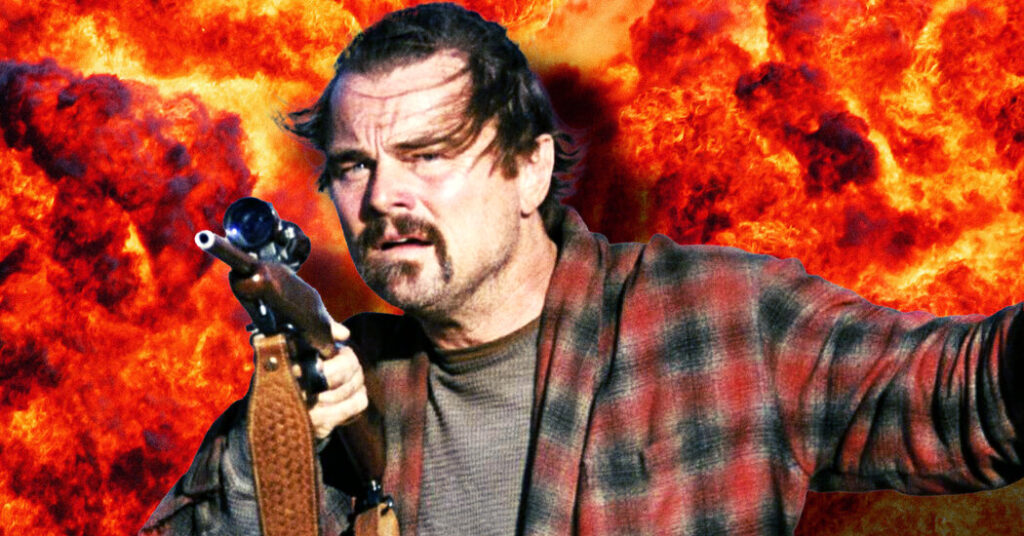
In the opening scene of the film the French 75 crew raids a migrant detention center on the Mexican border. “I got mortars, I got tear gas,” says Pat Calhoun (later known as Bob Ferguson, played by a sweaty Leonardo DiCaprio), who soon admits he’s “a little unclear as to what the plan is.” And indeed, as Perfidia Beverly Hills (played by a smoldering Teyana Taylor), his lover and co-conspirator, shouts at her nemesis, Col. Steven J. Lockjaw (a cartoonish Sean Penn), the plan is simply “to right your wrongs,” to which she adds a colorful expletive. The “message is clear,” Perfidia continues. “Free borders, free bodies, free choices and,” again adding another expletive, “free from fear.”
Though those aspirations are noble, her message is far from clear. As Perfidia and Pat declare war in the ensuing scenes — firing automatic weapons into the air, bombing a bank, a senator’s office and a transmission tower — it struck me they were not so much revolutionary heroes as adrenaline junkies who used violence as foreplay. They didn’t have specific ideological motivations or overwhelming moral authority, and they weren’t driven by particular injustices or identifiable crimes against humanity. They just wanted to burn the establishment to the ground for the fun of watching it burn, before having more hot sex.
“We believed that the revolution led by Black and brown people was imminent, and it was our job to convince working-class whites to act as foot soldiers,” my former Weatherman father, James Reeves, recently told me. “We designed our actions to expose the corruption and ruthlessness of the ruling class, especially when it came to the Vietnam War and Black liberation.”
Radicals like my parents sought to “bring the war home.”
After helping raid Harvard’s Center for International Affairs, rioting in flak jackets outside M.I.T.’s Instrumentation Labs and regularly getting arrested in the streets of Cambridge, Mass., my parents faced charges that included attempted murder, possession and use of incendiary devices, reckless endangerment, arson, passport fraud, disturbing the peace, conspiracy to incite violence and crossing state lines to incite a riot. Though my mother avoided prison, my father spent nine months and 15 days behind bars after pleading guilty to possession of dangerous weapons, possession of burglary tools, shoplifting and assault and battery on a police officer.
My parents, who in the years following settled into lives as (mostly) law-abiding college professors, aren’t sorry for what they did and would do it again, they both admitted, if they could be ’70s radicals, rather than radicals in their 70s or 80s.
“We did what we had to do,” said my father, who grew up in suburban New Jersey and joined the movement in 1968. “To stay silent, to let the capitalist pigs ruin the world, that was not an option. I still believe the actions we took and the extreme we represented influenced people’s consciousness and helped end the war.”
My mother, Susan Hagedorn, agreed. “Our intentions may have been naïve, but what the government was doing — lying to the country, killing Southeast Asians, as well as their imperialism all over the world — needed to end,” she said. “But these are dark times, darker even than what we were facing then. Why aren’t young people saying no to this madman and his whole authoritarian regime? Why aren’t you putting your privilege on the line to defend those who can’t defend themselves?”
At the end of “One Battle After Another,” Bob hands his daughter, Willa (played by a luminous Chase Infiniti), whom he’s been raising since Perfidia left, a letter from her mother.
“We failed,” Perfidia laments, 16 years after abandoning her family to continue her outlaw life. “But maybe you will not. Maybe you will be the one who puts the world right.”
In the last moments of the film, we see Willa — whose exasperation with her wayward and perpetually high parent I have tremendous empathy for — head out the door to do just that.
“Be careful!” Bob shouts as his daughter rushes to her car.
“I won’t!” Willa promises, setting off a wave of smiles and “awwws” through the theater.
Me? I stalked back home to fume.
I’ve come to realize that the reason I disliked “One Battle After Another” wasn’t the fault of the film. Had I gone into that theater hoping for nothing more than entertainment, I would have walked out happy — it was, after all, wickedly funny, superbly acted and expertly made.
But I strongly think that the film does not, and should not, serve as a battle cry for a generation. That burden was placed on it by critics who went looking for salvation in the wrong place.
I understand the impulse to find something, anything, that might galvanize us out of our current stupor to put the world right. But if federal agents killing innocent Americans in the streets and our president igniting a catastrophic war in the Middle East doesn’t rouse us, what will? A Hollywood film featuring attractive movie stars shooting up an inept enemy isn’t going to save the day.
Source photographs: Warner Bros. Pictures and VasilySmirnov/Getty Images.
Hope Reeves is a freelance journalist working on comic memoir of her childhood being raised by Weathermen.
The Times is committed to publishing a diversity of letters to the editor. We’d like to hear what you think about this or any of our articles. Here are some tips. And here’s our email: [email protected].
Follow the New York Times Opinion section on Facebook, Instagram, TikTok, Bluesky, WhatsApp and Threads.
The post The Popcorn Resistance of ‘One Battle After Another’ appeared first on New York Times.