Barbara Saffir clipped a camouflage vest around her chest, hung her heavy, long-lens camera and binoculars around her neck, and stepped in her knee-high, red galoshes through wet leaves and mud under a dense early morning fog on the edge of the Potomac River.
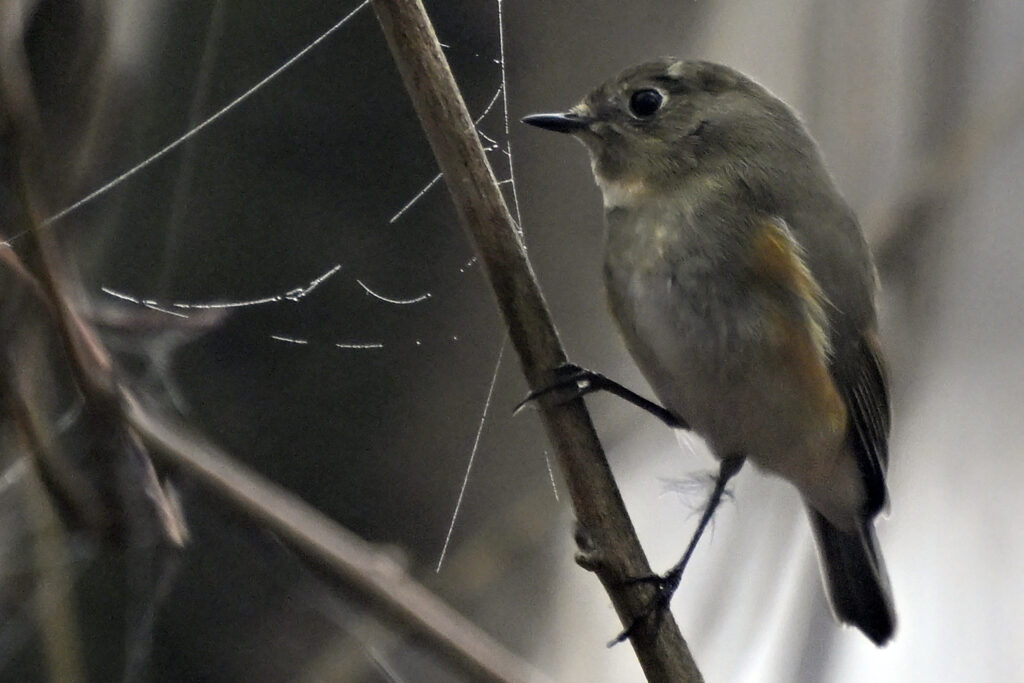
Her quest: to catch a sighting of a red-flanked bluetail, a bird that’s rarely seen in the United States.
Native to Asia, the tiny brown-colored bird with orange sides and a short, high-pitched whistle has been spotted east of the Rockies only once before. Its surprise landing in Northern Virginia recently has rocked the world of birding and made it an internet sensation.
Since a birder named Phil Kenny first discovered a female red-flanked bluetail in a tree just off the Capital Beltway on New Year’s Day, crowds of visitors have flocked to Great Falls Park — where the bird has been living for the past three months — to try to catch a glimpse. Locals young and old, plus bird nerds from as far away as Minnesota, Nevada, Texas, Michigan and Florida have all showed up with binoculars in tow.
“It’s a true rarity of it even being on this continent,” Andrew Farnsworth, an ornithologist, said in a phone interview from his office at Cornell University. “It lives in Asia, and seeing it in North America is really rare. This is only the second time the species has been seen in the Eastern U.S.”
After more than an hour of walking through the woods one recent morning, Saffir bumped into another birder. Brad Elvert, a former real estate agent from Eureka, California, had been in Ohio visiting his brother, who told him about the bird in Virginia. Elvert was headed to North Carolina but decided to take a detour to stop at Great Falls Park on the off chance that he’d be lucky enough to catch a glimpse of the rare bluetail.
He and Saffir exchanged pleasantries and then headed together to a spot near the river, where there was a reported sighting.
“Is that it?” asked Saffir, a wildlife photographer who lives in Montgomery County, as she pointed to movement near the river.
No, it was a Canada goose swimming in the water. A few minutes passed. Elvert saw something.
“There,” he whispered. “Over there, in that tree.”
There it was — hidden in the brown trees and gray of fog. The small bluetail. The bird gently landed on a tree branch overlooking the Potomac.
“That’s it!” Saffir exclaimed. “There it is.”
They each quickly snapped photos as the bluetail fluttered from one tree to another.
“It’s bobbing its little tail like it’s waving to people and saying, ‘Here I am. Here I am,’” Saffir said. “It’s come thousands of miles just to visit us in Virginia. For birders, seeing it is like a mini lottery win.”
How this bluetail traveled thousands of miles and ended up on Virginia’s shoreline is a bit of a mystery.
Known by their scientific name, Tarsiger cyanurus, bluetails are classified as “Old World flycatchers,” meaning they mainly eat insects and are commonly found in Europe, Asia and Africa. Typically, their breeding range stretches from the Russian province of Siberia to northeastern China and west to Russia, and even into parts of Scandinavia. In colder months they usually winter in warmer, forested areas of southern China, Taiwan and Thailand, where food is more plentiful during that period.
In the past few years, however, the bluetails have expanded their breeding range farther east and west.
There have been sightings of the species in Alaska, British Columbia, Mexico and California. Three years ago, a bluetail was spotted in New Jersey — the first time the bird species had been seen east of the Rockies.
Some D.C.-area birders theorize it is the same bird as the one seen in New Jersey. It is possible, given that birds show “strong fidelity to places they breed and spend the winters,” Farnsworth of Cornell said, but there’s another theory.
Ornithologists said it’s more likely that, because birds breed in — and migrate to — the same places every year, by similar routes, the bluetail on Virginia’s shoreline and the one that showed up in New Jersey are from a population with unique migratory patterns. Each bird may have had a change in its genetic makeup that made it more prone to migrate to the eastern coast of the United States. That, combined with favorable tailwinds, probably put the bluetail on the Virginia shoreline, ornithologists say.
Kenny, a trust and estate planning lawyer, first spotted the bluetail in Great Falls Park. On New Year’s Day, he’d been in the popular park to do some birding, his favorite pastime, and he spotted a bird that he said he “didn’t immediately recognize.”
Kenny did what many birders do: took a photo of it as it fed on a vine and texted the shot to a few birding buddies. A few hours later, one of them texted back: “Holy smokes! That’s a bluetail. Where did you see that? It’s rare.”
When Kenny got home later that day, he looked up the species on Cornell Lab’s ornithology app, ebird, and shared his photos of it to another app for birders in Virginia. His posts soon drew hundreds of comments and visitors to the park.
For Kenny, finding the bluetail is exactly what attracts him to birding. And seeing a rare one like a bluetail is a notch in what birders call their “life lists,” a tracking of every bird a person has seen.
“It’s the thrill of the chase,” Kenny said. “It’s a bit of a scavenger hunt, plus a bit of serendipity. You’re on a quest to find something, and then you see it, you get a picture of it and put it on your list. It’s like you won the game. You got the prize.”
It’s not the first time Kenny has spotted a rare bird. More than 20 years ago, he discovered a Bullock’s oriole in his backyard. After word spread on a neighborhood email list, hundreds of curious birders flocked to his backyard for several weeks to catch a glimpse. His wife, he said, thinks “I’m nuts.”
The bluetail in Virginia has now developed a bit of a paparazzi following.
Saffir has gone to the park five times in the past two months to look for it. She has smiled and laughed as she’s seen small crowds of people follow the bluetail as it flutters back and forth between its three favorite spots — a tree covered in vines, an area near three big green dumpsters in a parking lot and some trees near a large, moss-covered rock.
“The bluetail is like a puppet master,” Saffir said. “Every time it flies, people scurry along with it to watch it.” As she watched it that early Thursday morning, she noted how it ate the seeds on the vine of a winter creeper.
“It’s going to that vine because that’s food from where it’s from,” Saffir said. “It’s like an American tourist going to Paris and eating in McDonalds. It’s something from back home.”
Dan Rauch, D.C.’s wildlife biologist, said the bluetail has been hanging out with other small birds — chickadees, tufted titmice and ruby-crowned kinglets — because there’s “safety in numbers” from predators like hawks.
Rauch said the rare bird looks to be in good health and is very active as it flies and hops around, “snagging insects, spiders and caterpillars” from the bark of trees to “keep its little motor going.”
Seeing the bluetail, he said, “is a lifer experience.”
“This is the first time someone is likely to see this species unless you’re going to Eurasia or Thailand,” he said. “The chances of it coming here again on the East Coast is very remote. To have it on your bird list is pretty amazing.”
The post Bird rarely seen in the United States sends people flocking to Virginia appeared first on Washington Post.