Facing the possibility of big losses for Republicans in the midterm elections, President Trump has reiterated his unfounded assertions of electoral fraud. He has also begun speaking of the need to “nationalize” elections, and for Republican officials to “take over” voting procedures in parts of the country.
This rhetoric is often vague, coming across as a hint of plan, rather than an actual one.
But a map of potential targets may be coming into focus and includes the swing states Michigan, Georgia, North Carolina and Arizona. Voting experts, government officials and others have identified a host of conditions that could make those places ripe for meddling from the Trump administration or its allies.
In Michigan, a coalition of right-wing activists has obtained copies of about 150,000 absentee ballots and envelopes from the 2020 election, and is organizing to investigate them for errors, anomalies or fraud.
In North Carolina and Arizona, several Republican legislators and local election officials continue to embrace electoral conspiracy theories and have pushed for more control over voting processes.
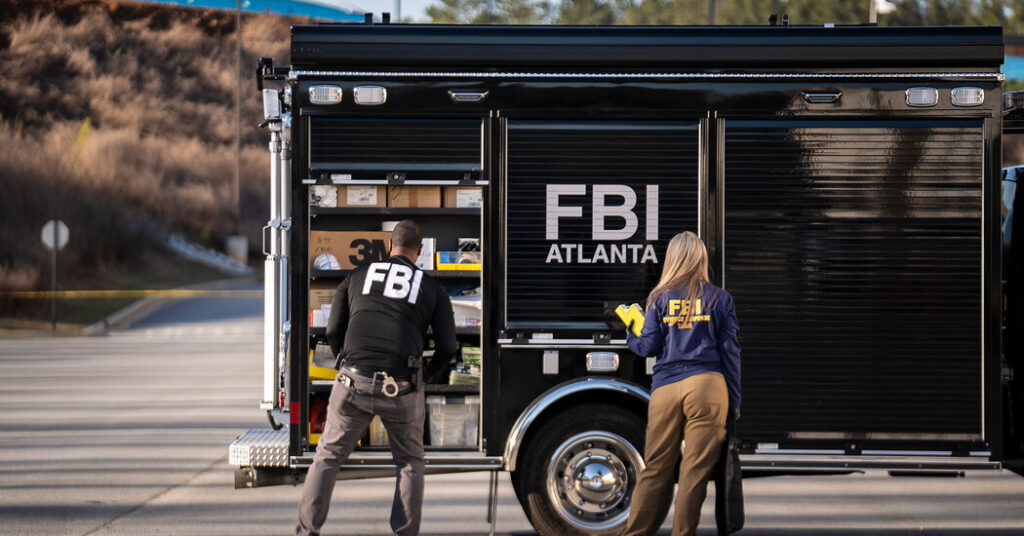
Most significant, in Georgia, the F.B.I., acting on a search warrant that relied on debunked claims about the 2020 race, seized hundreds of boxes of ballots from a government warehouse in late January, an extraordinary intrusion into the American electoral process.
The fear is that pro-Trump forces in these states could begin pushing dubious pretexts to try to change election rules, take over local voting systems or otherwise find ways to give Republicans unfair advantages as they seek to ride out a wave of discontent over Mr. Trump’s second presidential term.
Democratic officials in other states have also begun to wonder whether their jurisdictions will be the next target of the administration’s scrutiny, or worse.
Alisha Bell, the commission chair in Wayne County, Mich., which includes Detroit, said that she has been in contact with officials in Fulton County, Ga., which includes Atlanta. They have discussed, she said, how similar actions “could happen across the country.”
With control of Congress at stake, many Democratic state politicians and election officials are expecting, and preparing for, a fight with the Trump administration.
“This is really about trying to create that predicate for actions that will put more control in the hands of his administration and the federal government,” said Joanna Lydgate, chief executive of the States United Democracy Center, a nonprofit dedicated to fair elections.
A White House spokeswoman, Abigail Jackson, dismissed those concerns and pointed to the president’s desire to pass election legislation like the SAVE Act, which among other measures would require proof of citizenship to register to vote.
“President Trump is committed to ensuring that Americans have full confidence in the administration of elections, and that includes totally accurate and up-to-date voter rolls free of errors and unlawfully registered noncitizen voters,” she said in a statement.
Michigan
Pure Integrity Michigan Elections, a group led by right-wing election activists, is raking copies of the 2020 ballots for Detroit for possible challenges.
At a meeting of the group in February, an activist explained that the ballots had been obtained by a New Jersey resident through open records requests, according to a recording of the meeting posted online. The activist said about 50 volunteers were building their own database to analyze the ballots and envelopes.
He added that there was a “one to two month timeline before we can start making some final conclusions on the counts.”
Patrice Johnson, the group’s leader, told the nearly 60 people in attendance to “see if there are parallels” between what happened in Fulton County, Ga., and Michigan, a not-too subtle reference to what preceded the F.B.I. raid in Georgia.
The Michigan group had already met in January with the Election Integrity Network, a national coalition of pro-Trump election activists led by Cleta Mitchell, a lawyer who helped Mr. Trump in his effort to challenge his 2020 loss.
At that meeting, the Michigan activists listed “Assisting with audit of 2020 ballots from Detroit” as one of their priorities for the year, according to recordings of the presentation and documents of reviewed by The New York Times.
Ms. Johnson did not respond to requests for comment.
Christopher Thomas, a senior adviser to the city clerk of Detroit, said the city had no doubts in its 2020 election results and welcomed inspection of the ballots and envelopes.
“They can look at any of that stuff,” Mr. Thomas said. “We will see at the end of the process that it was a damn good election.”
North Carolina
In recent months, Republicans in North Carolina have enacted what may be the most consequential reconfiguration of an electoral system of any swing state.
In December 2024, as part of hurricane relief legislation, the Republican-controlled legislature stripped the Democratic governor’s power to choose the majority of the state election board, as well as the 100 county election boards, handing that power to the elected Republican state auditor.
Supporters of the change have argued that they reflect the state founders’ intention to keep the governor’s office weak after having suffered the abuses of British monarchs. The state auditor, Dave Boliek, has said his appointments would “uphold the law and put their focus toward counting legal votes, efficient tabulation and consistency across counties.”
Those boards have already made small but significant changes like removing polling places at some universities, including North Carolina A&T State, a historically Black institution. Board members cited cost efficiency, among other reasons, for the decision.
Democrats and other election observers are concerned that this Republican control could allow the party to give friendly hearings to G.O.P. candidates who aggressively challenge the results of close races.
In 2024, a Republican candidate for a State Supreme Court seat showed how aggressive such a challenge could be. Losing by 734 votes, the candidate, Jefferson Griffin, a state appeals court judge, tried to have roughly 65,000 votes thrown out, often on the grounds that voter registrations had not included required personal data — even though administrative errors had led to the omissions.
After a six-month legal battle, Judge Griffin conceded.
His challenge, however, could serve as a blueprint for a dubious challenge in the near future, said Jeff Loperfido, a lawyer for the Southern Coalition for Social Justice, a left-leaning nonprofit.
Activists, he said, now have an “understanding how they might prepare for it.”
Arizona
Republicans have promoted conspiracy theories about both the 2020 presidential election and the 2022 governor’s race, which Kari Lake, the losing Republican candidate, tried to overturn.
Justin Heap, the Republican official overseeing elections in Maricopa County, which includes Phoenix, has consistently borrowed from the right-wing coded lexicon of “election integrity,” and has at times refused to answer questions about whether the 2020 and 2022 elections were fair and accurate.
His office is currently locked in a legal battle, seeking control of in-person early voting and on-site tabulation of early ballots dropped off on Election Day. If successful, Mr. Heap would be in charge of processes previously controlled by the county board of supervisors — a significant shift in oversight power of county elections.
Mr. Heap’s office did not respond to requests for comment.
The State Legislature has also tried to enact elections policies, such as stationing Immigration and Customs Enforcement officers in polling places, an effort that failed. There are other attempts to alter voting rules, but they are likely to be vetoed by Gov. Katie Hobbs, a Democrat.
Pennsylvania
In Pennsylvania, the leader of a network of election deniers is now the head of election integrity in the federal Department of Homeland Security.
For years, that official, Heather Honey, directed an effort to challenge the state’s 2020 results. In 2024, she turned her attention to that year’s election, challenging the eligibility of votes already cast in Pennsylvania.
Philadelphia may be a target. In an interview last month, Mr. Trump lodged unfounded accusations of electoral corruption against Philadelphia, Detroit and Atlanta. In addition to being Democratic Party strongholds, the cities also have large numbers of Black voters.
In a phone interview, Omar Sabir, a Democrat who chairs the Philadelphia City Commissioners, placed Mr. Trump’s comments in the context of the nation’s long history of voter suppression, and said they had provoked a new round of concern.
“We receive phone calls from constituents,” Mr. Sabir said. “Some are afraid that we’re not even going to have an election.”
Nick Corasaniti is a Times reporter covering national politics, with a focus on voting and elections.
The post After F.B.I. Seized Ballots in Georgia, Other States Brace for Trouble appeared first on New York Times.