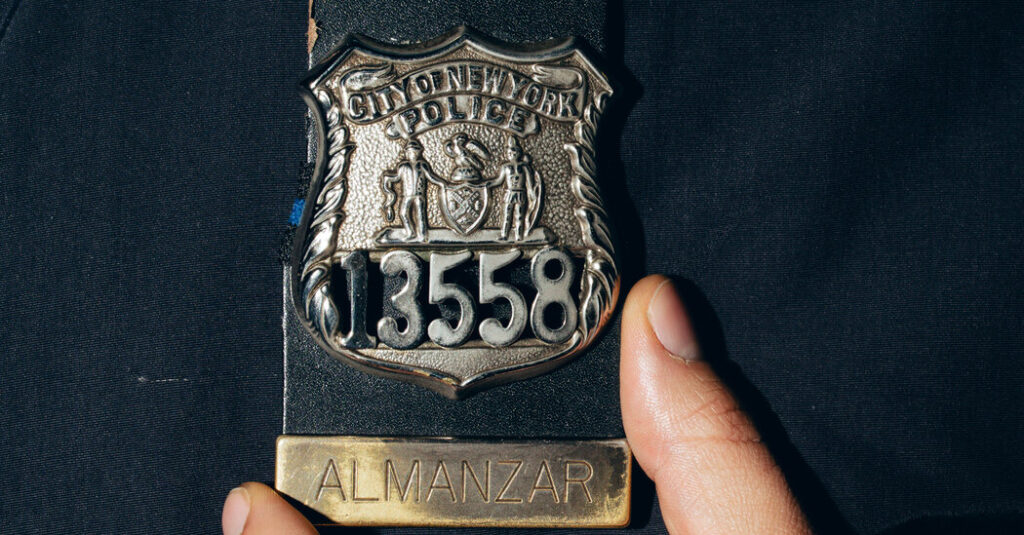
The police shield was marked No. 13558, and Patrolman Michael McCrory wore it over his long coat the night it attained a sort of mythical status in 1965. He had been on the beat in Upper Manhattan for about a year, and he liked the work, but he was ready to call it a night. He had a date later.
As if the universe was weighing in on this plan, a cabby flagged him down on West 121st Street and pointed to a man standing nearby. This guy is drunk and won’t pay his fare, the cabby said. Officer McCrory, 25, with one eye on his watch, suggested that the man pay up, and everyone go their separate ways. Sound good?
The drunk passenger cursed and pulled a gun.
The flash of the point-blank gunshot was blinding, and Officer McCrory was blown backward. He went down hard.
He wasn’t sure where he’d been hit, but he was pretty sure he wasn’t dead.
Only later would he notice his police shield and how it had changed, the brand-new dent scarring the number 3.
This is the story of a single police shield. Officers of the New York Police Department remember well the day they were first handed their own shield and sidearm, a milestone simply known as Gun and Shield Day. But the shield is strictly a loan, and years later, these older officers face an inverted, bittersweet moment, when they must give it back, after a promotion or upon retirement.
Each shield then goes back into the system. They start over. A hunk of metal one officer wore for 20 or more years is pinned to another’s chest on a future Gun and Shield Day.
Police records show that seven policemen have carried Shield No. 13558 over the last 100 years. They wore it to precincts all over Manhattan and the surrounding boroughs, through Prohibition, protest and unrest; the crack epidemic, Sept. 11, and today.
The story of Shield No. 13558 is a sort of vest-pocket history of the Police Department over the course of a century. It is a cool, metallic constant amid the sea changes to the city, the department and the job itself. It is present in the background of the war stories — the high-flying rescues and subway corpses — and the flaws of the officers who wore it.
Ice Cream and Mug Shots
The first known wearer of No. 13558, Joseph M. Smith, was born in 1903, the son of an Irish florist in Brooklyn. He joined the department at age 22. He fit in with the overwhelmingly Irish force of some 12,000 officers, and he wore the shield longer than most — 33 years, serving from the Jazz Age through the Great Depression and World War II and into the 1950s.
During his career, he married, had a daughter named Gioia, separated from his wife and moved out when their little girl was 3. He was promoted to homicide detective — keeping the shield, apparently, which is not the custom today, when officers are given different ones after a promotion.
Detective Smith would show up and take his young daughter out for ice cream, wearing a suit and tie.
“I was a creepy little kid, and used to ask him for pictures of the criminals he was after,” his daughter, now Gioia Clyde, 84, recalled from her home in Massachusetts. Her father carried them in his pocket. “Mug shots.”
In 1958, he turned in his shield, retired and took up golf.
At that time, officers handed over their shields at a drab personnel office, and a clerk would accept it and toss it directly into a cardboard box with the rest, where it would stay until someone younger needed one.
Detective Smith’s shield went into the box in May 1958 and came out six months later.
Malcolm X and Castro
John W. Hagemann, a 22-year-old former high school baseball star — he’d played briefly for a San Francisco Giants’ minor league team — was given No. 13558.
Joining the force on the cusp of the 1960s, Officer Hagemann’s short police career gave him a front row to history. He told his sons of standing post during events with Fidel Castro and Malcolm X in Harlem — perhaps referring to the time the two men met, at the Hotel Theresa in 1960.
But he saw the job as a steppingstone to his true destination, to become a firefighter, and three years on, his shield went back into the box, a footnote in his life story. He served longer with the Fire Department before launching a second career as a remarkably successful baseball scout.
He scouted for more than 40 years before his death in 2017. He earned three World Series rings, and his name is etched on Hall of Fame plaques from Staten Island to Baltimore’s Camden Yards.
The shield spent a year in its box. It was yet undamaged. That would soon change.
The Hollywood Truck
Michael McCrory didn’t see police work as a steppingstone to another job. As the city lurched through the turbulence of the late 1960s and 1970s, he seemed born to the work and the adrenalized culture of the unit he came to represent.
“When I was a kid, when I got in trouble, the first thing I’d say to the cop was, ‘Hey, man, I want to be a cop someday,’” Officer McCrory said in an interview during his career. “I don’t know how many times I got out of trouble because I said that.”
He pinned on No. 13558 in 1963, and soon, it would save his life, deflecting a bullet from a gun held by a drunk who didn’t want to pay his cab fare. After a stunned moment on his back, Officer McCrory rose to his feet and charged at the shooter. Both men crashed through the front door of a dry cleaner, landing in a heap of broken glass.
Another officer arrived, and the shooter, Lot Johnson, 56, was arrested. Officer McCrory, alert and responsive, was rushed into the back of an ambulance, where medics searched for the bullet’s entrance wound.
There was none.
Officer McCrory’s immediate reaction to this lifesaving twist of fate is lost to time. Maybe he kept that late-night date with the girl. Maybe he told her what happened in hushed, reverent tones.
What is true is that he pinned Shield No. 13558 back onto his coat the next day, posed for a picture in The Staten Island Advance, and returned to the job.
One might assume that having a bullet deflect off the shield on your chest might be the biggest story of your police career, a showstopper every time you told it at the bar. For Mike McCrory, it might not even crack the Top 10.
The city in the 1970s would be unrecognizable to those who only know it today, with economic crises, drugs, racial tensions and vice part of the weave of its fabric. Officer McCrory transferred to what was then called the Emergency Service Division. His unit, specially trained and armed, responded to calls deemed too dangerous for patrol officers carrying only a revolver.
“They are expected to climb to the tops of bridges, go down manholes, break down doors or remove bombs,” wrote the author of “Police Emergency Squad No. 1,” a 1974 book based on time spent with Officer McCrory and his fellow officers.
They rode in Truck One, which covered Manhattan below 59th Street. The Hollywood Truck, it was called, as it got a lot of press after high-profile calls.
A born raconteur, Officer McCrory was happy to take the role of lead actor on the Hollywood Truck. He appeared in so many newspaper stories that his mother kept a scrapbook, and it was not unusual for him to call his family after work to make sure they watched for him on the 11 o’clock news.
There was no shortage of material for the scrapbook. In 1972, when a man on the roof of an 18-story building on Broadway and 36th Street threatened to jump, Officer McCrory and a few others went up there, too, as a crowd gathered below.
Officer McCrory wasn’t one for smooth-talking or spiritual counseling.
“Those people down there don’t give a damn about you,” he told the man, according to the book about the Hollywood Truck. “If you jump, half of them are going to throw up in the street, and the other half are going to go eat lunch.”
Moments later, he darted over and tackled the man back onto the roof. A New York Times photographer captured the dramatic scene.
Read one headline from 1975: “Mike McCrory: New York’s Suicide Stopper!”
It was, without question, another era.
He flouted rules he found unnecessary. A proud Irish American, he replaced the department-issued nightstick on his belt with a shillelagh from the Old Country. He had an ownership stake in Ryan’s Daughter, an Irish bar on the Upper East Side — expressly forbidden for cops and apparently overlooked.
In 1976, the BBC sent a camera crew to New York City to follow Truck One — the Hollywood Truck yet again — for a week. Officer McCrory’s gift of gab was on full display, and the resulting 30-minute documentary was well received in Britain.
In the segment, the team from Truck One removes a corpse from a subway station, arrests a stickup man who robbed a Times Square massage parlor and investigates a possible letter bomb — by ripping the envelope open. In a lighter moment, Officer McCrory retrieves a woman’s diamond earring from beneath a street grate.
“That earring,” Officer McCrory reflects in his hard-boiled manner, “meant a lot to that broad.”
Speaking freely and loosely, Officer McCrory leans into the role of the big city cop.
“Now, I curse a lot at work,” he says, “but certainly I don’t go home to my little Irish mother and start saying, ‘We had this crazy —”
And here, he used a racial slur against Black people.
“She’d wash my mouth out with soap,” he concludes.
The moment might have been lost to time, but decades later the documentary resurfaced on YouTube. The 76-year-old former officer, long retired, listened to his 36-year-old self say it.
“He regretted that completely,” said his son, James McCrory, 42, a law enforcement officer with the Federal Reserve System in New Jersey.
“The context was, ‘Some guys come home and talk like this, but I don’t,’” he said. “Unfortunately, at the time, that’s a word that was thrown around a lot. Were there guys he worked with who were like that? Absolutely. But that was not him.”
Michael McCrory died last September at age 85. The video is still easily found.
“For someone who is not a user of that word at all, it’s kind of a cruel irony,” his son said. “That captured a moment in time. Moments in time aren’t always great.”
‘Have some friends who aren’t cops.’
Someone handed William Demauro Shield No. 13558 in a police lunchroom, wrapped in a small paper bag. He pulled it out and scanned the number with dismay. Not because of whatever damage remained from the deflected bullet — he had no idea of its history. But it was a “ZIP code shield,” as he and his friends called it, for the five digits.
Officer Demauro had been with the Transit Police, a smaller force that was absorbed into the full Police Department in 1995. He’d worn Shield No. 1700. Nice round number. Until now.
“Seventeen hundred was taken away from me,” Mr. Demauro recalled in an interview.
Nonetheless, he pinned the new one to his uniform. He doesn’t remember noticing the slightly offset digit in the facade — didn’t obsess over the object, or the job, in general.
“There are guys that get their shield tattooed on their arm” he said. “I had an old-timer tell me, ‘Have some friends who aren’t cops. You’re more well-rounded.’”
He worked in subway stations in the height of the crack wars. He ran to Lower Manhattan on Sept. 11 to help search for survivors — he’ll never forget the sight of a stranger handing out hot dogs in the street from his hibachi. But he mostly holds those stories close. No scrap book for Officer Demauro.
“I did my part, I came when I was called,” he said. “Nothing that would make me Popeye Doyle.”
‘Here’s your number. Remember it.’
Roniel Almanzar was born in the Dominican Republic in 1988. The family moved to Brooklyn a year or so later. His mother stayed home raising four sons; his father was a barber with his own shop.
He worked a bunch of short-term jobs. GameStop, Century 21, a bowling alley called Maple Lanes.
A friend approached him with an idea.
“‘Listen, we’ve got to do something with our lives,’” the friend told Roniel. “We can’t just keep doing all this stuff.’”
They signed up to take the New York City police exam. On the day, Roniel overslept. His friend came and woke him and hurried him to the test.
They passed. It was 2014.
What was a milestone for many new officers, Gun and Shield Day, is for him a hazy memory. Someone handed him a shield at the police academy in Manhattan — or was it at headquarters? — with instructions: “Here’s your number. Remember it. Don’t lose it.”
Today, Officer Almanzar reports to the transit police unit in the Union Square subway station. The unit covers mmuch of the east side of Manhattan. He once chased down an iPhone thief who’d snatched it from a woman in Grand Central Terminal.
Every weekday afternoon, he stands in one of several subway stations near the city’s large public middle and high schools. His purpose: make sure the large groups of teenagers — many rowdy after a long day — stay out of trouble and board the trains safely. Every now and then, one will approach and ask about becoming a police officer.
Sure, it’s not grabbing a jumper off a high roof. But in its way, it’s at least as vital, perhaps more so. Watching over countless young people, their minds elsewhere, their restlessness brimming.
The department looks different than when he was a kid. Black and brown officers now make up the majority within the ranks. The Irish have thinned out.
He never paid much mind to his shield number, or the way the number “3” is a little crooked compared to the others. He thought they all came that way.
Michael Wilson, who covers New York City, has been a Times reporter for more than two decades.
The post Lucky, Heroic, Profane: The Story of N.Y.P.D. Shield No. 13558 appeared first on New York Times.