On July 16, 2022, Mark Oppenheimer was in his basement office at home in New Haven, Conn., when he opened an email he’d hoped to receive for more than a decade. It was from Judy Blume, author of “Blubber,” “Forever …” and the Fudge books, among many other classics for children and adults.
Blume said she was ready to start talking about a biography and wanted to meet.
Oppenheimer was thrilled. He ran upstairs and shared the news with his wife, then waited a few hours before responding to Blume so as not too look too “thirsty,” as he jokingly put it.
Like many a Gen X’er who grew up before the internet, Oppenheimer learned some important facts of life — specifically about puberty and adolescence — from Blume’s novels. His favorites were “Starring Sally J. Freedman as Herself,” “Are You There God? It’s Me, Margaret” and “It’s Not the End of the World,” all borrowed from the library or purchased at Bay State West shopping center in Springfield, Mass., where he grew up.
“I remember some female friends being aghast that I had read ‘Margaret,’” Oppenheimer said. “It was as if they felt that it was the property of their sex and were surprised that I related to it. I was like, ‘It speaks to everyone.’”
In 1997, soon after he graduated from Yale, Oppenheimer wrote a tribute to Blume in the Book Review, praising her realism, range and enduring appeal. She responded by inviting him to visit her summer home on Martha’s Vineyard if he happened to be in the vicinity.
The following summer he spent a memorable two days with Blume and a handful of houseguests at her mini-compound on Lake Tashmoo. It was one of those pinch-me experiences, with a chef-prepared dinner, lively conversation and a view of houses owned by household names.
After that, Oppenheimer and Blume remained loosely in touch, and, at some point in the 2010s, he let her know he was interested in writing her biography.
Blume said she wasn’t ready. “Maybe someday,” Oppenheimer said, “but the time hadn’t come yet.”
When Blume called in 2022, Oppenheimer was teaching journalism at Yale and co-hosting “Unorthodox,” a weekly podcast about Jewish news. He’d wrapped up publicity for his latest book, “Squirrel Hill,” about the aftermath of the shootings at the Tree of Life synagogue in Pittsburgh, and was embarking on a biography of Ann Landers. He happily put that project aside.
Their arrangement was straightforward. Oppenheimer met with Blume and her third husband, George Cooper, who agreed to be interviewed and to help facilitate other interviews. The book wouldn’t be a collaboration — “This was never an authorized biography,” Oppenheimer said — but Blume promised to share notes she had made for a memoir and to answer questions via email, on the phone and in person.
“I wouldn’t have written the book otherwise,” Oppenheimer said. He described his conversations with Blume and Cooper as “meaningful, candid, thoughtful,” full of “on the record memories.”
“It would have been an impoverished biography without that relationship,” he added.
He doesn’t know why Blume gave up on the idea of writing a memoir. “I promised myself that I would never, ever put words in her mouth. You’d have to ask her.”
Blume declined to comment on “Judy Blume: A Life.” It comes out on Tuesday.
Writer, meet writer
Now 88, Judy Blume is so beloved by her fans that she has somehow entered the public domain, becoming a stand-in mother, friend, confidante and teacher to people who don’t know her but feel as if they do.
Oppenheimer, 51 and the author of five books, is first and foremost a journalist. He wanted to tell the story of Blume’s life evenhandedly, “with compassion and empathy,” he said. He knew he was in for a challenge, and anticipated pushback.
“About 10 years ago a woman I admire greatly was talking with me about books we both had in mind,” Oppenheimer recalled. “I mentioned a Judy Blume biography and she said, ‘Mark, I love you, but that has to be written by a woman.’ I said, I think that anybody can bring care and attention to any subject. It’s just what I believe.”
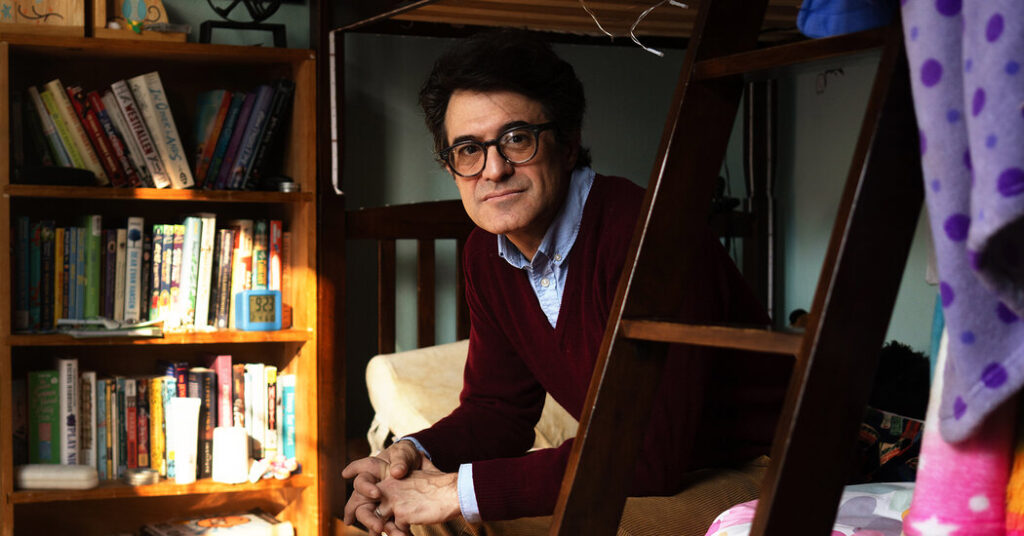
We were talking in the kitchen of the bookcase-lined house Oppenheimer shares with his wife, Cyd, their five children, a 14-year-old mutt (Archie) and a gray cat (Katniss Everdeen). He served a mean egg salad, and mentioned proudly that his wife built the bookshelves. He has the confidence of a grown-up wunderkind tinged with the humility of being a father many times over (not to mention a father of three teenage daughters).
Oppenheimer spent more than two years interviewing Blume and her circle — her son and daughter, her husband and longtime friends, her editor and fellow authors and publishing industry insiders, some of whom Blume helped connect him with. In all, he spoke with more than 100 people.
He revisited Blume’s oeuvre, reading some of her books for the first time. He spent months in a basement reading room at Yale’s Beinecke Library, poring over her archive.
He visited Blume’s childhood home in Elizabeth, N.J., and the house she lived in briefly in Santa Fe after her first divorce. He met with Blume multiple times at her home in Key West, Fla., and in New York City.
He even tried, unsuccessfully, to locate Brad Haines, who in 1968 made national news for swallowing a turtle, thus inspiring Fudge Hatcher, one of Blume’s most iconic characters.
“It was like doing another college degree, but you’re majoring in Judy Blume,” Oppenheimer said.
Janet Malcolm, whose papers are also at the Beinecke Library, famously compared a biographer to a burglar, “breaking into a house, rifling through certain drawers that he has good reason to think contain the jewelry and money, and triumphantly bearing his loot away.”
Oppenheimer didn’t appear triumphant during our interview, just well intentioned and matter of fact. He’d been invited into the house, so to speak; Blume had given him the key.
“She asked me to tell the story,” he said.
A ‘silly hope’
“Judy Blume: A Life” traces the slow build of Blume’s career — including the brief era when she sold felted crafts at Bloomingdale’s — and the many ways in which Blume flouted conventions for women of her generation, especially ones from a middle-class Jewish background, as she is.
Of particular interest is Oppenheimer’s account of the five-year period when Blume wrote 10 books, including ones she’s still known for, which roughly coincided with the end of her first marriage to John Blume, whom she married when she was 21, and a fledgling union with Tom Kitchens, whom she met on a plane. They were married for only a few years, bouncing from London to Los Alamos to Santa Fe with Blume’s adolescent children in tow.
Bruce Springsteen has “Nebraska,” which grew out of a time of lonely turmoil; Blume has “Tiger Eyes,” a thematic departure from her earlier work.
“It’s Judy Blume’s only book without any perky characters,” Oppenheimer writes. “Everyone in ‘Tiger Eyes’ is trying to figure out how not to be sad.”
Blume’s novels cover a kaleidoscope of weighty topics — from scoliosis to spirituality to adultery to a trio of airplane crashes that rattled northern New Jersey in the early 1950s — but the lens they share is humor.
Oppenheimer’s biography is earnest and dogged, as if he were so intent on wrangling the big subjects — divorce, parenthood, sex, sexism — that he rarely captures the lightness that put Blume on the map.
Perhaps the most salient information in “Judy Blume: A Life” is buried on Page 415, in a three-paragraph section called “Sources.”
“After I wrote a draft of this biography, I sent it to Judy,” Oppenheimer writes. “After several months, she returned it with hundred of comments in the margins; she also attached a separate memo, 40 pages long, offering suggestions, disagreements and assorted thoughts, covering every era discussed in the draft.”
Recalling the exchange, Oppenheimer said: “It was hard for me to click ‘open’ on that PDF. Once I did, I realized there was a lot of wisdom in it.”
As he described it, there wasn’t a particular revelation or section of the biography that Blume objected to, but a constellation of concerns she wanted addressed.
Choosing his words carefully, he said, “It really felt like a close edit by someone who could have had a career as an editor.”
Oppenheimer took some of Blume’s suggestions, rejected others and fixed the errors she had caught. In the book’s “Notes” section, he cites Blume’s email 100 times.
Their relationship cooled after that. The two have barely been in touch since.
Oppenheimer declined to share Blume’s memo, describing it as “thorough.” He acknowledged the potential discomfort of reading one’s own biography, especially for a subject who is a writer herself.
“I think on some level when you’re writing a bio of a living person, you have in mind the hope that they will decide that you know them best,” Oppenheimer said. “But of course, that’s a silly hope. They’re always going to know themselves best.”
Oppenheimer appeared uncomfortable with Blume’s rebuke, but also aware that he had to suspend his discomfort to stay true to his project. His goal was to tell a complete story, warts and all.
“A journalist is not a prosecutor, a journalist is a truth teller,” Oppenheimer said. The same could be said of a biographer.
A spokesman for Oppenheimer’s publisher, Putnam, wrote in an email, “We can’t speak to any legal issues, but can share that while this is not an authorized biography, we’re very pleased that Judy provided input and responded to fact-checking queries, which made the book much better.”
So what made Blume walk away from her own biography?
Maybe it was Oppenheimer’s revelations about her early sexual experimentation with a friend who recalled their games of “doctor” differently than Blume did (the friend remembers looking, but not touching). Maybe it was Oppenheimer’s inclusion of medical information relating to Blume’s two abortions, her mastectomy and hysterectomy, and details of her experience with menopause (not to mention her mother’s).
Maybe it was the postmortem on Blume’s first two marriages; or a disconnect with Oppenheimer’s writing style; or perhaps the book provided a glimpse of her own mortality.
Readers will have to draw their own conclusions.
Blume confirmed the timeline of events and original terms of her agreement with Oppenheimer, but declined to comment for this story.
Her agent, Suzanne Gluck, wrote in an email, “Neither Judy nor I are participating in any publicity for Mark’s book.”
Celebrating a different biography
Blume has championed another biography: Selina Alko’s picture book, “Otherwise Known as Judy the Great,” which came out on Feb. 17. It tells the story of Blume’s life in verse, accompanied by collage illustrations that include snippets of text from her books.
On March 1, Blume hosted a celebration for Alko at Books & Books, her bookstore in Key West, Fla.
Oppenheimer’s 13-city tour for “Judy Blume: A Life” culminates with an event at the Toronto Public Library, where he’ll be in conversation with Molly Ringwald, who narrated the audiobook.
Ringwald, an actor, writer and longtime fan of Blume’s books — and, arguably, another voice of Generation X — said of the biography, “There might be moments that Judy doesn’t like or agree with, but overall I think it’s a respectful treatment of her and her literary significance.”
She added, “If Mark didn’t show Judy’s flaws or humanity, it would be hard to feel invested.”
Indeed Oppenheimer shows Blume’s humanity — her loyalty and humor, her creativity, her tireless crusade against book banning — and acknowledges where he might have fallen short.
“What is frustrating, for the biographer, is the nagging sense that I am missing a lot,” he writes toward the end of the book, citing “internal family dynamics” as one area that remained opaque after interviews with Blume and her relatives.
“I pressed her a lot, but I could have pressed more,” Oppenheimer writes. He continues, “If there’s more to the truth, which I didn’t get at, perhaps the fault is mine.”
He doesn’t expect hear from Blume.
“When you decide to write a biography, you don’t work for the subject. You work for the reader,” Oppenheimer said. “Judy was an amazing interview subject who was incredibly generous with her time and at a certain point it had to become my book.
“We’re at that point now. She’s not a collaborator on the ongoing project of ‘Judy Blume: A Life.’”
Elisabeth Egan is a writer and editor at the Times Book Review. She has worked in the world of publishing for 30 years.
The post He Wrote Judy Blume’s Life Story. She Won’t Talk About It. appeared first on New York Times.