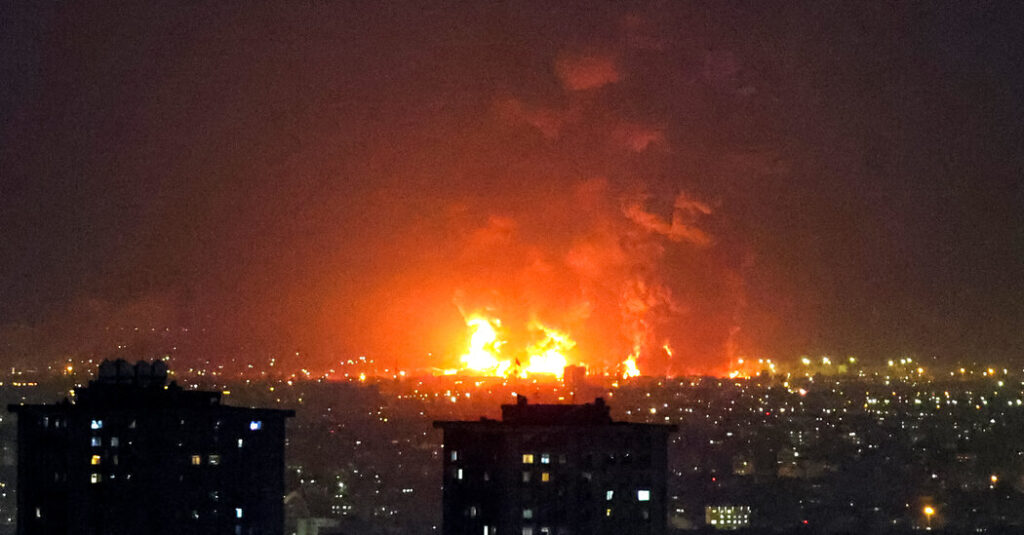
The Israeli military struck several Iranian fuel sites late on Saturday, sending huge balls of fire and smoke into the air and rocking Tehran and the neighboring city of Karaj with explosions.
The attacks, seen in videos circulating on social media and verified by The New York Times, appeared to be the first on Iran’s energy infrastructure since the United States and Israel launched strikes on Iran last weekend. Until this weekend, the U.S.-Israeli bombing campaign had been largely focused on ravaging Iran’s leadership and security services, and police stations, while also trying to eliminate its ability to produce and launch missiles and prevent Tehran from being able to produce nuclear weapons.
But Tehran is a sprawling metropolis of 10 million people, with densely packed neighborhoods, and as in many cities, residential, commercial and military structures are in proximity to one another. Iranian media and residents have reported widespread destruction to residential homes, shops, roads, water pipes and several hospitals and schools, located near targets sites.
Iran’s Ministry of Oil said in a statement that multiple oil storage depots in the provinces of Tehran and Alborz had been targeted.
The Israeli military confirmed in a statement that it had attacked several fuel storage and energy complexes in Tehran, saying the facilities were being used by Iran’s armed forces. Israel’s military called it a “significant strike” aimed at dismantling the military infrastructure of the government.
Tehran’s main oil refinery is next to one of the storage facilities, in the city’s southern Shahr Rey district, that was attacked, according to state media. Videos circulating on social media and verified by The New York Times showed huge columns of fire lighting up the sky, and rising from what appeared to be the area of the oil depot.
The explosions on Saturday night rattled residents of Tehran and came after an attack by Israel early Saturday on Mehrabad Airport, the nation’s busiest domestic travel hub. Israel said it had hit airplanes parked on the runway used by Iran to send money and weapons to its proxy militant groups in the region.
The sounds of the explosions at both the airport and the fuel depot shook homes miles away, residents said, and filled the air with smoke.
“It’s getting to a point where we feel no place is safe, and even the roads leading in and out of the city are dangerous because targets around them are attacked,” said Amir, a businessman who had taken his wife and two children, to the countryside from Tehran. He said they heard the explosion from one of the oil depots near the mountains.
Footage recorded on the outskirts of northern Tehran, on a major highway that leads to the upscale suburb of Lavasan, captured an enormous fire burning at another oil storage facility.
The Shahran oil depot in northwestern Tehran, which Israel targeted last June, was hit again, sending a dark plume of smoke swirling into the sky.
Iran’s oil ministry said that one of its depots in Karaj, just west of Tehran, was also struck.
The Iranian oil ministry statement said fire and emergency crews were working to put out the flames from the strikes, and asserted there would be no fuel or energy shortages because the ministry had taken precautions, anticipating strikes on its facilities.
Iran’s Revolutionary Guards Corps said it had launched a new wave of attacks on Israel in retaliation for the attacks.
Shirin, a 36-year-old dentist, said she and her family had decided to remain in Tehran but that the severity of the attacks were making it difficult for them to sleep, or go about any semblance of ordinary life.
“We are very, very scared,” Shirin said. “I want the war to end, immediately.”
Farnaz Fassihi is the United Nations bureau chief for The Times, leading coverage of the organization. She also covers Iran and has written about conflict in the Middle East for 15 years.
The post Israel Strikes Oil Facilities in Iran appeared first on New York Times.