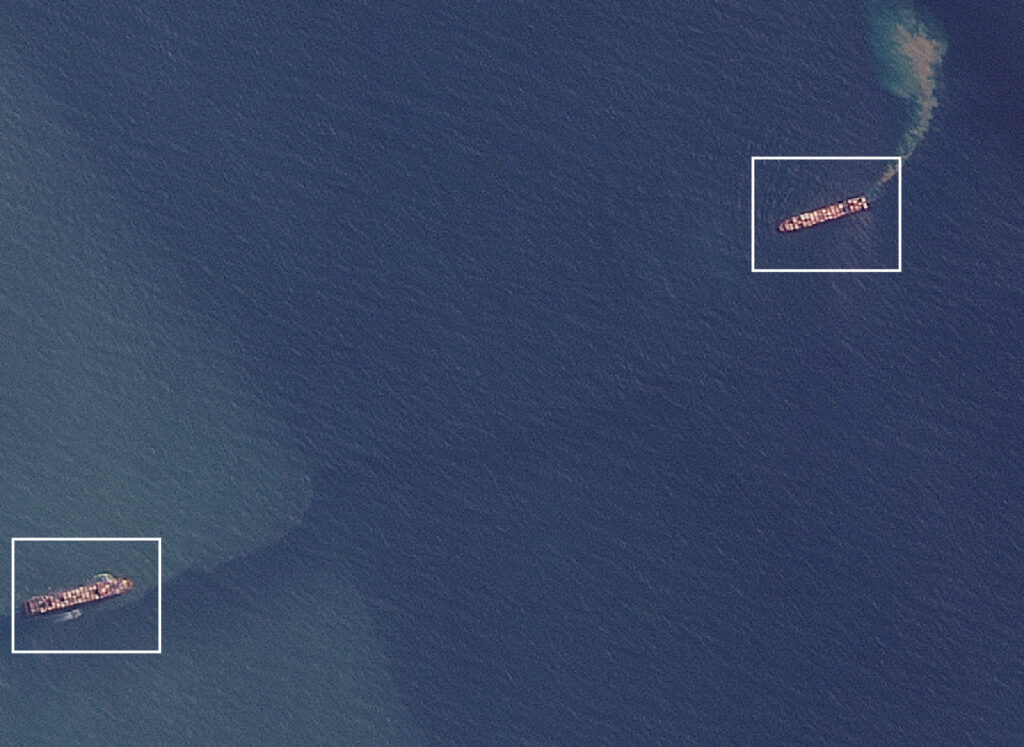
Two ships owned by an Iranian company that the United States has accused of supplying material to Tehran’s ballistic missile program departed a Chinese chemical-storage port this week laden with cargo and headed for Iran, according to a Washington Post analysis of ship-tracking data, satellite imagery and Treasury Department records.
The vessels are part of the Islamic Republic of Iran Shipping Lines (IRISL), a state-owned company under U.S., British and European Union sanctions that has been described by the U.S. State Department as the “preferred shipping line for Iranian proliferators and procurement agents.”
The Shabdis and the Barzin — which can carry up to 6,500 and 14,500 20-foot-long containers, respectively — had docked at the Gaolan port in Zhuhai, a city on China’s southeastern coast. Experts told The Post that Gaolan is a loading port for chemicals including sodium perchlorate, a key precursor for solid rocket fuel that Iran desperately needs for its missile program.
A dozen other IRISL ships have visited the port since the start of the year. But experts said it would be notable for Beijing to allow any vessels to depart in this moment bound for Iran with weapons-related material as they expected China — America’s chief and most powerful strategic rival — to be wary of such an action while the United States and Iran are in direct combat.
“China could have held these vessels at port, imposed an administrative delay, invented a customs hold — any number of bureaucratic tools, but didn’t,” said Isaac Kardon, a senior fellow at the Carnegie Endowment for International Peace, to The Post. “That’s a deliberate policy choice made during an active war in which Beijing publicly calls for restraint.”
Although IRISL operates as a large commercial carrier, Kardon said the circumstances of these shipments strongly suggest the cargo is sodium perchlorate. “Given the track record, the most parsimonious explanation is that they’re loading the same commodity they’ve been shuttling for the past year-plus,” he said.
The Chinese Embassy in Washington did not respond to messages seeking comment.
The Pentagon, the White House and the U.S. Treasury Department also did not respond to requests for comment.
The Barzin arrived Saturday at the Gaolan port. Based on how deep the ship was sitting in the water when it departed Monday, it appeared to have taken on cargo. That data point, which is contained in ship-tracking data and is known as draft, also suggests the Shabdis took on cargo between the time it arrived Wednesday and when it departed Thursday. The maritime intelligence firm Pole Star Defense independently verified The Post’s draft analysis.
“The Gaolan port hosts some of the largest liquid chemical storage terminals in south China,” said Miad Maleki, a former U.S. Treasury official who worked on Iran sanctions efforts and is now a senior adviser at the Foundation for Defense of Democracies.
Maleki said that based on the history of transfers of the chemical from the Gaolan port to Iran, the involvement of IRISL, and the movements of the Barzin and Shabdis, his assessment is that the two vessels now in transit are carrying sodium perchlorate.
As of Saturday, the ships were in the South China Sea, according to AIS data, which provides real-time information about vessel position, draft, speed, course and destination, among other details. The data was provided by the global intelligence company Kpler.
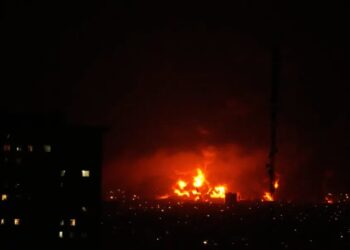
The Barzin has dropped anchor off the coast of Malaysia. Its destination remains the port in Bandar Abbas, some 4,000 miles away, where it is expected to arrive next Saturday. The Shabdis is currently sailing, with about 4,500 miles to go, and is expected to arrive at Iran’s Chabahar part on March 16. Both ports are in the Strait of Hormuz and host major Iranian naval bases. Satellite imagery from Monday shows black smoke spewing from multiple sites after Bandar Abbas was struck in the U.S. and Israeli barrages that began last weekend.
Treasury’s Office of Foreign Assets Control announced sanctions last year aimed in part at interrupting Iran’s ballistic missile production, with a focus on stopping the flow of sodium perchlorate and dioctyl sebacate from China to Iran. Sodium perchlorate is used to produce ammonium perchlorate. Ammonium perchlorate and dioctyl sebacate can be used in the solid propellants that power ballistic missiles.
The United States has for years accused China of providing its ally Iran with missile-related technology and materials. Beijing has often denied direct assistance and said the U.S. accusations overstate commercial or dual-use trade. Sodium perchlorate has a narrow range of civilian uses beyond rocket propellants and fireworks.
If the ships that departed Gaolan port this week are carrying sodium perchlorate, that would be a departure from China’s previous approach to balancing its interests in the region, said Grant Rumley, a senior fellow at the Washington Institute for Near East Policy.
“With missiles and drones raining down on gulf states, any show of support like this towards Iran risks souring China’s relations with a number of gulf countries,” he continued. “It’s an uncharacteristically bold strategy.”
The other 12 IRISL-owned ships that have visited Gaolan port since the start of the year all docked at the same terminal as the Barzin and the Shabdis, and draft changes suggest all but one picked up cargo. Several — like the Barzin — are known sodium perchlorate haulers, according to experts and media reports citing intelligence agency assessments and satellite imagery reviews.
Some of the ships cycled through Gaolan port on a nearly daily cadence during a one-week period in mid-February as U.S. forces amassed near Iran and a second round of nuclear talks ended without a breakthrough.
Draft analysis indicates that many of the vessels unloaded their cargo at Iran’s Shahid Rajaee port, which handles the great majority of the country’s container trade. Last year, after an explosion at the port killed at least 17 people, a Post examination of visuals showed the blast was caused by a chemical fire that began in a shipping container. Experts said the color of smoke indicated that perchlorates were present.
AIS data suggests some of the ships lately have been forced to shift their planned routes due to the U.S.-Israeli strikes.
Three that were en route to Bandar Abbas — the Hamouna, Abyan and Arzin — changed their AIS destination to the “high seas” after the strikes began and on Saturday were near Iranian waters. Another, the Basht, stopped transmitting AIS data Thursday, around 13 miles from Bandar Abbas.
Meanwhile, at least two IRISL-owned ships are on their way to the Gaolan port.
The U.S. and Israel strikes have hammered Iran’s missile storage bunkers and underground depots. “Tehran’s need for propellant precursors just went from urgent to existential,” Kardon told The Post.
Alex Horton contributed to this report.
The post Laden Iranian ships depart Chinese port tied to key military chemicals appeared first on Washington Post.