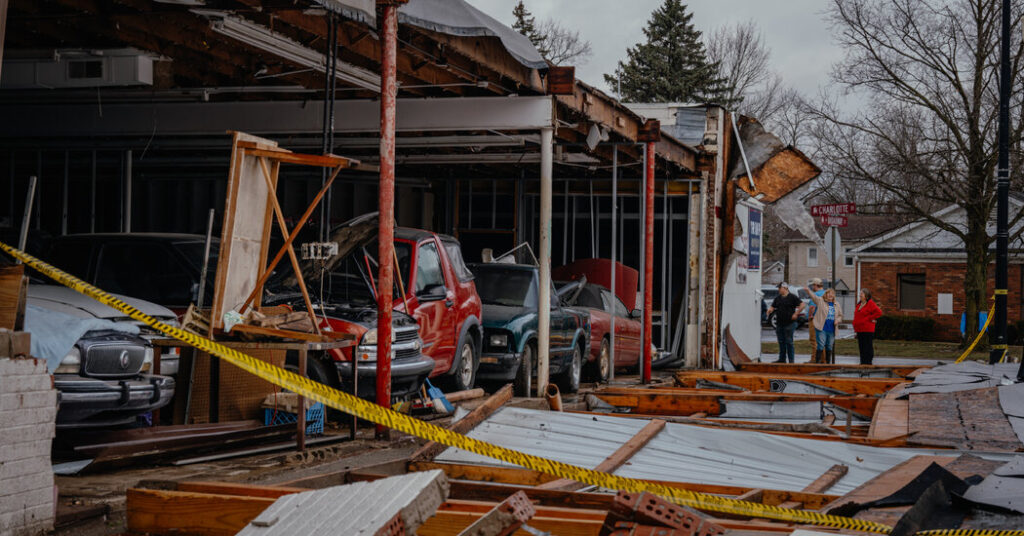
After tornadoes swept across Michigan and Oklahoma late Friday, killing at least six people, residents spent Saturday surveying the damage to their homes, schools and businesses.
In Union City, Mich., where three people were killed in an especially violent storm, Paul Guthrie emerged to find that his roof had cracked and that his shed had been picked up by the swirling winds and hurled across the street.
His mailbox flew much farther, he said, maybe a half or even three-quarters of a mile away, landing near a friend’s home.
The damage had happened impossibly fast.
“Five seconds of wind, and then it was over,” said Mr. Guthrie, 38, as he stood in his front yard under a drizzling rain. Behind him, his son’s room, at the western peak of his roof, was open to the sky.
Between the two states, the National Weather Service had fielded 13 tornado reports through Friday night.
The deadliest of the tornadoes, which tore through the village of Union City in southwestern Michigan, killed three people and injured at least 12 others. The tornado was spawned by a lone supercell thunderstorm. While typical thunderstorms have updrafts that last for 30 minutes or an hour, the updraft of a supercell can persist for hours, taking on rotation and causing especially violent weather. The worst of the storm had abated by Saturday morning, though a light rain persisted. In the center of town, a wall of an auto shop had toppled onto the sidewalk, leaving a cluster of cars inside exposed to the wet and wind. Just a short walk away, however, a tire shop sat untouched.
A tornado near Edwardsburg, Mich., killed one person and injured others in Cass County in the southwestern part of the state, according to Clint Roach, the county’s sheriff. Gov. Gretchen Whitmer said on Friday that people had also been injured in St. Joseph County.
Next door to Mr. Guthrie, Tony and Ashley Macklin already had a disaster cleanup service parked in their driveway. Multiple windows on their home were boarded up, and broken glass was still scattered across their living room floor.
“The pressure was just insane,” said Ashley Macklin, 40, who works as a kindergarten teacher. “I couldn’t hear anything. It felt like your face was being sucked in.”
In another part of Union City on Saturday morning, Monte Putnam and his wife, Bridget, were out surveying the damage to their neighborhood. The storm had blown the windows out of their garage door and left it hanging askew, and had destroyed the shed in their backyard, dragging a lawn mower across the property.
He and his wife said they were lucky — having just survived a car crash a few weeks ago — to come out of this unscathed. The same could not be said for their new truck, which was pinned under the dislodged garage door. Ms. Putnam joked that their insurance company was going to hate them.
In Tulsa, Okla., there were damaged buildings and downed power lines, said Monroe Nichols, the city’s mayor, on social media. Some 30 miles south, two people were killed and several others were injured after a tornado destroyed a house near the small city of Beggs, Okla.
In Tulsa, a roof had been torn from a building on the Peoria campus of Tulsa Tech, a career and technical education institute. Twisted metal debris had been scattered across a lawn on campus and was caught in the trees.
Tony Heaberlin, a spokesman for Tulsa Tech, said no one was in the damaged building at the time and no injuries had been reported at the Peoria campus, which hosts about 550 students.
For millions of Americans, the danger isn’t over. Going into the weekend, the risk for additional thunderstorms remains high from central Texas to western New York, with the potential for flash floods, damaging winds and additional tornadoes. The risk for tornadoes is highest on Saturday in eastern Ohio, western Pennsylvania and parts of West Virginia.
Jared Guyer, a meteorologist with the Storm Prediction Center, said on Saturday that the next storms were expected to be “a notch down in intensity” but the threat remained and people needed to be prepared.
Kristi Eaton and Amy Graff contributed reporting.
Chris Hippensteel is a reporter covering breaking news and a member of the 2025-26 Times Fellowship class, a program for journalists early in their careers.
The post Communities Survey Devastation After Tornadoes in Michigan and Oklahoma appeared first on New York Times.