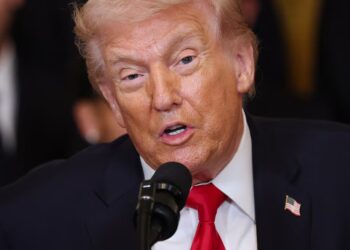
Prime Minister Shehbaz Sharif of Pakistan stood beside President Trump last October in Egypt and effusively praised him for “saving millions of lives” in the Middle East and stopping eight wars, noting that Pakistan was nominating him for the Nobel Peace Prize.
Many in Pakistan now say that Mr. Sharif’s praise has aged poorly.
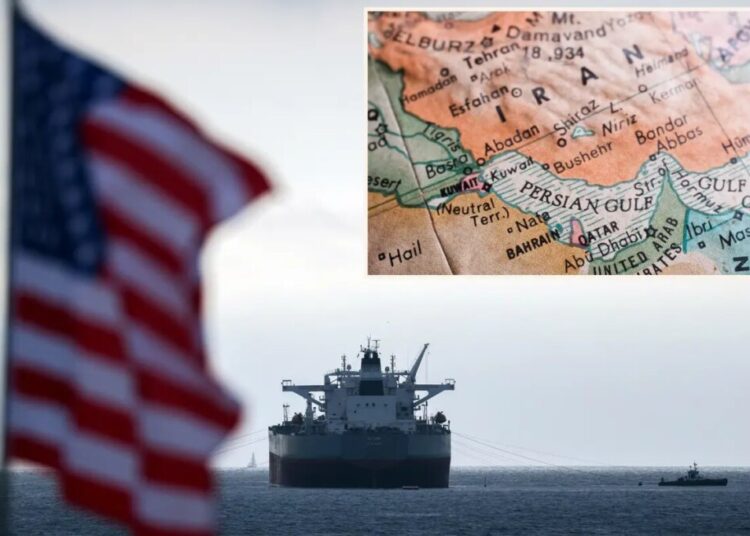
Since the United States and Israel began bombing Iran last week, videos of his comments have resurfaced online, highlighting the complications that the war has created for Pakistan — a nuclear-armed nation that has a border with Iran, ties to Gulf Arab states and a brittle relationship with the United States.
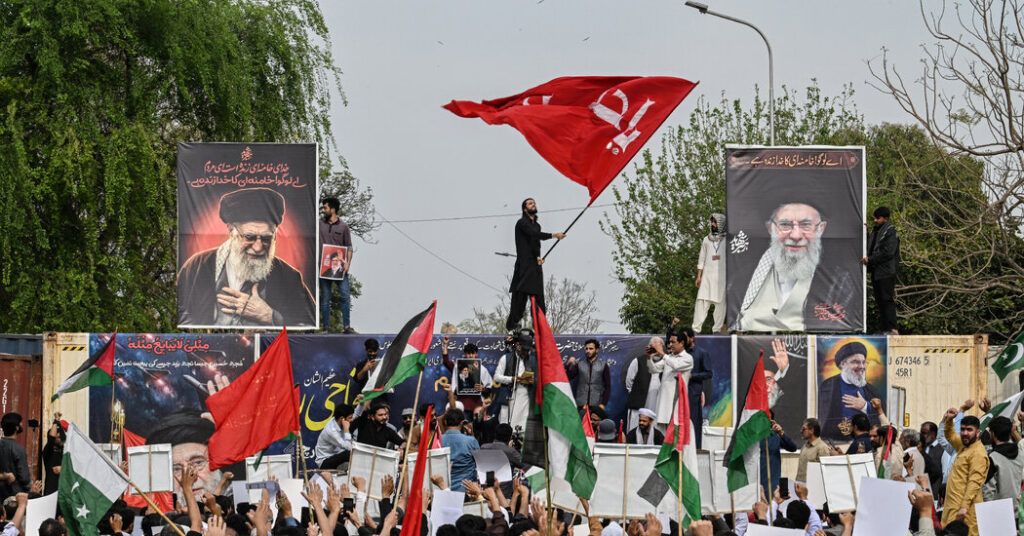
On Friday in Islamabad, Pakistan’s capital, hundreds of protesters trampled on portraits of Mr. Trump and of Prime Minister Benjamin Netanyahu of Israel. Some held photographs of Ayatollah Ali Khamenei, the supreme leader of Iran who was killed in U.S.-Israeli strikes last Saturday.
Mr. Sharif’s government now has to justify its overtures to the Trump administration, which it pursued as an economic strategy to yield crypto and critical minerals deals and a geopolitical move to get more clout in South Asia at the expense of its rival, India. Pakistan, home to what is estimated to be the world’s largest Shiite community outside Iran, is now grappling with deadly anti-U.S. protests and an energy crisis sparked by the U.S.-Israeli bombing campaign.
“The Pakistani government is now under a lot of pressure for cozying up to Trump,” said Maleeha Lodi, a former Pakistani ambassador to the United States and the United Nations.
Arif Hussain Wahidi, a Shiite political leader, told the crowds at Friday’s protests that he was ashamed that Mr. Sharif’s had nominated Mr. Trump for the Nobel Peace Prize, a move that the Pakistan prime minister made last year after the Pakistani government said Mr. Trump helped stop a short-lived conflict with India.
“The government must now recognize who the real victims of terrorism are and who the terrorists are,” Mr. Wahidi said.
At least 26 people died in anti-U.S. and anti-Israel protests in Pakistan in the past week, including 11 who were shot and killed as demonstrators tried to storm the U.S. Consulate in Karachi. The U.S. Embassy in Islamabad declined to say whether it was U.S. armed personnel or Pakistani security forces who opened fire.
Pakistan has walked a delicate line so far, condemning the strikes on Iran without criticizing the United States directly.
“The prime minister and the field marshal have to find a balance, but a good relationship with the U.S. is good for Pakistan,” said Mosharraf Zaidi, a government spokesman. Referring to Mr. Sharif and to the Pakistani army chief, Syed Asim Munir, he added: “They have the courage to withstand the criticism at home, which they know comes from a place of good will and pain for our Muslim brothers.”
Ms. Lodi, the former ambassador, said that anger was not limited to the Shiite community. “That anti-U.S. sentiment is a national sentiment, not a sectarian one,” she said.
Pakistan also has had to manage its longstanding ties to the Gulf states that have been hit by Iran’s retaliatory missile and drone strikes. More than half of the $40 billion worth of remittances sent to Pakistan every year comes from the Gulf.
“It cannot be that Iran keeps hitting the Arabs and we say that we are neutral,” said Anwaarul Haq Kakar, a Pakistani senator and former caretaker prime minister.
On Saturday, Field Marshal Munir met with Saudi Arabia’s defense minister, Prince Khalid bin Salman, to discuss “Iranian attacks on the Kingdom and the measures needed to halt them,” according to a Pakistani military statement. Pakistan and Saudi Arabia signed a mutual defense pact last year stipulating that an attack on one is an attack on both, and on Tuesday Pakistan warned Iran that it is bound by that agreement.
Pakistan, a Sunni Muslim-majority country where 15 to 20 percent of the population is Shiite, has had a rocky relationship with Iran since its 1979 revolution. Pakistani officials say they have often tried to mediate between Iran’s leaders, the United States and Arab states.
But the impact of the current conflict is straining those efforts.
To preserve Pakistan’s dwindling energy stocks, which it hasn’t been able to replenish from the Gulf, the government is considering imposing a four-day workweek, and remote school and work. Pakistan has crude oil reserves for less than two weeks and liquefied natural gas through the end of the month, according to the oil ministry.
The chaos in Iran also threatens to spill over into Balochistan, a resource-rich province in southwestern Pakistan along the border with Iran. The United States has pledged $1.25 billion to finance a gold-copper mine in Balochistan, even as a separatist insurgency there has surged. Experts say it carried out more than 200 attacks last year.
“Any security vacuum on the Iranian side would make it easier for militants to move between Iran and Pakistan,” said Pearl Pandya, a senior analyst for South Asia at Armed Conflict Location & Event Data, a conflict-tracking group.
Pakistan is also counting on U.S. support in a conflict with another neighbor — Afghanistan, where it has been carrying out airstrikes on military installations for more than a week. As Pakistan has accused the country’s Taliban government of supporting militant groups that target Pakistani security forces, the State Department said Pakistan had a right to defend itself.
Pakistan “is far better off staying on the right side of the Trump administration particularly in times of instability, so long as it’s able to balance out the domestic side,” said Elizabeth Threlkeld, an analyst at the Stimson Center.
Privately, some Pakistani officials have expressed fears that Mr. Trump is too mercurial to build a lasting partnership. The relationship also remains troubled by a deep-seated view in Washington that Pakistan played a double game during the 20-year U.S. war in Afghanistan by covertly supporting the Taliban.
The latest conflict in the Middle East is likely to threaten that fragile balance, analysts said.
“We’ve had our challenging times with the United States,” said Jauhar Saleem, a Pakistani diplomat and former acting foreign minister. “It’s one of those times.”
Salman Masood and Zia ur-Rehman contributed reporting from Islamabad.
Elian Peltier is The Times’s bureau chief for Pakistan and Afghanistan, based in Islamabad.
The post Pakistan Praised Trump. Now It Risks Being Caught Up in His War. appeared first on New York Times.