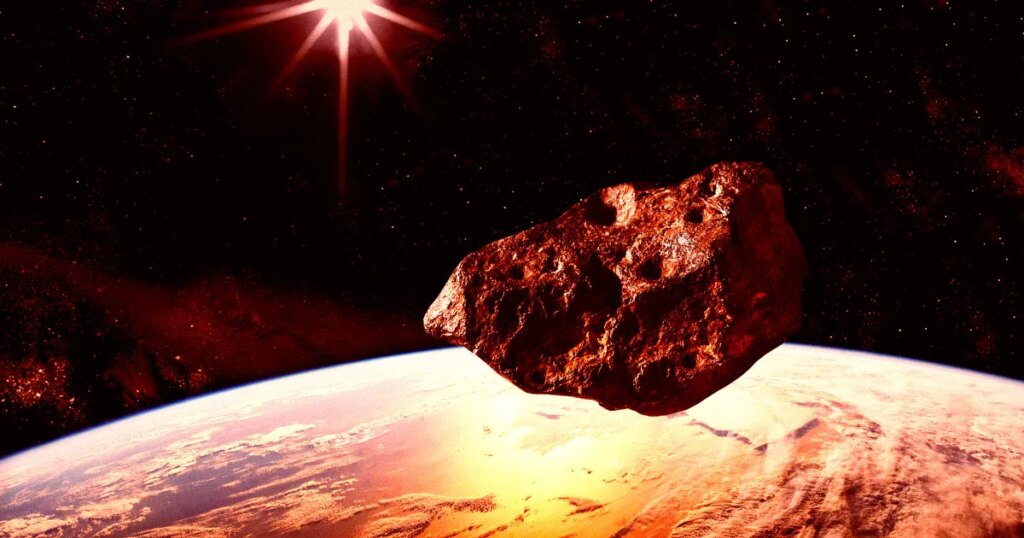
In an effort to explain how life started on Earth billions of years ago, some scientists have suggested that microbes — or perhaps the organic building blocks of life — may have hitched a ride while clinging to space dust, asteroids, comets, or planetoids.
The hypothesis, dubbed panspermia, raises the possibility that the earliest forms of life may have originated on other planets, including perhaps Mars, which scientists believe may have once been covered in oceans, lakes, and rivers. A sub-theory, dubbed lithopanspermia, holds that asteroid strikes on other planets may have dislodged surface material back into orbit, allowing microorganisms embedded within the debris to eventually make it to Earth.
It’s an intriguing idea, but proving it is exceedingly difficult. In an effort to push things along — and satisfy their curiosity — Johns Hopkins University asteroid impact expert KT Ramesh and his colleagues gathered experimental data exploring whether bacteria could survive a journey between planets via an asteroid strike.
As detailed in a new paper published in the journal The Proceedings of the National Academy of Sciences NEXUS, the team found that an “extremophile” microorganism dubbed Deinococcus radiodurans, a bacterium that has previously been shown to be resistant to the extreme conditions of space, could indeed survive “controlled extreme pressures” simulating asteroid impacts.
Even after being blasted with 24,000 times the atmospheric pressure exerted by a steel plate while sandwiched between two more steel plates, an astonishing 60 percent of tiny organisms survived. At even more extreme pressures of 30,000 times atmospheric pressure, just under ten percent of the bacteria still managed to survive.
“The work has significant consequences for considerations of planetary protection, spacecraft mission design, our understanding of where we might find extraterrestrial life, and lithopanspermia,” the authors concluded.
Despite Deinococcus radiodurans being known to be able to self-repair, survive extreme dehydration, and cope with copious amounts of radiation, the results surprised the researchers.
“We didn’t know what to expect,” coauthor and Johns Hopkins University doctoral student Lily Zhao told the New York Times. “We would have been excited to see one percent survival, honestly.”
The team was unable to determine at which pressures all of the microorganisms would’ve died after running into the limits of their experimental apparatus.
“The metals were failing and fracturing before the cells,” Zhao said.
Of course, the jury is still out whether there even are, let alone were, microorganisms on Mars. Despite our best efforts, evidence of life on the planet remains elusive. But if they are there, it’s looking like an asteroid strike could have dislodged some of these microbes and seeded the Earth billions of years ago.
The team is now hoping to expose other microorganisms, including fungi, to similar scenarios. They’re hopeful others will also survive the ordeal.
“Life is always hardier than we expect it to be,” Zhao told the NYT.
More on panspermia: Russia Tests Whether Life Could Spread Between Planets With Spacecraft Filled With Critters
The post Scientists Find Microbes Can Survive Traveling from Planet to Planet While Clinging to Asteroids appeared first on Futurism.