As the old saw goes, the only constant is change. But change doesn’t always feel as overwhelming as it does right now. We are living in an era of widespread democratic backsliding, sweeping technological disruption and the slow-motion disaster of the climate crisis, to name just a few of the most troubling societal upheavals. But what if, despite all that, there’s a different and more hopeful story to tell about change?
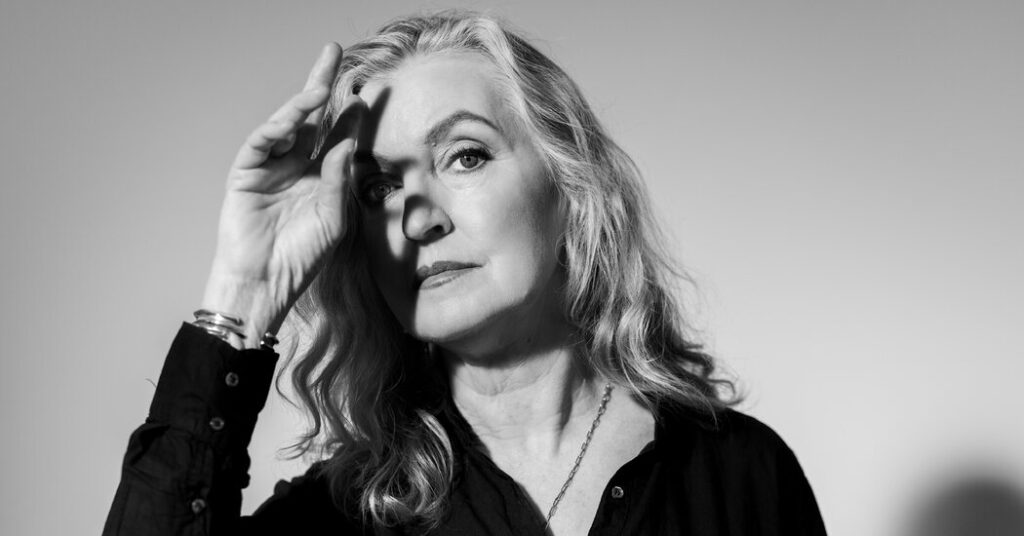
That’s the question at the heart of “The Beginning Comes After the End,” the new book by the prolific and critically acclaimed progressive writer Rebecca Solnit. A thematic sequel to her classic “Hope in the Dark,” the book shines a light on the vibrant world often hidden within our own seemingly gloomier one — a world that has embraced ideas of interconnection, ecological care and political equality. It’s not a naïve book — Solnit is keenly aware of the challenges we’re all facing — but it provides a stabilizing counterweight to the feeling that the world, of late, has spun dangerously off-kilter.
Subscribe: Apple Podcasts | Spotify | YouTube | Amazon | iHeart
When people are reading the news and it’s making them feel as if they’re barreling into a grim dystopian future, what additional context should they have that would help them complete the picture and show them that there are deeper currents of positive change happening? Even the right tells us something encouraging, if we listen carefully to what they’re saying. They tell us: You are very powerful. You’ve changed the world profoundly. All these things that are often treated separately — feminism, queer rights, environmental action — are connected, so they’re basically telling us we’re incredibly successful, which is the good news. The bad news is that they hate it and want to change it all back. There is a backlash, and it is significant. But it is not comprehensive or global. I was on a book tour last year in Europe, and the Europeans astounded me by being like: Oh, Roe v. Wade was overturned — doesn’t that mean feminism has failed? The United States is 4 percent of the population. Meanwhile, all these Catholic countries — Argentina, Mexico, Ireland, Spain — have greatly expanded reproductive rights and abortion access. And even though the overturning of Roe took away national protection, a lot of blue states strengthened it. So it’s really how you tell the story.
Why does it feel easier to internalize the upsetting and retrogressive aspects of the world we live in, rather than that more positive context? You’re coming to the wrong person. My friend Sam calls me the hope lady. I remain hopeful partly as defiance. But what you’re addressing is narrative itself. Most stories are: Something goes wrong, and then we have to address it. When nothing goes wrong, there’s no story. But also, a lot of what’s right are stories of incremental change. One of the stories people don’t comprehend is the energy revolution at the turn of the millennium. We didn’t have an alternative to fossil fuels. But because solar and wind have suddenly become these incredibly cheap, incredibly effective adaptable technologies, we can run almost everything on renewables and have more energy than we could possibly use. Very few people comprehend it because it’s nerdy, technical and incremental.
I need to reveal my party-pooper attitude about renewable energy. There is comfort in knowing that clean energy is the future. But the United States is pumping more oil than ever before. We’re going to blow past our global climate temperature-increase targets. We have no idea what the feedback-loop effects of rising temperatures are or how bad they’ll get. So while there’s comfort in knowing what our shared energy future is, it can feel like a cold comfort to me. Well, cold is good in the climate movement. [Laughs] You talk about comfort. I am not comfortable with where we’re at. The wonder and horror for climate is that the great majority of people on Earth support climate action. The obstacles are not technological. They’re political. The fossil-fuel industry and the rich and powerful and governmental figures who either are or serve the fossil-fuel industry are what’s holding us back. So the wonder and horror exist side by side. You can be thrilled by all the things that are happening and horrified by all the things that should be happening but aren’t. Everything we can save is worth saving. Everything we can do is worth doing. We’ve already lost a lot, but we don’t have to lose everything. We don’t have to surrender. You got me all worked up!
It probably didn’t take that much! I’m just passionate about these things. It is so not over, and we don’t know what’s going to happen next. I went back and read a bunch of the media in the English-speaking world from the spring and summer of 1989. Nobody foresaw that all that unrest in East Germany, Poland, Hungary, Czechoslovakia, the other Eastern European countries was going to amount to much, or they thought it was going to be chaos. The fact that they would topple totalitarianism across that whole swath of Soviet-dominated Eastern Europe, largely nonviolently, almost all at once in October and November, was really inconceivable. And I think it was inconceivable to the people who did it.
If we’re talking about counternarratives that can lead to positive change, one of the defining counternarratives of the last few years could fall under the umbrella of “the resistance.” I would like to hear your perspective on whether any of the strategies against President Trump and Trumpism have been counterproductive. That is, if calling him or the movement fascist, sexist, racist pushed people into their respective corners? That’s the least of our problems. They are racist, they are authoritarian, they are misogynist, they are homophobic, and tiptoeing around it protects them and not the targets of the hatred and discrimination. I get so tired of the idea that progressives have gone too far in asserting that every human being deserves human rights when people are being shot in the streets of Minneapolis. We are facing such horrific brutality. Politeness is not really the problem. I think we got into this situation in part by a lot of people in the mainstream thinking it was more important to be polite than to call things by their true names. There’s a wonderful historian and scholar of nonviolence named George Lakey who says polarization is good. That’s when you have clarity. Sometimes people have to pick sides. You do not get authoritarians to behave better by being meek and gentle and polite. You get it by being strong.
I want to switch subjects for a minute. You got a lot of attention for your book “Men Explain Things to Me,” which was published in 2014. That book was adapted from an essay you wrote that went viral, which was credited with helping popularize the term “mansplaining.” Was there anything about that book or essay that got lost somewhere along the path to virality? The essay went super viral, but what I find a little disturbing is that people love to tell the original anecdote over and over, which happened in 2003 when I was passing through swanky Aspen, Colo., and got taken to this swanky party full of swanky people.
Sounds swanky. Yeah, not my scene. When we were trying to leave the party, [the host] sat us down and said, “So I hear you’ve written a few books?” I’d written seven, and he asked, “What are they about?” The most recent one was about Eadweard Muybridge, the photographer whose revolutionary technologies laid the groundwork for the birth of cinema. He said, “Oh, have you read about the very important Muybridge book that had just come out?” And it turned out to be mine. It’s a very funny anecdote. It also should be a horrifying anecdote about how deeply not listened-to women are. But the next anecdote in that book is about a woman running screaming out of her house in the middle of the night, saying that her husband is trying to kill her. A nuclear physicist, the uncle of my boyfriend in my 20s, told me that anecdote and thought it was funny, because he firmly believed that in his upper-middle-class nuclear-physicist suburb, men do not try to kill their wives, but women are crazy. Men kill their wives all the time, including in upper-middle-class white suburbs. Nobody talks about that anecdote, which I think is actually much more important. So I felt that the enormity of the situation got underestimated when everybody enjoyed telling that opening anecdote.
The socially transformative power of storytelling is something that comes up in your work a lot. But over the last 10 years, there has been powerful first-person storytelling about police abuse, the climate crisis, sexual assault. At the same time, one could plausibly argue that despite being awash in this powerful storytelling, the underlying systemic issues not only aren’t improving but in some cases are getting worse. What does that suggest about the effectiveness of storytelling? It’s important to recognize that stories can obscure the truth as well as reveal the truth. There are stories to justify white supremacy, misogyny, environmental destruction. The right has its stories. The fact that this regime has to lie constantly says a lot about who they are. Stories can be destructive. Stories can oversimplify. I often see the stories people on the left tell — and the left is a lot of different things, not a monolith — as very driven by their own version of sectarianism, grievance. Everyone in that category was like this, and everyone in this category is like that. The idea that stories are these magical devices that will do all our work for us is, itself, a bad story.
You know, there’s something I said earlier that I want to amend. We were talking about the green-energy transition, and I pessimistically did some quibbling. That was stupid. Obviously, every tenth of a degree of warming that we can prevent matters. I think what got my back up a little bit was this idea that somehow the market will help solve the climate crisis, even though the market is kind of the thing that got us into the climate crisis in the first place. That’s where my comment was coming from. I figured you were just playing devil’s advocate. I always feel like I’m asking people to go for nuance and shades of gray rather than black and white, and the existence of contradictions and complexities. You really have to hold both: that there’s still a lot to hope for and a lot to mourn, and those things can exist at the same time. You can be kind of heartbroken and exhilarated about climate and keep doing the work — which keeps getting done with a lot of pushback, including from the current horrendous administration here in the U.S.
Whether it has to do with environmental degradation or degradation of our politics or of people, it seems as if the public is hungry for an individual to be a counterweight to Trump and Trumpism. I don’t know whether that person is Zohran Mamdani or Gavin Newsom, who is clearly trying to position himself that way. But for whatever reason, that person has yet to be identified. Why do you think that is? One of the great weaknesses of our era is that we get lone superhero movies that suggest that our big problems are solved by muscly guys in spandex, when actually the world mostly gets changed through collective effort. Thich Nhat Hanhsaid before he died a few years ago that the next Buddha will be the Sangha. The Sangha, in Buddhist terminology, is the community of practitioners. It’s this idea that we don’t have to look for an individual, for a savior, for an Übermensch. I think the counter to Trump always has been and always will be civil society. A lot of the left wants social change to look like the French Revolution or Che Guevara. Maybe changing the world is more like caregiving than it is like war. Too many people still expect it to look like war. I denigrate politicians I don’t respect as windsocks. I just want us to understand that most of the important change is collective.
Do you think Governor Newsom is a windsock? Not exactly. I’m watching the left gear up to attack Gavin Newsom just in case he’s the nominee in 2028, and it makes my heart sink, because I watched people tear down Al Gore, I watched people tear down Hillary Clinton, I watched people tear down Joe Biden and Kamala Harris. There are definitely major things to critique about every one of them, but at the moment, when the job is to defeat the other guy, we defeat ourselves.
I want to read a line from your memoir, “Recollections of My Nonexistence”: “Sometimes now I envy those people who are at the beginning of the long road of the lives they’ll make, who still have so many decisions ahead as the road forks and forks again.” You’re no longer at the beginning of the long road of your life. But can you see an exciting or pivotal decision coming? I’m pretty happy with the path I’m on. I grew up with people telling me to have low expectations for myself. My mom told me that my writing was just a hobby and that I should glom onto my lovely, successful boyfriend forever, whom I was in the process of leaving. The only advice my father ever gave me was that I should be a business major because I’d never make a living in the humanities. I didn’t expect to have the trajectory I did. So I’m kind of thrilled with it.
This interview has been edited and condensed from two conversations. Listen to and follow “The Interview” on Apple Podcasts, Spotify, YouTube, iHeartRadio or Amazon Music. Follow us on Instagram and TikTok.
Director of photography (video): Aaron Katter
David Marchese is a writer and co-host of The Interview, a regular series featuring influential people across culture, politics, business, sports and beyond.
The post Rebecca Solnit Says the Left’s Next Hero Is Already Here appeared first on New York Times.