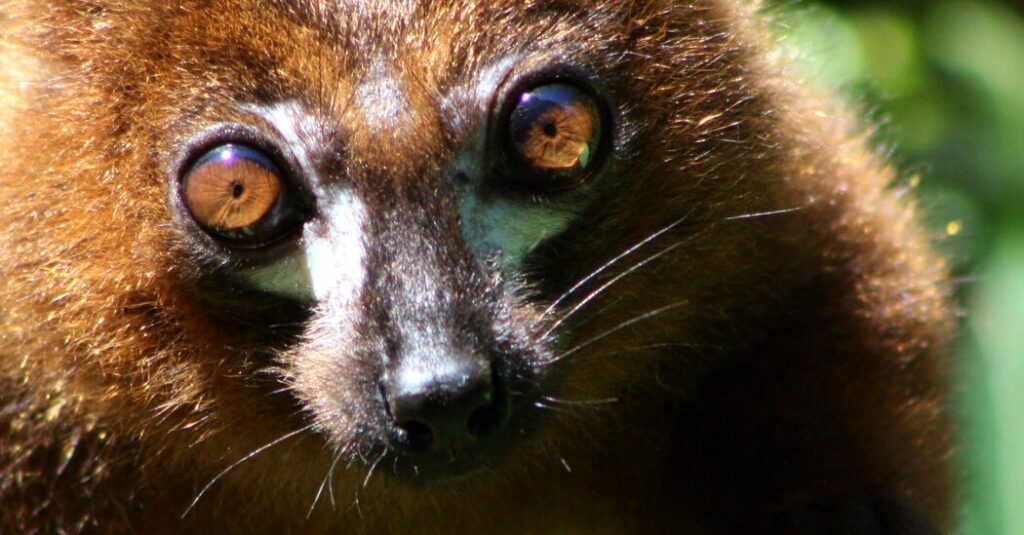
Madagascar may be facing a tough choice: restore its disappearing forests or feed its endangered lemurs?
Just a quarter of the island’s native forests remain. But the recovery of woodlands damaged by deforestation is being undermined by the strawberry guava, a highly aggressive invasive plant species. In places where guava has taken hold, it has choked out native vegetation, diminished insect populations and altered soil nutrients, according to research published in January in the journal Biological Conservation.
But conservationists have been hesitant to wage an all-out eradication effort against the plant because many of the 100 species of lemurs on the island, nearly all of which face extinction, love to eat its sweet fruit and seem to thrive where it is dense.
“For a long time, some conservationists thought it’s not that harmful — it feeds lemurs, so maybe it’s good,” said Amy Dunham, an ecologist at Rice University and an author of the study. “Now we know that while it can provide short-term benefits to wildlife, it also causes long-term ecological harm.”
Jonah Ratsimbazafy, a primatologist at the University of Antananarivo in Madagascar who was not involved in the work, said its findings were useful.
“Recommendations for how to deal with invasive species like guava are very important for the park managers,” he said.
Madagascar’s future depends not only on protecting remaining forests, but also on restoring natural landscapes that were disturbed by human activities. Such efforts are ongoing, as are projects to create corridors connecting patches of old-growth forest.
“There’s recognition that we have so little forest left it might not be enough to sustain the lemurs we have now,” Dr. Dunham said.
But these disturbed restoration areas are also the places where guava trees most often find a foothold.
Native to Brazil, the strawberry guava now plagues ecosystems from Hawaii to Norfolk Island of Australia. It is listed as one of the 100 worst invasive species by the International Union for Conservation of Nature.
Many researchers in Madagascar assumed that native trees regrowing in disturbed areas would eventually shade out invasive competitors like the strawberry guava. But Dr. Dunham and her colleagues found that the invasive plant “becomes the dominant species,” she said. “It’s almost a complete monoculture in these patches.”
The researchers focused on a part of the island where people previously lived but were forcibly removed by the French. The area has been regenerating into forest for 80 years. Some sections were dominated by dense thickets of guava, while others were relatively free from the species. The researchers created plots to count and classify seedlings, used various traps to catch insects and collected soil samples for analysis.
The findings revealed the pervasive impacts of the strawberry guava. While native seedlings did sprout in invaded areas, they did not survive. In those areas, the researchers also found less diversity of ground-dwelling invertebrates and flying insects, and less carbon and nitrogen in the soil.
That suggests invasive guava alters whole ecosystems, said Kerry Brown, a plant ecologist at Kingston University London who was not involved in the research.
And in a place like Madagascar that is so rich in species, he said, it “raises concerns about hidden losses that are unlikely to be detected.”
Dr. Dunham and her colleagues did not survey mammals. But a previous study revealed that lemurs were more abundant in areas with guava, and that the animals helped to disperse the invasive plant’s seeds. In research Dr. Dunham is preparing for publication, she and her colleagues also found that lemurs and other fruit-eating animals favored guava over native fruits, meaning native trees were likely to be missing out on seed dispersal.
Invasive species have played a role in around 60 percent of global extinctions and 90 percent of island extinctions. For Madagascar’s forests to escape the worst effects, guava needs to be controlled, Dr. Dunham said. But lemurs’ growing dependence on the fruit makes removal tricky.
“How do we do it in a way that is least disturbing to these endangered primates?” Dr. Dunham said.
A lack of resources is another issue. Madagascar does not have the funds to undertake a major guava eradication campaign, and nonprofit conservation groups rarely focus on invasive species. “It’s harder to rally fund-raising around something negative,” Dr. Dunham said.
Guava, which is well-established in the island’s forests, is exceptionally difficult to get rid of, and roots have to be dug out or else they will sprout anew. “Large-scale removal would be both financially costly and logistically impossible,” Dr. Brown said.
Moving forward, one thing that can be done, Dr. Dunham said, is to ensure new patches of guava do not take root in current restoration sites. “When they’re just seedlings, we’ve got to rip them out,” she said.
The post Lemurs Love This Fruit That Is Choking Madagascar’s Forests appeared first on New York Times.