Times Insider explains who we are and what we do and delivers behind-the-scenes insights into how our journalism comes together.
KAYAK, LEVEL, MOM, RACECAR: What do these words have in common?
If you said “palindromes,” you just solved the trickiest category in the first Connections board, published on June 12, 2023.
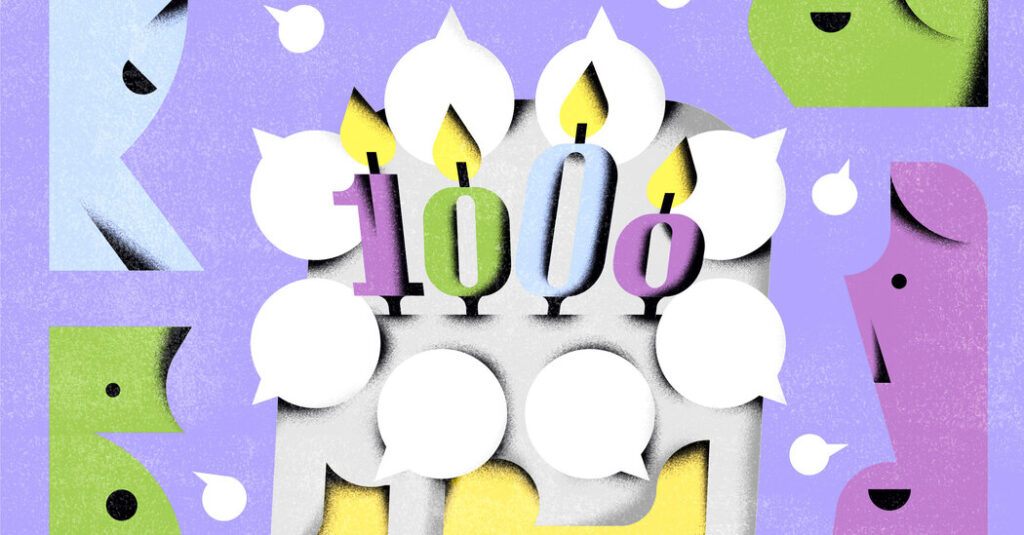
Now, 999 puzzles later, Connections, the New York Times game that requires solvers to group words into four categories, has grown in ways I couldn’t have predicted. (One way: It has gotten harder!) The biggest and most delightful surprises have come from watching the playful, passionate conversation the game sparks.
A question I often hear as the puzzle’s writer is, simply: “What were you thinking?”
It’s a question I find myself asking the solver, too.
I joined The Times in 2020 as a Crossword editor and, in 2022, started writing Connections, a new puzzle that the Times Games team had created. When I first started making the puzzle, Connections boards were primarily built around words that belonged in multiple categories. Over time, I learned different ways to create challenges — including wordplay (anagrams, homophones, hidden words), adding trivia and embedding misleading categories that aren’t part of the puzzle’s solution.
I expected that my process would evolve, but didn’t quite anticipate the role of solvers in that change. We’ve built on each other’s expectations. When KAYAK, LEVEL, CIVIC and MADAM appeared on a board in December, solvers might reasonably have expected them to form a palindromes category. But this time the palindromes belonged to four separate ones — it was, as the solver community calls it, a rainbow herring.
These days, the biggest challenge, and the most rewarding, is trying to present something unexpected. Maybe it’s a couple of words that seem like they belong together, but don’t. DEAN and FACULTY can evoke an academic institution, but they might belong in categories of classic Hollywood actors or synonyms for aptitude. Or maybe there’s a message spelled out on the board, like “K POP DEMON HUNTER,” “HEATED RIVALRY” or “FINAL DESTINATION.” (I was obsessed with “Final Destination: Bloodlines” last year.)
As the categories have gotten, well, weirder, I’ve tried to create balance by not mixing tricky wordplay with hard trivia, so that there’s a path to a solution. If there’s a particularly hard-to-spot category, I might try to include a hint on the board. While cards are usually arranged to mislead the solver, sometimes the arrangement can be used to help, too. The category of “Anagrams of Famous Painters” was tough, for example, so the top row of that board read “EGADS SCRAMBLE ARTIST NAME” (EGADS is an anagram of “Degas”).
One tip: If you don’t know what a word means, maybe you don’t have to. Check if there is another word hidden at its beginning or end, or say it out loud and see if it’s a homophone. Because the puzzle’s format is such that if the solver identifies three categories, the fourth is given to them, I’ve come to see the fourth category as a stand-alone brainteaser. It can be an extra challenge, like a bonus round in a game show, but knowing why four words work as a category is not necessary to winning the game.
I’ve loved seeing the meta-gaming that’s emerged as solvers make Connections their own. Terminology has emerged: There’s the aforementioned “rainbow herring,” when four words that could be grouped together each belong in different categories; “wobniar,” or “rainbow” backward, when you solve in order from trickiest to most straightforward, or Purple, Blue, Green then Yellow; and “grellow,” the ambiguity between the Green and Yellow categories, for those trying to get a wobniar.
I’ve also learned that some people hate when a word on the board is repeated in a category name. So I was honored when a friend showed me a post in the subreddit r/NYTConnections, with the heading “In celebration of the single worst purple connections category ever …” A solver shared an image of what appeared to be a tattoo: a clam encircled by the words “Things That Open Like a Clam.” (COMPACT, LAPTOP, WAFFLE IRON and … CLAM.)
I’m inspired by the solver’s responses to Connections, even when they’re mad. The game has been shaped by this dialogue. In January 2024, my colleague Robert Vinluan posted a meme in Slack that highlighted the top row of the day’s puzzle “SPONGE SALT SMOKE SHAFT” with the caption “WHOOOOO LIVES IN A PINEAPPLE UNDER THE SEA,” the first line in the “SpongeBob SquarePants” theme song.
Unable to resist, I got to work making a board whose top row read “SPONGE BOB SQUARE PANTS.” I was thrilled to learn that solvers, knowing that the top four words were unlikely to be a group, still selected them as their first guess.
I love that some of the joy I experience making a board can be felt by a solver as well. “Saturday Night Live” once parodied the Purple categories, describing them as “units of measurement plus the letter Q, or types of beans minus the concept of love,” which inspired a board with a top row that began: “BEANS MINUS LOVE.”
I’ve learned so much from the people who play this game, and I’m grateful for the chance to keep building and growing it with you.
The post I Make Connections. Here’s What I’m Actually Thinking. appeared first on New York Times.