Alistair Smith initially invested in BrewDog, a Scottish brewery and pub chain, because he liked its vibe.
Created in 2007, the company branded itself as an anti-establishment disrupter — committed to paying a livable wage and becoming carbon-neutral — while selling beers with names like Wingman and Elvis Juice.
“It felt interesting and positive,” said Mr. Smith, a 53-year-old consultant from Perth, Scotland. He was one of more than 220,000 small investors who poured around 95 million pounds (roughly $125 million) into the company through its “Equity for Punks” program.
The investment also felt smart. Around 2019, when Mr. Smith put in roughly £700 (or $930), BrewDog beers were on sale in supermarket chains and bars, and it was opening its own pubs in Britain and around the world. “It looked like a business that was going places,” he said.
This week, after years of missteps and a slew of controversies, BrewDog was sold for £33 million ($44 million) to Tilray Brands, a cannabis and packaged goods conglomerate based in the United States that has a history of buying formerly high-flying craft beer brands. It was a striking fall for a company that less than a decade ago was valued at around $1 billion.
The fallout from the deal, announced on Monday, is substantial. The company is set to close nearly 40 bars, eliminate roughly 500 jobs and leave the small investors it called its “equity punks” empty-handed.
AlixPartners, the restructuring firm managing the sale, said in a statement that the equity punks would not receive any of the proceeds. (Tilray confirmed the number of equity punks and the sums invested.)
BrewDog’s downfall, and its heavy reliance on a legion of amateur investors, has brought renewed focus on the risks and lack of protections around equity crowdfunding, particularly in Britain.
Unlike donation- or reward-based crowdfunding, which is popular on Kickstarter and GoFundMe, equity crowdfunding allows investors to purchase a stake in a company with the hope that it will go public or be sold for a large amount, allowing them to profit.
BrewDog pitched its “Equity for Punks” program as a “unique way for beer enthusiasts to become stakeholders.” It marketed the shares as an opportunity to “own a slice of the brewery and share in its success and growth.” The investors were also given discounts on beer and invited to special events.
The shares, however, were hard to dispose of. Investors could sell them back to the company, but only on specific “trading days” hosted by BrewDog, the last of which was in 2022. The punks also got low priority, their claims on BrewDog ranking below those of preferred investors and other creditors.
Hadar Gafni, an assistant professor in the business school at King’s College London who researches crowdfunding, said the BrewDog setup was unusual for a few reasons. Shares were sold on the company’s website, and the pitch focused less on financial metrics and more on joining a group of fans.
“They really pushed the nonfinancial, community side,” Professor Gafni said. “It blurred the line between investing and fandom.”
Andrew Morgan, a 55-year-old lawyer from Oxfordshire, invested a few hundred pounds in 2020. He said many investors felt misled.
“It would have been a more honest transaction if they had said, ‘We’re using a crowdfunding type model because we want to raise this much revenue,’” he said. “It felt a bit more like a proper financial decision because they branded it ‘Equity for Punks’ and they called them shares.”
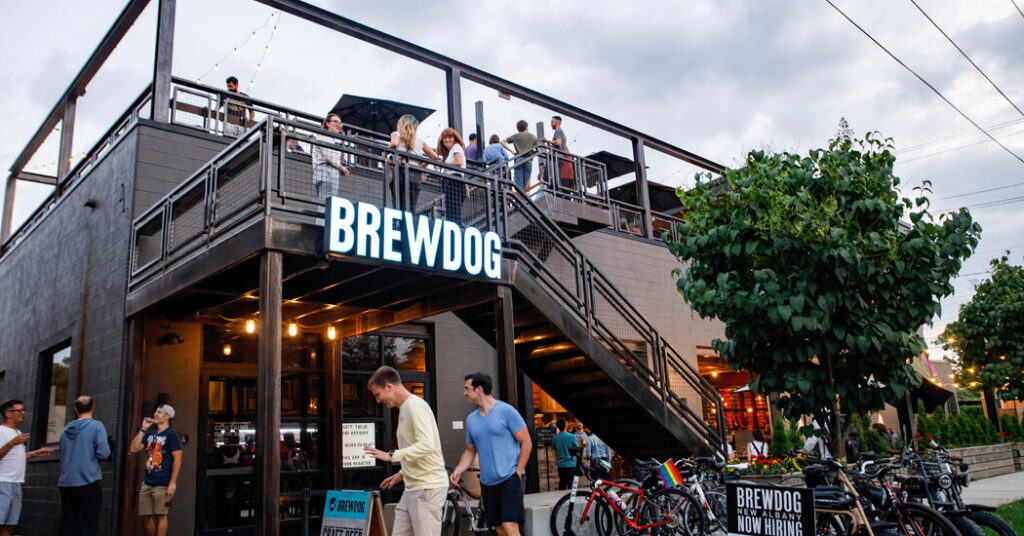
BrewDog was founded by James Watt and Martin Dickie, childhood friends who were early to the craft beer craze in Britain. Their company rapidly expanded thanks in part to several rounds of equity crowdfunding between 2009 and 2021, growing from a single brewery in Fraserburgh, in northeast Scotland, to four breweries, hotels and more than 100 pubs in 2023, including locations in the United States, Australia, Germany and other countries.
While BrewDog’s early marketing emphasized its rebellious nature and featured headline-grabbing stunts like driving a tank through London, it later partnered with international brewing conglomerates, becoming one of the first British craft brewers to go global while focusing on hoppy, bitter beers like India pale ales.
But in recent years, the company failed to turn a profit. It also experienced a number of self-imposed controversies, many of which struck at the core of its do-gooder and rebellious image.
In 2021, dozens of former employees signed a letter accusing the company and Mr. Watt of creating a “culture of fear” in which employees were “treated like objects.” In 2022, Mr. Watt was accused of inappropriate behavior toward women and abuse of power by former employees, accusations he has denied. The same year, BrewDog lost its B Corp designation, which certifies a company’s commitments to treat the environment, the community and its employees ethically.
The company backtracked in 2024 on its promise to provide a living wage for employees. In 2025, it sold land in Scotland where it had planned to plant a forest — once central to a commitment to be carbon negative — after 250,000 trees died there.
Mr. Watt left his role as chief executive in 2024, and Mr. Dickie left the company around a year later. BrewDog did not respond to a request for comment, but in a statement posted online this week, its leaders thanked their employees, acknowledged the punks’ contributions and said that Tilray’s purchase of the company would help strengthen and expand the business.
“The gloss has been coming off it for an awfully long time,” said Mr. Smith, the small investor.
He said he didn’t see the money he put into the company as a substantive investment and was satisfied with the beer discounts and the chance to support a company he initially believed in. Other equity punks, however, have lost much more and some saw their shares as critical to their savings.
Irwin D. Simon, Tilray’s chief executive, said his primary goal after acquiring BrewDog was “stabilization” and returning the operations to profitable growth.
As for the equity punks, he said he would continue to honor their discounts and other benefits. “They are important ambassadors of the company going forward,” he said.
Robyn Klingler-Vidra, an associate professor at King’s College London who researches start-up capitalism, deemed this a cautionary tale in the high-risk, high-reward area of equity crowdfunding.
The punks were sold ordinary shares in the company, as opposed to the preferred stock which professional investors often purchase. Preferred stocks give the holders more power, including the right to veto a sale if they believe the price is too low.
“So the challenge for the equity punks around BrewDog is that they don’t have that power,” she said. “And therefore no ability to shape the outcome and whether or not you’re going to see a return on your investment.”
Professor Klingler-Vidra said she believed the fallout would lead to fresh calls for regulations around equity crowdfunding, perhaps reducing an existing limit on how much amateur investors can buy.
For Mr. Smith, the investor, the punks’ situation calls into question whether established private businesses should be allowed to raise money from their customers through crowdfunding, because “you don’t have the protections that you would have if you were an investor in just a market-listed company.”
Despite his disappointment, he said he still occasionally goes to his local BrewDog for discounted pints, to take advantage of what’s left of his investment.
“I’m still quite attracted by the savings that I get, and the fact the staff are great,” he said. “But it’s a long time since I would have worn the T-shirt.”
Jonathan Wolfe is a Times reporter based in London, covering breaking news.
The post An Upstart Brewery Sold a Novel Investment to ‘Punks.’ Now They Won’t Get Anything. appeared first on New York Times.