As political pressure mounted in 2002 to support President George W. Bush’s push to attack Iraq, congressional Democrats were badly divided.
Some were highly skeptical of the administration’s case for war, while others insisted that the nation needed to present a united front in the aftermath of the devastating terror attacks a year earlier. They worried about the political risk of being seen as weak on military matters.
“There was a vigorous debate that split our caucus right down the middle,” recalled Tom Daschle, a former Democratic senator from South Dakota who was the majority leader at the time and cosponsored the resolution granting the Republican president the authorization he had sought for the attack. It was ultimately approved with significant Democratic support in both the House and Senate.
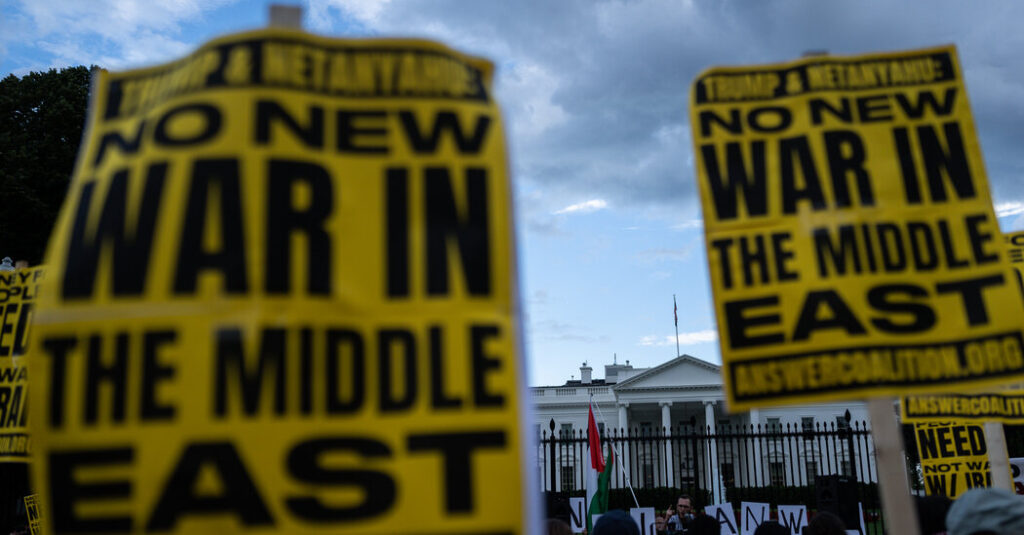
Few such divisions exist today among Democrats deeply opposed to President Trump’s decision to attack Iran without the same congressional approval for Middle East military action won by Mr. Bush and, a little over decade earlier, by his father, President George H.W. Bush, for Operation Desert Storm.
All but one Senate Democrat voted on Wednesday to try to rein in Mr. Trump’s ability to wage war against Iran without congressional approval. Just four House Democrats broke with their party the next day to join nearly every Republican in successfully fending off the Democratic efforts.
It was a stark change from the legislative clashes of decades ago, when many Democrats feared being labeled timid on national security or insufficiently supportive of American troops.
Now, Democrats say they are willing to defy the president based on their experience with misguided military operations and the unpredictable consequences of war overseas and at home.
“Lesson learned,” said Senator Richard J. Durbin, Democrat of Illinois, one of 21 Democratic senators who voted against the 2002 authorization, while 29 of his Democratic colleagues voted for it after a month of intense debate in Washington and across the globe. In the House, 126 Democrats opposed that resolution, while 81 voted for it.
Democrats say the Iran decision was far less complex and fraught than the one in 2002, when the nation was still reeling from the Sept. 11 attacks and the White House was painting a dire picture of the possibility of even more destructive terrorism.
Democrats are looking at polling that shows the attacks on Iran lack public support, while the administration offers varying and sometimes conflicting reasons for having initiated them, building what Democrats see as insufficient justification only after the fact. And they believe the ripple effects, such as rising gas prices, will be quickly felt by voters who already think the White House is not focused enough on their economic struggles.
“With so many challenges facing our country right now, Americans aren’t interested in foreign adventurism,” said Senator Chuck Schumer, Democrat of New York and the minority leader, who voted for the 2002 resolution approving the use of force in Iraq. “Americans are scratching their heads wondering what in the world Donald Trump is thinking.”
Democrats remember the tension coursing through Washington in the fall of 2002 as the Bush administration pressed its Iraq effort with an address by the president at the United Nations that September and a full-court press on Congress that October, with crucial midterms looming.
“We were still in thrall after the attack on 9/11,” said Senator Jack Reed, Democrat of Rhode Island and a former Army officer who ultimately voted against Mr. Bush’s request. “We had conducted a lightning attack in Afghanistan and thought Iraq would be easy. Another factor was there was an election within weeks, and people were in difficult positions.”
Just after midnight on Oct. 11, 2002, the Senate voted by an overwhelming 77 to 23 to grant Mr. Bush the power to take action, after the House had voted 296 to 133 to do the same. Operation Iraqi Freedom was initiated the following March.
Many Democrats came to regret their votes when the weapons of mass destruction the Bush administration had warned about were never found, and U.S. troops were not welcomed as the liberators, as officials had promised.
Those involved in the current debate say that the Bush administration had at least engaged Congress and sought the approval that many lawmakers believe the Constitution requires, while the Trump administration did not bother and instead initiated the assault on Iran with little regard for the views of lawmakers.
“I have to say that for all the other limitations of President Bush’s leadership at the beginning and throughout the Iraq War, he respected the Constitution,” Senator Chris Coons, Democrat of Delaware, said. “He made the case to the American people and the world, and we had a vote.”
More votes are ahead for Democrats, and it could become more politically difficult if the administration requests tens of billions of dollars to pay for what is quickly becoming a very costly conflict.
The White House is all but certain to frame the need for the money as support for the troops, and would likely portray Democrats opposing it as weak and unpatriotic. But Democrats are already raising questions about a sizable infusion of unspent Pentagon funds included in last year’s tax cut law, which was paid for by deep cuts in Medicaid and other safety net programs.
Democrats say they are also determined to keep attention focused on the domestic affordability issues that they see as a political advantage, including housing, health care, food and energy costs, a potential flashpoint if gasoline prices continue increasing as a result of the conflict. They are holding events to hammer on those subjects, while accusing Mr. Trump of straying far from his “America First” commitment by engaging in multiple foreign exploits.
History has shown that there is no predicting how such monumental votes can play out over the years. After the success of Operation Desert Storm in 1991, some Democrats rued their vote against authorizing the conflict. That position influenced the outcome of the 2002 showdown, prompting some of them to pivot and support the war.
But when the justification for the war unraveled and the region was thrown into chaos, support for the war in 2002 became a political anchor and sunk the ambitions of many who voted that way, including Hillary Clinton.
On the other hand, Barack Obama, who was not in Congress at the time, could point to his opposition to the war resolution as an Illinois legislator, a stance that helped boost him to the presidency.
Mrs. Clinton is not the only one who wished she could have had that vote back.
“It is one of the votes that I most regret,” Mr. Daschle said.
Carl Hulse is the chief Washington correspondent for The Times, primarily writing about Congress and national political races and issues. He has nearly four decades of experience reporting in the nation’s capital.
The post Democrats, Divided on Past Middle East Wars, Unite Against This One appeared first on New York Times.