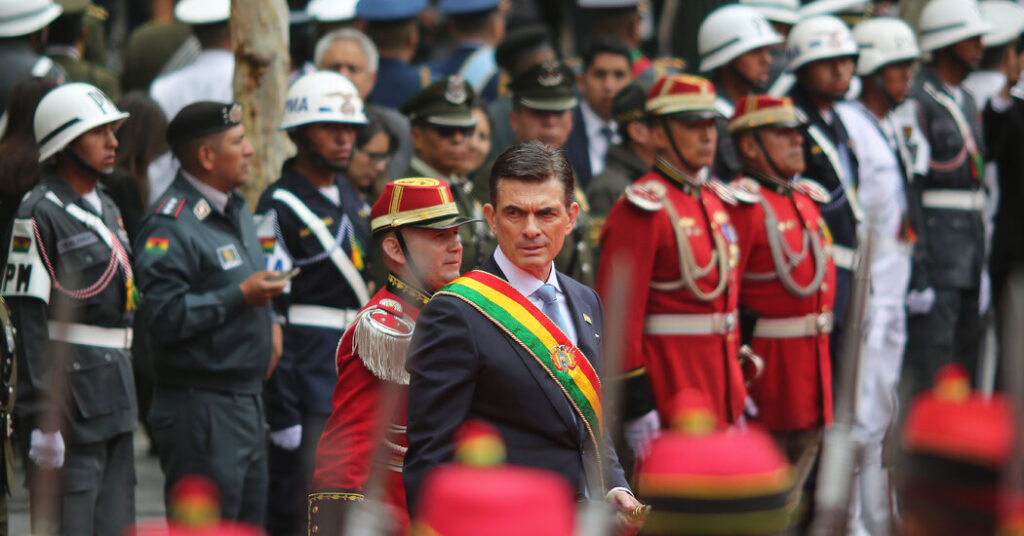
For two decades, Bolivia defined itself in opposition to Washington.
Evo Morales, the leftist president from 2006 to 2019 often called the United States “the empire’’ and expelled American officials, including the ambassador, while deepening ties with Venezuela, Iran and Russia.
But now, Bolivia, a mineral-rich landlocked South American nation has made a political about-face after the country’s president, Rodrigo Paz, a right-leaning centrist, took office in November.
Mr. Paz’s administration eliminated visa requirements for U.S. citizens, announced that a U.S. ambassador would return to Bolivia and secured multibillion-dollar loans, including from the Washington-based Inter-American Development Bank, with the aim of boosting the economy and creating jobs.
On Saturday, Mr. Paz will meet with President Trump at a gathering of right-wing Latin American leaders in Miami the White House called the “Shield of the Americas’’ summit. The gathering of about a dozen presidents includes Argentina’s Javier Milei and El Salvador’s Nayib Bukele.
Mr. Paz will likely highlight Bolivia’s pivot toward Washington, which includes inviting the Drug Enforcement Administration to officially return to conduct anti-trafficking operations and encouraging U.S. tech giants like Amazon, Tesla and Oracle to invest in the country.
Topics for discussion in Miami between the Latin American leaders convening for the gathering and Mr. Trump are expected to include drug trafficking, trade and China’s influence in Latin America.
In an interview with The New York Times Friday at Trump National Doral golf club near Miami, Mr. Paz said he was attending the event and renewing relations with the United States because it was time for Bolivia to open up to the world — and for the world to open to Bolivia.
“I come with a clear idea that Bolivia must have a continental role,’’ he said.
Mr. Paz came to power after infighting within Mr. Morales’s party, Movement Toward Socialism (MAS), divided the left, opening the way for Mr. Paz’s runoff victory over a conservative rival. But while he has avoided full-throated public support of Mr. Trump, Mr. Paz has developed bonds with right-wing leaders like Mr. Milei and Ecuador’s president, Daniel Noboa, both of whom attended his November inauguration.
It’s a tectonic shift in Bolivia, where Mr. Morales expelled the U.S. ambassador and the D.E.A. in 2008, and U.S.A.I.D. in 2013, often saying “We’re better off without the U.S.” In a region marked by decades of intervention by Washington, Mr. Morales accused the D.E.A. of “political espionage” and financing “criminal groups.”
In the late 1990s and early 2000s, anti-narcotics operations conducted by Bolivian forces — backed by U.S. money and training — destroyed coca crops and killed growers, fueling Bolivian discontent.
Coca is the raw material for cocaine, but in Bolivia growing, selling and consuming the plant is legal and it has been chewed and brewed as a mild stimulant for centuries. Mr. Morales himself was an Indigenous coca grower.
“Eradication teams would turn up in a truck with an American flag on the side,” said Thomas Grisaffi, a professor at the University of St. Gallen who studies coca cultivation in Bolivia. “People knew precisely who their enemy was.”
Now, Ernesto Justiniano, Bolivia’s top drug enforcement official, said in an interview that D.E.A. agents were already operating in the country and that he had joined them on reconnaissance flights. Bolivia, along with Colombia and Peru, is a major producer of coca, some of which is made into cocaine.
Closer ties between Bolivia and Washington have historically come with political interference, said Carmen Soliz, a Bolivian associate professor of history at the University of North Carolina. In the 1990s, she said, the “U.S. Embassy was so embedded in Bolivian politics” that every cabinet appointment “needed to be consulted with the U.S. Embassy.”
The U.S. Embassy in La Paz declined to comment. After Mr. Paz’s election victory, Secretary of State Marco Rubio said the vote marked a “transformative opportunity” for Bolivia and the United States.
To those who study Bolivia’s history, its politics today seem like a return to the past. Countries with “space for U.S. investment that offer the least possible resistance” have historically been attractive partners, Ms. Soliz said. “There is an imbalance in this partnership.”
Jaime Paz Zamora, Mr. Paz’s father, who was president from 1989 to 1993, said he hopes his son can revive the close relationship Bolivia once had with President George H.W. Bush.
In Miami, Mr. Paz plans to negotiate U.S. technology investments and is seeking to make the central-western region of Cochabamba into a data center hub.
Bolivia also wants to attract foreign investments in its rare earth minerals and lithium industries, Fernando Aramayo, the country’s foreign minister, said in an interview.
Mr. Morales “isolated the country,” said Mr. Aramayo, who will join Mr. Paz in Miami. “We are seeking to recover a trajectory that was stolen from us over the last 20 years.”
Key to the Paz administration’s renewed engagement with Washington is the restoration of cooperation with the D.E.A. The alliance includes training, technical assistance and intelligence sharing, said Mr. Justiniano. Though the decision to re-establish D.E.A. offices in Bolivia rests with Washington, a physical presence would be “fantastic” to facilitate the restored relationship, he said.
Mr. Paz’s election victory was a surprise to observers and highlighted Bolivians’ discontent with the ruling party, but also their unwillingness to support a more conservative candidate.
Mr. Paz, in an echo of Mr. Trump, has largely governed by executive order. In December, he eliminated longstanding fuel subsidies as part of a package of moves that included austerity measures and the privatization of natural resources, triggering nationwide protests.
After weeks of negotiation with labor unions and other groups, the government retreated, preserving the fuel subsidy cut but scrapping or revising most of the other provisions.
Reactions in Bolivia to warming ties with Washington have varied.
Coca growers in the central part of the country fear the return of the D.E.A., recalling eradication campaigns that often involved brutal crackdowns. “They’re worried about facing poverty, they’re worried about facing repression,” said Mr. Grisaffi.
Others — particularly in Bolivia’s business sector — see opportunity. Jorge Amantegui, the president of an association of soybean and sunflower producers, said closer ties with Washington could lower Bolivian tariffs on imported American machinery and open access to previously banned genetically modified seeds to boost yields. “For us, having a good relationship with the United States is fundamental,” he said. “We hope it can be achieved in the short term.”
Experts say the technology and mining investments promised by the government will take time. Mineral reserves must be certified, workers trained and environmental impact studies carried out before investments bear fruit, said Alfredo Zaconeta, a mining expert at a Bolivian research institute.
As it courts Mr. Trump, Mr. Paz’s administration is walking a fine line, trying to secure international financing while avoiding open conflict with swing voters who helped elect him to the presidency.
The government has also cautiously responded to global conflicts involving Washington. After U.S. forces captured Venezuelan President Nicolás Maduro in January, Bolivia called for a democratic transition, but did not comment on the U.S. invasion. Following U.S. and Israeli strikes on Iran, the foreign ministry called the situation “highly sensitive,” but avoided taking sides.
As Bolivia edges closer to Washington, Mr. Paz Zamora hopes the Miami meeting will represent a key turning point.
“We’ve worked together before,” he said. “That’s an important precedent.”
Frances Robles contributed reporting from Florida.
Max Bearak is a reporter for The Times based in Bogotá, Colombia.
The post At Trump’s Summit, a Former Foe Makes a Political U-turn appeared first on New York Times.