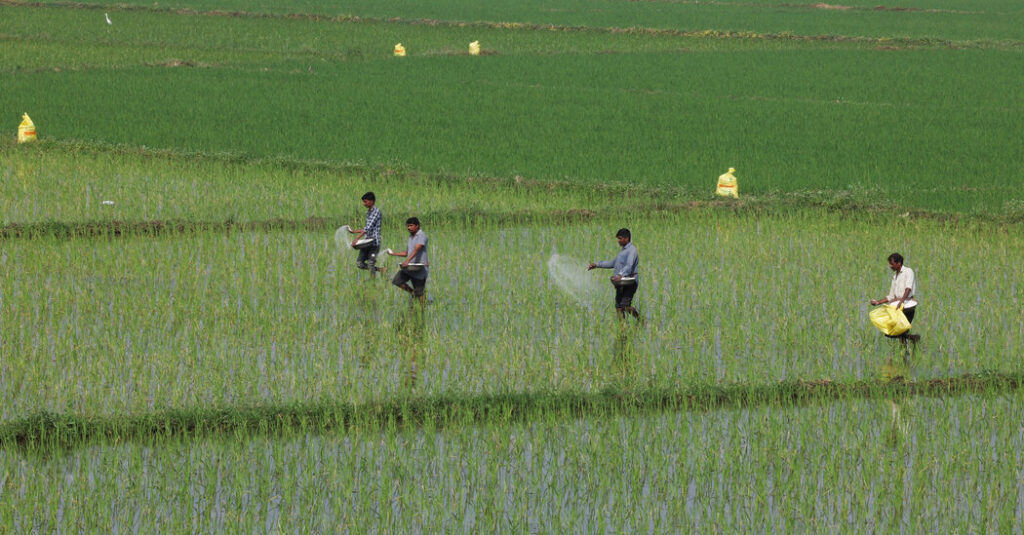
The longer the conflict in the Middle East continues, the greater the likelihood that people around the globe will pay more for food. And those in the most vulnerable countries could face hunger.
The Persian Gulf is a dominant source of fertilizer. Though the region is best known as a prodigious source of oil and natural gas, its abundance of energy has spurred the development of factories that make the raw materials for many types of fertilizer, especially those that deliver nitrogen.
Nitrogen fertilizers are essentially natural gas reconfigured as plant nutrients. They nourish crops that yield roughly half the world’s food supply.
For now, most factories in the Gulf that make nitrogen fertilizers are continuing to produce them. But delivering their wares to farmers is suddenly impossible, given the effective shutdown of the Strait of Hormuz, the narrow channel linking the Gulf to the Indian Ocean.
The cessation of marine traffic on the strait is the primary reason that oil and gas prices have surged. If the waterway remains off limits, prices for key fertilizers, and the chemicals used to make them, will go up. That could prompt farmers to limit their application, reducing the world’s food supply while making sustenance less affordable.
“It’s bad — there’s no other way of putting it,” said Chris Lawson, vice president of market intelligence and prices at CRU Group, a London-based research and data firm focused on commodities. “The world is highly reliant on fertilizer and associated raw materials supplied out of that region.”
War has a way of exposing vulnerabilities that arise from interconnection. Four years ago, when Russia invaded Ukraine, the world gained a wrenching lesson in the geography of agriculture. Both countries were substantial sources of wheat and other grains. Shortages of bread soon emerged from West Africa to South Asia.
Russia and Ukraine also produce significant quantities of fertilizer. The enduring conflict made those products scarce, driving up prices and prompting farmers to conserve their use of fertilizer. The result was depleted harvests.
The latest upheaval in the Middle East does not affect the harvesting of grain, but its impacts for fertilizer may be even more profound.
“The volumes are greater this time around, potentially, than in the Russia-Ukraine conflict,” said Sarah Marlow, global editor for fertilizers at Argus Media, a news and data service focused on commodities. “You’ve got multiple producing countries.”
Fertilizers can be divided into three basic types that deliver particular nutrients to soils: nitrogen, phosphorus and potassium. Five primary fertilizer exporters — Iran, Saudi Arabia, Qatar, the United Arab Emirates and Bahrain — rely heavily on the Strait of Hormuz to export their wares.
Collectively, these countries supply more than one-third of the world’s trade in urea, the dominant form of nitrogen fertilizer, as well as nearly one-fourth of another type, ammonia, according to data compiled by the International Fertilizer Association, a trade group based in London. The same five countries produce nearly one-fifth of phosphate fertilizers.
One major source of urea, QatarEnergy, halted production this past week when it lost access to natural gas after strikes from Iranian drones and missiles. Other factories are continuing to make urea, stockpiling it near ports and waiting for shipping to restart.
“No one knows how long this could go on and still have enough storage,” said Laura Cross, director of market intelligence at the International Fertilizer Association.
Some view the evolving crisis confronting agriculture as a warning sign about excessive reliance on a handful of fertilizer producers to satisfy humanity’s need for calories.
The pandemic exposed the risks of depending on a single country, China, for basic ingredients for medicines. The upheaval in the Middle East has underscored the dangers of relying on the Gulf for oil and gas, prompting talk that countries must move faster to deploy renewable sources of energy like wind and solar. And the disruption of the fertilizer industry is a reminder that the same volatile region is a vital part of the world’s food supply.
“The long-term solution is not to be dependent on fertilizer that has to be trafficked through Strait of Hormuz,” said Raj Patel, a political economist and expert in sustainable food at the University of Texas at Austin. “We have become rather hooked on these imports.”
One potential solution, he added, is found in India and Brazil, where governments have encouraged farmers to slash their application of imported fertilizers by diversifying their crops and adding locally available nutrients to soils.
“More sustainable production is the long-term switch we need,” Mr. Patel said.
Many experts agree, but Mr. Patel’s favored solution does not solve the immediate problem of how to produce this year’s harvest.
The timing of the crisis is especially troubling for farmers in the Northern Hemisphere, now faced with the need to apply fertilizer for crops they will plant in the spring.
The situation is acute for American agriculture. President Trump’s tariffs had already raised the costs of imported fertilizer, forcing many farmers to hold off stocking up. The White House exempted fertilizers from its latest tariffs last month. But millions of tons of urea cannot quickly be summoned from points around the globe.
India is uniquely vulnerable, given that it traditionally buys some 40 percent of its urea and phosphate-based fertilizers from suppliers in the Middle East.
As the world seeks other sources, the most obvious alternative is China. But the Chinese government, seeking to cushion its own farmers from the very sort of geopolitical turmoil now at play, last year imposed restrictions on the export of fertilizers.
Already, traders are reacting to the threat of a shock to the supply of fertilizers. Over the past week, urea sold in Egypt — a widely watched market — has climbed from about $485 per ton to $665 per ton, or roughly 37 percent, according to Argus.
That is far from the $1,000-plus fertilizer prices seen after the Russian invasion of Ukraine. But the longer that Gulf suppliers remain disrupted, the greater the risk of similar increases.
A sustained rise in the cost of fertilizer could force governments in South Asia and sub-Saharan Africa to subsidize the cost of growing crops or otherwise watch food prices climb. That could add to debt burdens afflicting many lower-income countries.
Adding to the strain is the fact that fertilizers are generally traded in the American dollar. The U.S. currency has benefited from its status as a safe haven since the war began, gaining value against others. But that makes imported fertilizer and components more expensive in local currencies.
Farmers in much of Africa suffered the most from increased fertilizer prices in 2023, according to a paper published last year.
Globally, higher fertilizer prices could reduce yields, limit the supply and raise the price of food.
“The price of food will go up,” said Jan Willem Erisman, a chemical engineer and fertilizer expert at Leiden University in the Netherlands.
Higher food prices generally prompt increases in malnutrition in poor countries, researchers have found.
Another focus of concern is sulfur, a yellow, powdery substance that is a byproduct of refining oil and gas. Sulfur is shipped in bulk freighters to ports around the world and then used to make both phosphate fertilizers and metals.
Nearly half of the world’s sulfur is now on the wrong side of the Strait of Hormuz, effectively stuck in place, according to the CRU Group.
Roughly a quarter of that sulfur is destined for China, where it is used to make phosphate fertilizer. A similar share is sent to Indonesia, both as an ingredient for fertilizer and as an element used to produce nickel. African agriculture is also heavily dependent on sulfur from the Gulf.
Sulfur stocks were already lean in much of the world before the war. Given already-high prices, buyers had been reluctant to build up inventories.
Now, prices are rising further.
If sulfur becomes scarce, that will be felt most acutely in Morocco, where factories use it to make phosphate fertilizer.
“Sulfur is essentially the commodity that is most exposed,” said Mr. Lawson at the CRU Group. “It’s fairly astonishing, the exposure that all these different markets have to sulfur as a raw material.”
Peter S. Goodman is a reporter who covers the global economy. He writes about the intersection of economics and geopolitics, with particular emphasis on the consequences for people and their lives and livelihoods.
The post How War in the Middle East Could Sow Hunger appeared first on New York Times.