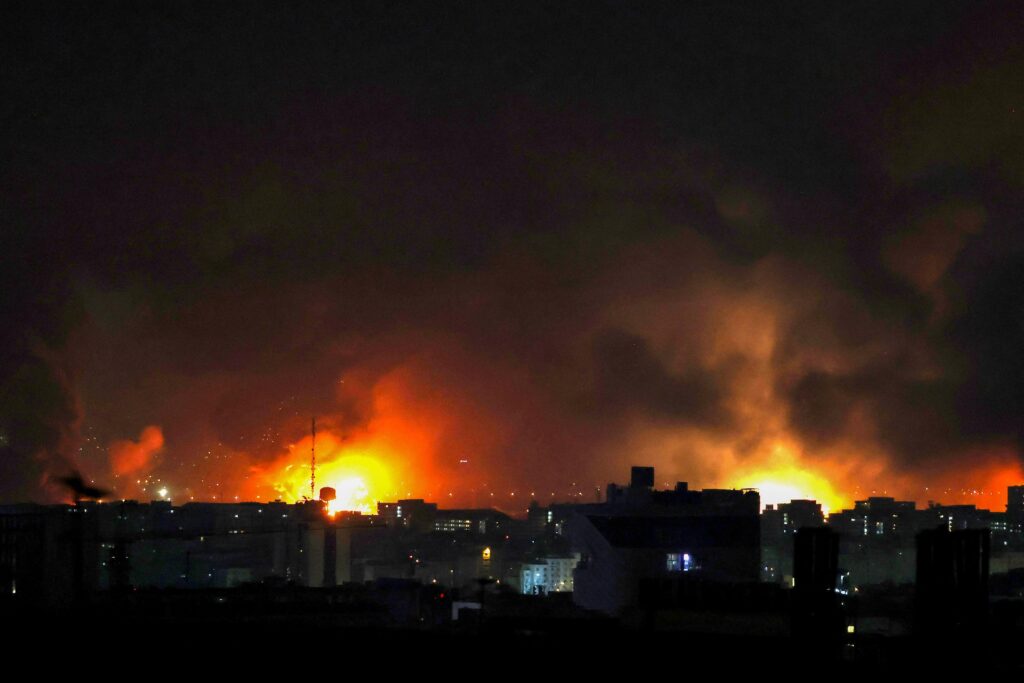
In striking Iran, the United States isn’t responding to an attack, as when the Japanese raid on Pearl Harbor drew the country into World War II. It’s not coming to the aid of an ally, as when it led a coalition to drive Iraqi forces out of Kuwait in the Gulf War. The Trump administration hasn’t presented a formal case for war, as the George W. Bush administration did before the 2003 invasion of Iraq.
Instead, President Donald Trump and top administration officials have offered a range of rationales for launching Operation Epic Fury, the joint U.S.-Israeli attack on the Islamic Republic.
Those rationales have included “imminent threats” to the United States; preventing Iran from acquiring nuclear weapons and/or missiles capable of reaching the United States; freeing the Iranian people; regime change; potential Iranian retaliation for an Israeli attack; alleged Iranian attempts to interfere with U.S. elections; alleged Iranian attempts to assassinate Trump; and regional and global peace.
The administration has not provided evidence that Iran posed in imminent threat to the United States, was close to acquiring nuclear weapons or attempted to interfere with U.S. elections. In his State of the Union address last week, three days before the attack on Iran, Trump said the June 2025 U.S.-Israeli strike on nuclear facilities in Iran had “obliterated Iran’s nuclear weapons program.” The Justice Department has brought charges against three men in two cases of alleged Iranian murder-for-hire schemes targeting Trump.
Here are rationales the administration has given for Epic Fury.
Nuclear weapons
“If we didn’t do that, they would have had a nuclear weapon within two weeks. And then all of this would not have been possible.” — Trump, Fox News interview, March 1
“I think the president was looking for the long haul. He was looking for Iran to make a significant long-term commitment that they would never build a nuclear weapon, that they would not pursue the ability to be on the brink of a nuclear weapon.” — Vice President JD Vance, Fox News interview, March 2
Ballistic missiles
Iran has continued to develop “long-range missiles that can now threaten our very good friends and allies in Europe, our troops stationed overseas, and could soon reach the American homeland.” — Trump, video statement, Feb. 28
“The United States is conducting an operation to eliminate the threat of Iran’s short-range ballistic missiles and the threat posed by their navy, particularly to naval assets.” — Secretary of State Marco Rubio, remarks to reporters, March 2
“This operation is a clear, devastating, decisive mission: destroy the missile threat, destroy the navy, no nukes.” — Defense Secretary Pete Hegseth, remarks to reporters, March 2
‘Imminent threat’
“Our objective is to defend the American people by eliminating imminent threats from the Iranian regime. A vicious group of very hard, terrible people. Its menacing activities directly endanger the United States, our troops, our bases overseas, and our allies throughout the world.” — President Donald Trump, video statement, Feb. 28
“There absolutely was an imminent threat, and the imminent threat was that we knew that if Iran was attacked — and we believe they would be attacked — that they would immediately come after us.” — Rubio, remarks to reporters, March 2
Potential response to an Israeli attack
“We knew that there was going to be an Israeli action, we knew that that would precipitate an attack against American forces, and we knew that if we didn’t preemptively go after them before they launched those attacks, we would suffer higher casualties and perhaps even higher those killed, and then we would all be here answering questions about why we knew that and didn’t act.” — Rubio, remarks to reporters, March 2
“Obviously, we were aware of Israeli intentions and understood what that would mean for us, and we had to be prepared to act as a result of it. But this had to happen no matter what.” — Rubio, remarks to reporters, March 2
“I think [Iran was] going to attack first. And I didn’t want that to happen. So if anything, I might have forced Israel’s hand.” Trump, remarks to reporters, March 3
“Somebody asked me a question yesterday — did we go in because of Israel. … And I said no. I told you this had to happen anyway. The president made a decision, and the decision he made was that Iran was not going to be allowed to hide behind its ballistic missile program, that Iran was not going to be allowed behind its ability to conduct these attacks.” Rubio, remarks to reporters, March 3
Alleged assassination attempts
“I got him [slain Ayatollah Ali Khamenei, Iran’s supreme leader] before he got me. They tried twice. Well, I got him first.” — Trump, ABC News interview, March 2
“Iran tried to kill President Trump and President Trump got the last laugh.” — Hegseth, remarks to reporters, March 2
“We’ve known for a long time that Iran had intentions on trying to kill President Trump and or other U.S. officials. And while that was not the focus of the effort by any stretch of the imagination, — in fact, never raised by the president or anybody else — I ensured, and others ensured that those who were responsible for that were eventually part of the target list.” — Hegseth, remarks to reporters, March 2
Alleged election interference
“Iran tried to interfere in 2020, 2024 elections to stop Trump, and now faces renewed war with United States.” — Truth Social post, Feb. 28
Regime change
“When we are finished, take over your government. It will be yours to take.” — Trump, video statement, Feb. 28
“As the president has said, he would love for the people of Iran to use this as an opportunity to rise up and remove these leaders. They’ve been wanting to remove them for a long time. We’ve successive waves of protests, and we’ve seen them slaughter people.” Rubio, remarks to reporters, March 2
“This is not a so-called regime-change war, but the regime sure did change, and the world is better off for it.” — Hegseth, remarks to reporters, March 2
“What we did in Venezuela,” where U.S. forces captured President Nicolás Maduro and Trump said he would “run” the country through Vice President Delcy Rodríguez, “is the perfect, the perfect scenario.” — Trump, New York Times interview, March 1
“I have to be involved in [choosing a successor to ], like with Delcy.” — Trump, Axios interview, March 5
The Iranian people
“All I want is freedom for the people.” — Trump, Washington Post interview, Feb. 28
World peace
“We’re undertaking this massive operation not merely to ensure security for our own time and place, but for our children and their children, just as our ancestors have done for us many, many years ago.” — Trump, video statement, Feb. 28
“The heavy and pinpoint bombing, however, will continue, uninterrupted throughout the week or, as long as necessary to achieve our objective of PEACE THROUGHOUT THE MIDDLE EAST AND, INDEED, THE WORLD!” — Trump, Truth Social post, Feb. 28
The post Why is the U.S. at war with Iran? Here’s what the Trump administration says. appeared first on Washington Post.