Russia has a question for the European countries that have shunned its energy exports: Do you miss us now?
The Kremlin is enjoying a sudden resurgence of its importance as a global supplier of oil and gas, as the conflict in Iran disrupts energy production and shipment across the Middle East and sends global energy prices soaring.
President Vladimir V. Putin of Russia, in his only comments to a journalist since the start of the U.S.-Israeli onslaught against Iran, did not mention President Trump or what he had earlier called the “cynical murder” of the Iranian supreme leader, Ayatollah Ali Khamenei.
Instead, Mr. Putin spoke with bravado about European nations’ longstanding plans to phase out imports of Russian gas in response to Moscow’s invasion of Ukraine, threatening to accelerate the divorce himself as prices spike on the continent.
“Now other markets are opening up, and perhaps it’s more advantageous for us to stop supplying the European market right now,” Mr. Putin said on Wednesday to a state television reporter, Pavel Zarubin, who chronicles the Russian leader.
The surge in energy prices comes as a reprieve to Moscow, after a year in which Russian oil and gas revenues declined by nearly a quarter and strained the nation’s wartime economy.
“We are seeing an increase in demand, a substantive increase in demand for Russian energy providers in connection with the war in Iran,” the Kremlin spokesman, Dmitri S. Peskov, told journalists in a briefing on Friday.
European gas futures have risen by more than 60 percent since the Iran conflict began last weekend, and while prices remain well shy of levels that would induce a sense of crisis, the upheaval is spooking leaders. Iranian oil is subject to Western sanctions, but the disruption to production and transit in both Iran and the rest of the Gulf has driven up prices globally for all buyers.
Norway’s energy minister, Terje Aasland, said on Tuesday that the soaring gas prices would revive a debate about how much pain the European Union was willing to endure in its efforts to starve Moscow’s war machine.
Yet Europe has so far shown little sign of ending its campaign to wean itself off Russian energy.
Officials from across the 27-nation European Union have met repeatedly in recent days to discuss the situation in Iran and its potential impact on energy prices. So far, they have emphasized that the shock is temporary and that it comes at the end of winter, just as heating demands are lessening.
The cost to Europe is “going to depend on how long the disruption in the Middle East lasts,” said Eamon Drumm, a Paris-based research fellow at the German Marshall Fund who focuses on energy.
Europe’s efforts to phase out Russian energy since 2022 have sharply — though not fully — cut its reliance on Moscow. The European Union imported about 13 percent of its gas and 3 percent of its oil from Russia last year, down from 45 percent for gas and 27 percent for oil as of 2021.
European nations have turned to other providers, including the United States, which is now a bigger global oil and gas producer than Russia.
“The crisis in the Middle East in some quarters leads to questions about Russia — whether to go back to Russia or not,” Fatih Birol, the executive director of the International Energy Agency, said at a news conference in Brussels on Friday.
“One of Europe’s historical mistakes was the overreliance of its energy sources on one single country, which is Russia,” he added. Looking to Russia as an alternative option for gas, he said, would be “economically and, in my view, politically wrong.”
Still, analysts at the bank ING wrote that if Mr. Putin were to abruptly cut off gas flows, as he has warned, it “would be a challenge for Europe,” since other economies are also looking for alternative suppliers now. Russia would be less likely to cut off oil flows, the analysts wrote.
Hungary and Slovakia still heavily rely on Russia for oil imports, making them outliers in Europe. Those two nations, which have Russia-friendly governments, were already facing supply disruptions because of the closure of the Druzhba pipeline, which transports Russian oil across Ukraine and into both countries.
Ukraine has said that the pipeline was damaged by Russian strikes. Budapest has suggested that Kyiv is slow-walking repairs, and the conflict between the two governments has prompted Hungary to hold up a 90 billion euro E.U. aid package to Ukraine.
Now the Iran conflict threatens to exacerbate those energy challenges. Hungary’s foreign minister, Peter Szijjarto, met with Mr. Putin at the Kremlin on Wednesday to ask for what he called a guarantee that Russia would continue sending supplies.
In Asia, India has returned to buying Russian oil after receiving a 30-day waiver from the Trump administration, which for months had pressured Indian officials to cease buying crude from Moscow.
“Crawling back?” the Indian outlet of the Russian state news network RT quipped in a post on social media.
In his own post, Kirill Dmitriev, Mr. Putin’s special envoy for foreign investment and economic cooperation, wrote that the world now realized that Russia was a “must-have supplier of energy.”
He posted a video of a tsunami and said Europe would suffer a “complete energy collapse and bankruptcy” because of what he called “idiotic” and “Russophobic” decisions by European officials to cut off Russian energy supplies.
Earlier in the week, Mr. Dmitriev used rocket emojis in predicting that oil prices would soon exceed $100 a barrel. The price of U.S. domestic benchmark crude closed at $91 on Friday, up more than 35 percent from a week earlier, before the Iran attacks.
Before the attacks, energy prices had broadly been declining, with a glut of crude oil and weaker-than-expected demand. The soft market, combined with sanctions that forced a discount on Russian oil, was leading Moscow to borrow money, raise taxes and make spending cuts to continue funding its war against Ukraine.
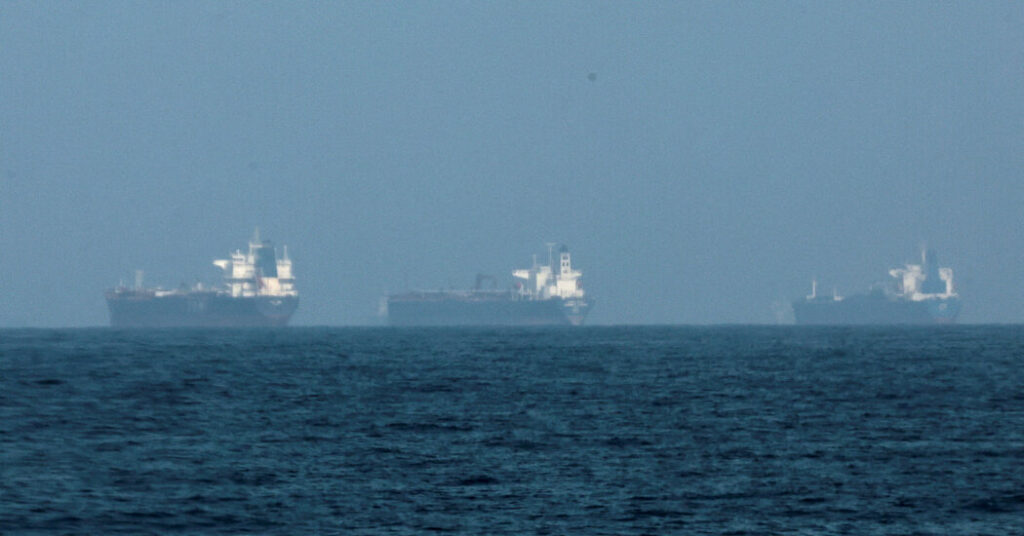
The hostilities in the Middle East have all but halted traffic in the Strait of Hormuz, through which about a fifth of the world’s crude exports travel, with much of the oil destined for Asia.
The situation has revived Russia’s prospects, including as a primary supplier for China, the world’s largest energy consumer. Mr. Trump’s “takeover” of the Venezuelan oil industry has also roiled a supplier to China in recent weeks.
“Iran plus Venezuela is about 17 percent of China’s oil imports,” said Alexander Gabuev, the director of the Carnegie Russia Eurasia Center in Berlin. “This has to come from somewhere, and that somewhere is Russia.”
Mr. Gabuev said the disruptions, depending on how long they last, could make China reconsider its reluctance to move forward on a stalled natural gas pipeline, known as the Power of Siberia 2, which would bring more Russian natural gas to China. Russia has been eager to move forward on the project for years, but China has slow-rolled it, assuming that natural gas flows from the Middle East and an existing pipeline would make the new transit route unnecessary.
“All of these assumptions may be revisited,” Mr. Gabuev said.
Mr. Trump, speaking on Tuesday during an appearance in the Oval Office with Chancellor Friedrich Merz of Germany, said oil prices may be higher “for a little while, but as soon as this ends, those prices are going to drop, I believe, lower than even before.” Mr. Trump has said the campaign against Iran could continue for four to five weeks, or possibly longer.
Mr. Merz, whose nation is heavily dependent on fossil fuel imports, noted that the rising energy prices were “damaging our economies.”
Paul Sonne is an international correspondent, focusing on Russia and the varied impacts of President Vladimir V. Putin’s domestic and foreign policies, with a focus on the war against Ukraine.
The post Russia Revels in a Sudden Reversal in Fortunes as Oil and Gas Prices Soar appeared first on New York Times.