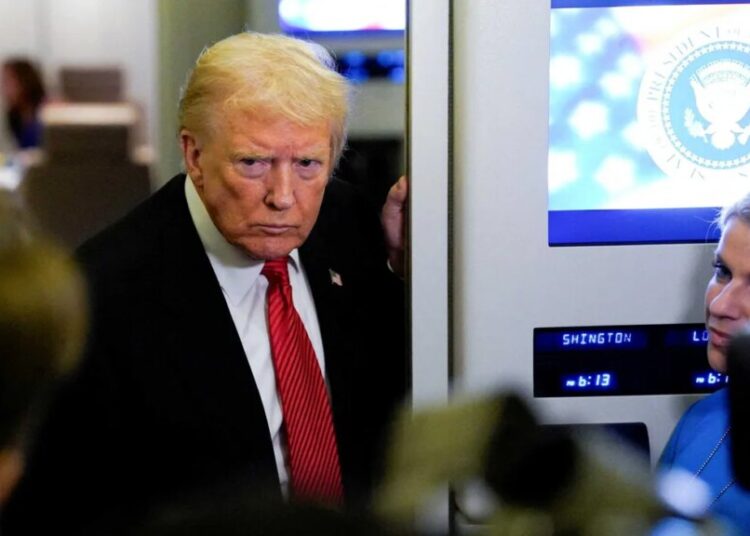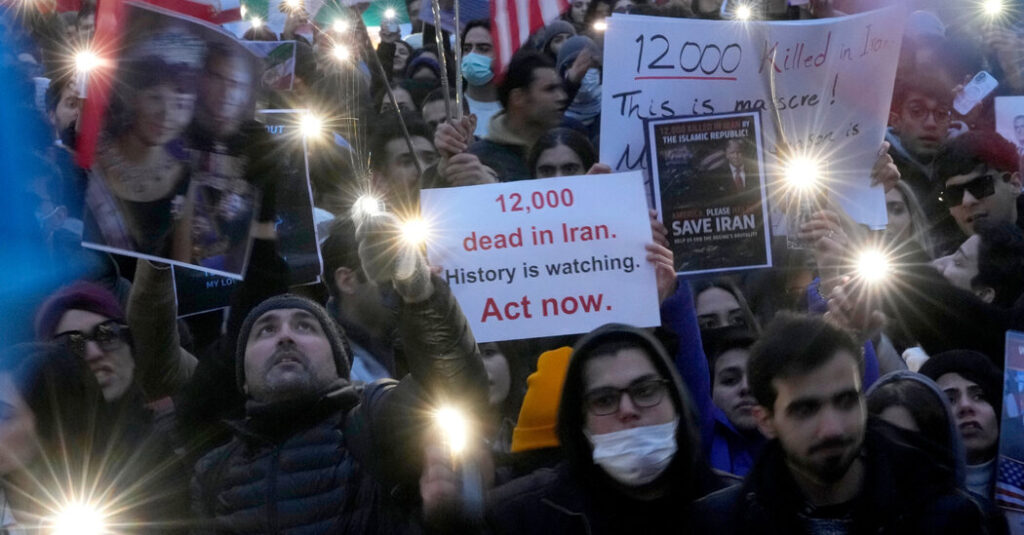
If Iran “violently kills peaceful protesters, which is their custom, the United States of America will come to their rescue,” President Trump wrote on Truth Social in January as protesters flooded the streets of Iran in the largest anti-government demonstrations in the country’s history. “We are locked and loaded and ready to go.”
As it turned out, Iran did kill thousands of protesters. But the United States was not as ready as it claimed. It was not until Feb. 28 that the U.S. and Israel launched an attack on Iran’s government.
Since the bombing began, Mr. Trump has offered a series of shifting justifications for the war. He’s mentioned Americans taken hostage in 1979; he’s criticized Iran’s use of proxy forces in the Middle East; most of all, he has blamed Iran for its failure to abandon its nuclear program.
Yet a certain appeal to humanitarianism still echoes through the discussion of the war. You can find it in the words of Mr. Trump’s supporters, like Senator Lindsey Graham. “The ayatollah and his henchmen slaughter people for protesting, they beat young women to death for wearing their head scarves improperly, and they have overseen the largest state sponsor of terrorism for decades. Who wants that to continue?” Senator Graham, a South Carolina Republican, wrote in an op-ed days before the attack began.
Such sentiments can even be heard among the war’s reluctant critics. President Emmanuel Macron of France said that the Israeli-U.S. strikes are “outside of international law, which we cannot approve.” But, he added, “History never weeps for those who butcher their own people, and none will be missed.”
Few believe that Mr. Trump is driven by a concern for human rights. He has also made clear his lack of interest in international law. And the war has already been catastrophic for many Iranian civilians, including dozens killed at an elementary school in an apparent U.S. missile strike on a nearby naval base. Yet the invocation of humanitarianism to help justify the war taps into — whether the president intends it or not — a powerful argument that has reshaped the global order since the end of the Cold War.
Under international law, force is permitted only in self-defense against an armed attack, or with authorization from the U.N. Security Council. There is no right to invade another country to protect civilians, even if their own government is the one harming them. That can often lead to governments or armed militias getting away with massacring protesters, torturing prisoners, committing ethnic cleansing or other atrocities. These rules of international law and the institutions that apply them have long been a source of anger.
The doctrine known as the “Responsibility to Protect,” often abbreviated as R2P by foreign-policy wonks, sought to change that. It emerged out of an era of liberal triumphalism, when the United States, its allies and some international institutions started to believe that sometimes, might could be a force for right — perhaps even if that meant violating international law.
But the effort to carve out a humanitarian exception, experts say, has left a weak spot in legal norms around the use of force — one that can now be exploited by leaders seeking to justify invasions of other sovereign states.
“I think Trump is pretty masterful at seeing these points of discomfort that people have with supporting the international order,” said Oona Hathaway, a professor at Yale Law School and a co-author of “The Internationalists and Their Plan to Outlaw War.”
The American president is not the only leader who has recently invoked humanitarian logic to justify a war that is, as Mr. Macron put it, “outside of international law.” President Vladimir V. Putin of Russia claimed in 2014 that his country’s invasion of Crimea was necessary to protect the Russian-speaking population there from deadly threats. In 2022, he claimed that his invasion of the rest of Ukraine was needed to stop the “genocide of millions of people.”
“It’s more effective to pick up a tool that already exists than to create a new one,” said Kate Cronin-Furman, a professor at University College London and the author of “Hypocrisy and Human Rights: Resisting Accountability for Mass Atrocities.”
“There’s an academic conception of zombie norms, which are norms of international law that get sort of hollowed out, but still hang around with rhetorical relevance, even though they don’t seem to really constrain anyone’s behavior,” Professor Cronin-Furman said.
The fact that Responsibility to Protect once had considerable legitimacy, she said, means that Mr. Trump, or Mr. Putin, can still draw on it now.
Morality Trumps Legality
In 1999, during the Kosovo crisis, the Secretary General of the United Nations, Kofi Annan, wrote an op-ed in The Economist in which he asked the international community to think about the Rwandan genocide that had occurred a few years earlier. “Imagine for one moment, in those dark days and hours leading up to the genocide, there had been a coalition of states ready and willing to act in defense of the Tutsi populations, but the council had refused or delayed giving the green light. Should such a coalition then have stood idly by while the horror unfolded?”
The implication was clear: Even though there was no U.N. Security Council authorization for the use of force in Kosovo, the NATO countries ready to intervene there had morality on their side. After they did so, an international commission concluded that their airstrikes on Kosovo had been “illegal but legitimate.” Morality trumped legality.
This was not isolated to Kosovo. With the Cold War recently over, and the United States the sole superpower, wars between governments seemed like a relic of the past — an argument explicitly made in “New and Old Wars,” an influential 1999 book by the political scientist Mary Kaldor. Instead, the most urgent threats to peace came from the rebellions, civil wars and ethnic conflicts that were boiling over around the world.
Genocides in Rwanda and the former Yugoslavia, predatory rebel groups in West Africa and Congo, and warlords in Somalia and Haiti seemed like indications that there was a terrible blind spot in international law and the institutions that were supposed to implement it. The system put in place after World War II was devised to prevent countries from invading and conquering each other, but those same rules also made it difficult for outside powers to aid civilians whose own governments were persecuting them, or had failed to protect them from harm.
That’s how R2P was born. In September 2000, the Canadian government announced that it would form an international commission to consider when it was appropriate for one state to take military action against another for the purpose of protecting civilians. The following year, the commission published a report arguing for the “Responsibility to Protect” doctrine. In 2005, it was unanimously adopted at the U.N. World Summit, a gathering of over 170 heads of state.
The principles were designed to complement the international system, not undermine it. The first two pillars of the doctrine emphasized that states had a responsibility to protect their own citizens, that other nations had a duty to “encourage and support” them in doing so. But the third pillar proclaimed that if a state failed to meet those protection obligations, the international community should act.
Under the formally adopted rules, any intervention under that third pillar was supposed to happen within the existing rules of international law, via U.N. Security Council resolutions. But from the start, some argued that humanitarian interventions could be permissible — or necessary — even if the Security Council refused to give a green light.
“Everyone agreed that a Security Council approval would be the best way,” said Thomas Weiss, a professor emeritus at the City University of New York’s graduate center, who was the research director of the commission that developed the Responsibility to Protect principles. But if it was not possible to get Security Council approval, he said, the commissioners’ conclusion was that some sort of regional entity, such as NATO, or an international “coalition of the willing,” could be a substitute.
The issue with that, however, is that “everything can be a coalition of the willing,” he said. It was an exception that could easily swallow the rule.
The high-water point for the doctrine came in the 2011 intervention in Libya. The U.N. Security Council resolution that authorized the use of force explicitly authorized member states to take “all necessary measures” to protect civilians. But while Libya’s government had oppressed its people, killing the country’s leader turned out to increase Libyans’ peril. The chaos that followed helped to turn the international community against the Responsibility to Protect, Professor Hathaway said.
Even though the R2P doctrine fell out of favor, it had helped to cement the idea that humanitarian needs could serve as an exception to international law’s rules on sovereignty and nonintervention. To leaders courting public opinion, the argument that a war could be “illegal but still legitimate” remains a potent tool.
A Series of Tragedies
It would be ridiculous to blame the Responsibility to Protect doctrine for Mr. Putin’s invasion of Ukraine or Mr. Trump’s attacks on Venezuela or Iran. None of these military operations was actually about protecting civilians. But both leaders appear to have recognized that the zombie norms created an opening, one that they used to their advantage.
The implication of the zombie norms, after all, was that states’ right to sovereignty could be contingent on treating their citizens well. Governments that abused their citizens, or were unable or unwilling to protect them, would no longer be entitled to the full measure of protection against other states’ armed interventions. From one angle, this seemed like a measured — perhaps even insufficient — response to catastrophes like genocide. But from another, it seemed like an easily exploited exception to the principles of the entire international system.
International law is a funny thing. With no real means of enforcement, it’s essentially a set of reciprocal expectations. It only works if states believe others will follow the rules, too. Anything that departs from those expectations weakens that system.
“These arguments that we can sort of make this one-off exception and somehow ignore the rule now, and the rule will stay intact, fail to recognize that damage that you do to the norm and that that damage itself is putting people at risk,” Professor Hathaway said.
The effects are likely to go far beyond the current conflicts. “The harm is felt in the wars that haven’t happened yet,” Professor Hathaway said. “It’s felt in the unleashing of other states who want to use military force against our neighbors, or against others, but might have felt limited in the past.”
Another tragedy of the current situation is that civilians remain in urgent need of protection from mass violence — and solutions to that problem seem more remote than ever.
In just the past year, rebel groups have massacred civilians in Sudan and the Democratic Republic of Congo. In Gaza, Israel’s monthslong blockade of food and foreign aid led to famine, compounding the suffering of civilians trapped by a catastrophic war. In Myanmar, the military has killed thousands during the yearslong civil war.
The more that the zombie husk of R2P is used as a pretext for other wars, the more difficult it will become to engage with the problem of how to protect people from that kind of violence. The rhetoric and ideas of R2P will become tainted by association.
It’s happening already. “It’s impossible to have a legitimate debate in the Security Council or the Human Rights Council and in other areas without using some of this language, but it is not in the least operational these days,” Professor Weiss said, adding that he wished there was more willingness to take action to protect civilians in places like Gaza, Sudan and Myanmar.
A world in which states feel confident that their sovereignty is safe is one in which the international system can contemplate genuine solutions to humanitarian disasters. But sovereignty is looking less and less like a safe bet every day. And the world’s civilians, increasingly, are on their own.
Amanda Taub writes the Interpreter, an explanatory column and newsletter about world events. She is based in London.
The post How Good Intentions Helped Pave Trump’s Road to Iran appeared first on New York Times.