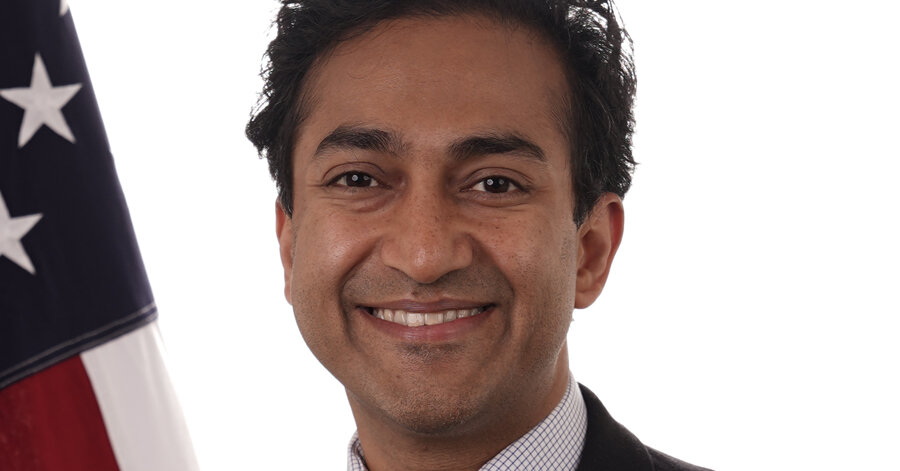
Dr. Vinay Prasad, a polarizing figure at the Food and Drug Administration who oversaw vaccines, is leaving the agency at the end of April, according to a Health and Human Services spokesman.
As the agency’s chief science and medical officer, Dr. Prasad had wide-ranging authority over vaccines, drugs and gene therapies. He issued several controversial decisions, including overruling career scientists on some vaccine approvals and cracking down on a biotech company linked to two teenagers’s deaths.
In one of the most highly publicized moves, Dr. Prasad refused to accept Moderna’s application for a new mRNA flu vaccine, causing an uproar among companies and some experts who complained he was too often moving the goal posts on studies that had been OK’d by the agency. Within days, Dr. Marty Makary, the agency’s commissioner, reversed the decision after the company agreed to conduct another study.
And in recent months, he had issued a series of rejections for treatments of rare diseases, increasingly upsetting patients who have few options and biotech companies invested in developing cures.
Many of those decisions were made with little warning. He shied way from public advisory panel meetings on drugs under review, rebuffing calls for greater transparency. Dr. Prasad has criticized those forums, saying that the drug industry manipulated public opinion.
Throughout his brief tenure at the F.D.A., Dr. Prasad rankled career scientists with policy dictates that were sometimes accompanied by threats against employees who might leak information. He publicly invited agency staff members who disagreed with him to resign.
Last summer, he was dismissed after the right-wing influencer Laura Loomer led an attack against him by referring to favorable statements he had made about Democrats in the past. At the insistence of Dr. Makary and Health Secretary Robert F. Kennedy Jr., he was soon brought back.
The Wall Street Journal first reported his planned departure on Friday. Dr. Prasad declined to comment.
In an email to F.D.A. staff members on Friday, Dr. Makary praised Dr. Prasad for his efforts to identify promising drugs for speedy review and to allow for drug approvals after companies have conducted one major study, rather than two.
He also complimented Dr. Prasad’s work on a new Covid vaccine framework, which advised giving the shot only to people 65 and older or those with an underlying medical condition.
“These reforms represented a tremendous body of work achieved in a remarkably short period of time,” Dr. Makary wrote. “They are substantive, durable changes that will shape the agency’s approach for years to come and stand as part of Vinay’s lasting legacy here.”
Leaders in the biotech and investor communities had long pressed the White House for his ouster.
However, Diana Zuckerman, a close observer of the F.D.A. and president of the nonprofit National Center for Health Research, said Dr. Prasad’s decision to leave was a loss to independent researchers who had “hoped he would help strengthen the public health mission of the F.D.A.”
“F.D.A.’s ‘flexible’ standards for approving products that are not proven to work are resulting in an unsustainable health care system,” she said, noting the cost of failed therapies to Medicare and to patients.
Before joining the agency, Dr. Prasad was an academic at the University of California, San Francisco. He was known for criticizing the F.D.A., saying its drug review officials were too permissive in issuing approvals.
He has also been described as a Covid contrarian after complaining on podcasts and on his YouTube channel about public health measures that he deemed ill-informed by medical evidence.
But he and Dr. Makary broke with Mr. Kennedy on whether pregnant women should get the vaccine, including pregnancy as a condition warranting vaccination, in an article in The New England Journal of Medicine. Dr. Prasad later claimed in a memo to staff members that a small number of children had died after receiving the Covid vaccine, but amid internal disagreement over the cases, no further report has been released.
Last summer, after a second teenager died from liver-related complications from a therapy for Duchenne muscular dystrophy, Dr. Prasad demanded that the manufacturer, Sarepta, stop distributing the drug. The company pushed back, and the agency settled on keeping the drug from older children who were more likely to be harmed by it.
The episode was soon followed by Ms. Loomer’s social media posts that cited previous statements by Dr. Prasad favoring Senator Bernie Sanders, the independent from Vermont, and needling President Trump.
The Department of Health and Human Services held a background briefing on Thursday about the latest controversial decision, against a treatment for Huntington’s disease.
A senior administration official who identified himself as an oncologist at the University of California, San Francisco, defended his decision to refuse an application for the drug’s review from UniQure, which had reported success in a small trial of Huntington’s patients.
The official, who spoke on the condition that his name not be used, called it a “failed therapy” and detailed conversations between the company and the F.D.A., which the company later disputed.
The official said he missed his clinic, his teaching role and his ability to speak freely. Dr. Prasad is an oncologist on leave from U.C.S.F.
On Friday, Representative Jake Auchincloss, a Democrat of Massachusetts, said on social media that Dr. Prasad was the official and that he had disclosed trade secret information about UniQure’s treatment without legal authorization. A Health and Human Services official said that everything discussed on the call had been disclosed by the company and that it was a reasonable matter for the agency to address.
In a social media post Friday evening, Dr. Makary said that Dr. Prasad would be resuming his work in California and that a successor would be announced before he leaves.
Christina Jewett covers the Food and Drug Administration, which means keeping a close eye on drugs, medical devices, food safety and tobacco policy.
The post Divisive F.D.A. Vaccine Regulator Is Resigning appeared first on New York Times.