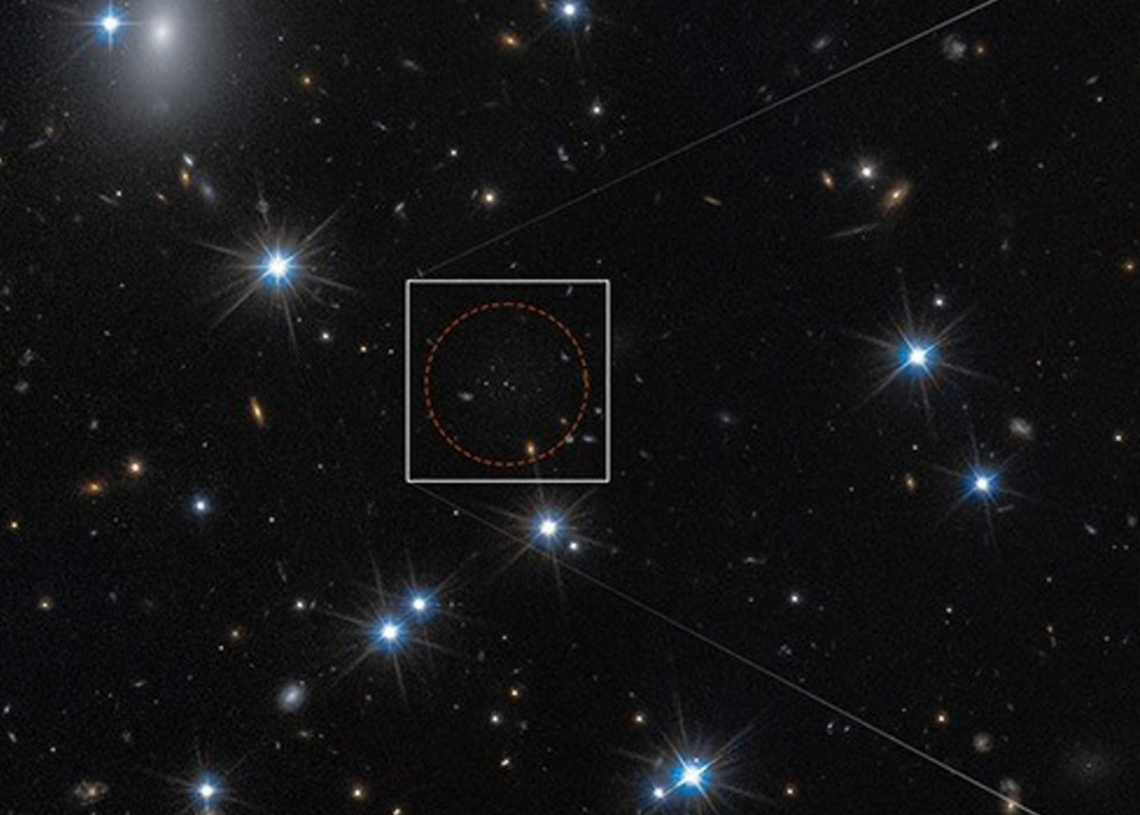
Astronomers have identified a distant galaxy so faint it barely qualifies as visible. It’s not just the distance part that has researchers squinting to get a better view. Dubbed Candidate Dark Galaxy-2, or CDG-2, the object appears to be composed of at least 99.9 percent dark matter, the invisible substance believed to make up most of the universe’s mass.
Detailed in The Astrophysical Journal Letters, the finding is based on data collected from the Hubble Space Telescope, the Euclid space telescope, and the Subaru Telescope. Located about 300 million light-years away in the Perseus Cluster, CDG-2 is so dim that researchers classify it as an “almost-dark” galaxy, which could make it part of a theorized class of galaxies with little to no stars.
How Did Scientists find an Invisible Dark Galaxy?
There is an enormous amount of dark matter in the universe, outweighing ordinary matter by roughly 5 to 1, and yet none of it can be directly observed. Its presence in a galaxy is inferred through gravity. Galaxies rotate quickly, and clusters hold together too tightly for visible matter to be the sole explanation.
Researchers found it by tracking dense ancient star groupings called globular clusters, whose gravitational stability hinted at a larger unseen mass. A faint halo around them suggested a surrounding galaxy that had almost no hydrogen gas, which is needed to form new stars. Astronomers think CDG-2 may have lost its gas early on, as it was all stolen via interactions with larger nearby galaxies.
All of this means that CDG-2 could offer researchers one of the cleanest environments found yet that allows them to study dark matter without interference from normal matter. It’s one giant galactic clean slate, primed and ready for earthbound researchers to point their telescopes at the hope of more precisely measuring its mass, all in an effort to gain even a bit more understanding about one of the most elusive yet abundant substances in the universe.
The post NASA Scientists Found a Nearly Invisible ‘Ghost Galaxy’ Made of 99% Dark Matter appeared first on VICE.