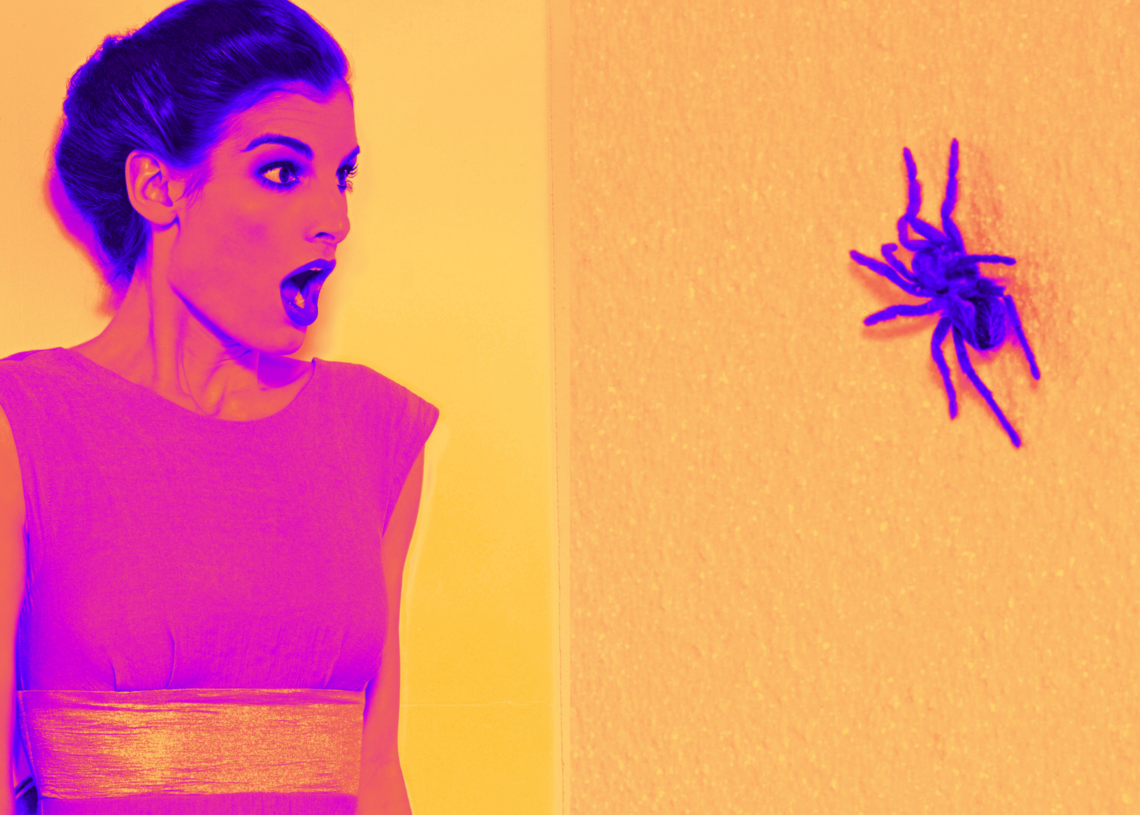
For some, arachnophobia extends well beyond being creeped out by spiders. It can alter people’s lives in fairly dramatic ways, shaping where they walk, where they sit, and which rooms they dare to enter, and all of that has an effect on mental health and can severely limit their experiences, especially outdoors.
A new study published in Frontiers in Arachnid Science, a new personal favorite in the long, ever-growing list of niche scientific publications, found that while the spiders themselves play a large role in arachnophobia, our eye movements play a surprisingly large role as well.
Researchers recruited 118 undergraduate students and tracked their eye movements as they viewed paired images. Spider versus butterfly, spider versus insect, spider eyes versus insect eyes, spider versus non-spider arachnid, and spider versus myriapod, like centipedes or millipedes. Later rounds compared scorpions to non-scorpions and, finally, spider against spider, the hairy kind versus less hairy, web versus no web.
The spiders varied in fang size, hairiness, and whether they were shown guarding eggs or suspended in webs. Participants’ gaze patterns were measured using four metrics, including how quickly they fixated on an image, how long they lingered, and how often they returned to it.
please let me look at the butterfly
Participants consistently looked at butterflies faster than spiders. They spent more time examining insects, other arachnids, and myriapods than spiders. Overall, pictures of spiders instantly triggered avoidance, and participants’ eyes fixated on anything that wasn’t spiderlike. For instance, when forced to compare two spiders, viewers focused on ancillary details like a web rather than on the spider itself.
Understanding these visual triggers could help scientists figure out exactly what repels people, which we could help them adjust how they present spiders and educational or conservation discussions. The conservation aspect is important, as it can be difficult to convince people to save a creature vital to ecological balance if humans are naturally repelled by its mere image.
The path toward making peace with freaky-looking spiders might start with understanding what our eyes are even doing when we look at them, and why.
The post Something Funny Happened When Scientists Tried to Make People Look at Spiders appeared first on VICE.