Kristi Noem was not fired after federal agents in Minneapolis shot and killed two American citizens.
She was not ousted when a chief judge in Minnesota said her immigration agency had violated more court orders than some federal agencies do in their entire existence. Nor did it happen when she described a Veterans Affairs nurse shot by her agents as a domestic terrorist, or when she falsely claimed he had brandished a weapon before he was pinned down and killed.
Rather, Ms. Noem was ousted shortly after she appeared to cross one of the few red lines of the Trump White House: She appeared to shift responsibility for her own political problems back to President Trump.
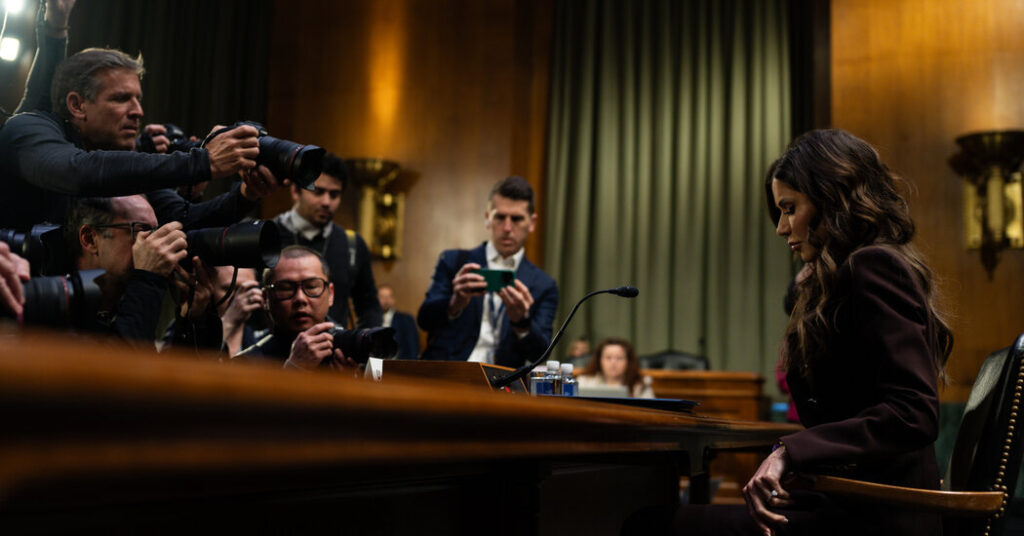
During a congressional hearing this week, Ms. Noem was asked if Mr. Trump had approved a $200 million-plus government ad campaign in which she was prominently featured. Ms. Noem said Mr. Trump had tasked her with “getting the message out to the country.” Asked if Mr. Trump had signed off on the campaign before the ads aired, Ms. Noem responded, “We had that conversation, yes, before I was put in this position and sworn in and confirmed. And since then as well.”
Ms. Noem’s comments suggested Mr. Trump had signed off on a massively expensive ad campaign that even some in her department found cringe worthy — with Ms. Noem on a horse at Mount Rushmore. And by indicating Mr. Trump had ownership of the messaging campaign, Ms. Noem rattled Mr. Trump out of one of his comfort zones, which is as a spectator to his own policies. Shortly after her statement, Mr. Trump told Reuters he did not know about the contract.
The decision to remove Ms. Noem was another reminder that Mr. Trump’s barometer for his cabinet is not just measuring policy actions on the ground as much as an appearance of disloyalty and political optics.
In making her the first cabinet official to be pushed out of a job in his second term, Mr. Trump did not condemn the mass deportations and aggressive tactics Ms. Noem enthusiastically embraced under the watchful eye of Stephen Miller, the architect of Mr. Trump’s immigration agenda. He did not signal a shift for the department, which administration officials have said will continue to advance the same goals under Senator Markwayne Mullin, the Republican of Oklahoma tapped to replace Ms. Noem.
The decision instead appeared driven by an eagerness to distance Mr. Trump from the person who had become politically untenable.
“The loyalty is absolutely the key,” said Gil Kerlikowske, a former commissioner for Customs and Border Protection, which is under the umbrella of the Homeland Security Department. “It’s a good rule of thumb to never throw your boss under the bus and with him in particular I think it’s the cardinal sin and she certainly violated that.”
D.H.S. declined to comment Friday on the ouster of Ms. Noem, who will lead the department through the end of the month.
Asked about Mr. Trump’s reasoning for pushing out Ms. Noem, the White House referred to a statement from White House press secretary Karoline Leavitt saying Mr. Trump was “grateful” to Ms. Noem for her work to reduce illegal crossings at the border to record lows and that Mr. Trump’s immigration agenda “will continue without interruption.”
The White House did not answer other questions about why Mr. Trump did not know the details for the commercial campaign for one of his favorite policies — deportations — or why he did not inquire for more details about commercials playing on television for months. The Office of Management and Budget, which is part of the White House, did not respond when asked if the office approved of the advertising campaign.
One Trump administration official, speaking on the condition of anonymity to speak candidly about Mr. Trump’s growing frustration with Ms. Noem, claimed that the decision stemmed in part from her answer on the ad campaign. But the person said it was also a culmination of a number of factors, including her handling of the fallout of the operation in Minnesota, what some in the White House perceived as a mismanagement of her staff and her disputes with other department leaders.
But it was also the latest example of Mr. Trump, whose aides conducted loyalty tests for candidates seeking top government postings, trying to distance himself from his administration’s immigration actions when they have become increasingly politically toxic.
Mr. Trump earlier this year told The New York Times he was “not happy about” an ICE raid at a Hyundai facility in Georgia last year, in which agents detained hundreds of South Korean citizens on hand to help build a new battery plant. Mr. Trump’s anger did overlook that he ultimately runs ICE as head of the executive branch, and that he directed Ms. Noem to oversee a massive deportation campaign to remove millions of undocumented immigrants.
Mr. Trump has said he is interested in comprehensive immigration reform, though he has not pushed his administration to work with Congress on any meaningful immigration legislation. When asked about his administration’s decision to suspend refugee admissions for almost everyone around the world besides white South Africans, Mr. Trump said he hadn’t “seen that.” His top State Department aides welcomed some of the first refugees when they arrived in Washington.
And when Ms. Noem made the unfounded claim that Alex Pretti, the nurse fatally shot by Customs and Border Protection officers in Minneapolis, had committed an act of domestic terrorism, Mr. Trump followed up days later by saying he thought a “softer touch” was needed in Minneapolis.
It will now be up to Mr. Mullin to walk the tight rope as Mr. Trump’s homeland security secretary, a position that saw a rotating cast of acting officials lacking Senate confirmation for much of Mr. Trump’s first term.
Current and former officials say he will have to balance Mr. Trump’s demands for loyalty with a Homeland Security Department suffering from funding struggles and low morale.
Janet Napolitano, the D.H.S. secretary during the Obama administration, said that she hopes that Mr. Mullin is able to help the department come out of a year of controversies and problems, including by restoring the gutted subagencies focused on cybersecurity and disaster relief.
“I hope he appreciates that the secretary of D.H.S. is a massive, massive job from an operational and management perspective and that he understands that this job is not just to be in videos but to really help reconstitute the department,” Ms. Napolitano said.
She also said it was important that the White House recognize that D.H.S. is not ‘the department of immigration.’
Multiple officials in the rank and file of the Homeland Security Department described a celebratory atmosphere in some corners after Ms. Noem’s exit. But some were cautious as to what comes next.
“Often times an administration will appoint change agents or leaders to break the mold and get things moving, then look to others to build a plan to carry that office into the future,” said Matthew Hudak, a former senior Border Patrol official.
Mr. Hudak said that it was “clearly problematic to be spending hundreds of millions on questionable programs and procurements, as well intentioned as they may be.”
Mr. Kerlikowske said Mr. Mullin faced a tall task, particularly as “morale is in the dumpster and the vast majority of personnel throughout D.H.S. want nothing to do with the current focus on arrests and deportations.”
But he also expressed concern, given Mr. Trump’s measure of success for his cabinet.
Mr. Trump, he said, was focused on recruiting leaders “that will bring chaos and attempt to alter the face of the federal government.”
Zolan Kanno-Youngs is a White House correspondent for The Times, covering President Trump and his administration.
The post Kristi Noem Survived Many Crises. Then She Crossed a Trump Red Line. appeared first on New York Times.