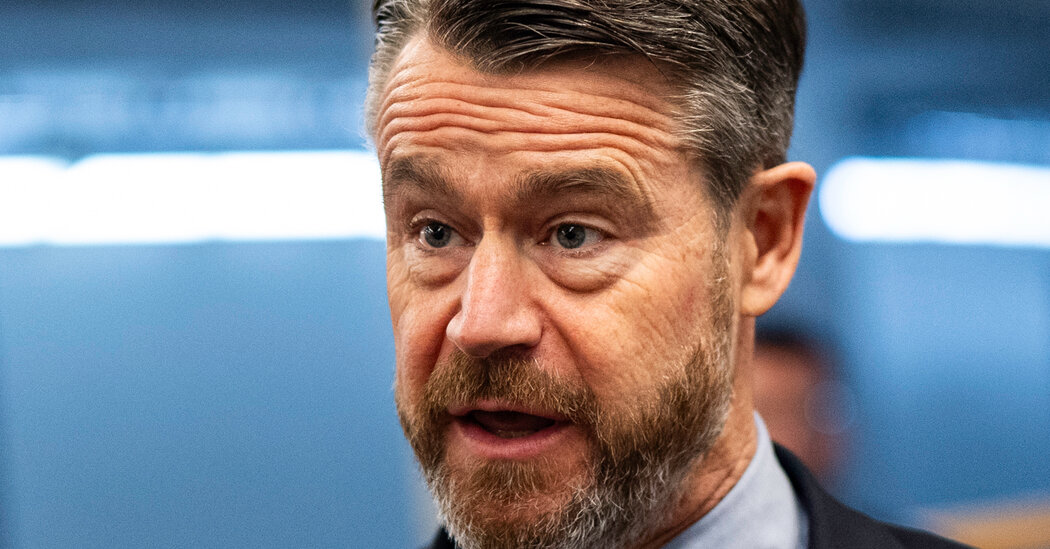
As he contemplated how to respond to President Trump’s escalating war in Iran, Senator Todd Young of Indiana looked at his menu of options and found few satisfying choices.
For years, he had warned of the dangers of a legislative branch that had ceded its war-making powers to the executive branch. He had routinely teamed with Democrats in efforts to repeal authorizations for combat operations against Iraq and to urge a restoration of Congress’s “proper constitutional role on questions of war and peace.”
But on Wednesday, Mr. Young, a 53-year-old former Marine, joined all but one of his Republican colleagues in opposing a measure that would limit Mr. Trump’s power to continue waging war against Iran without congressional authorization.
Despite harboring deep qualms about his institution’s role in reasserting its prerogatives, Mr. Young said his decision reflected the unwieldy military reality that Mr. Trump had thrust upon the nation when he decided unilaterally to carry out sweeping strikes against Iran, and the apparent lack of appetite among his colleagues in Congress to reclaim their war-making authorities.
“We fell short institutionally in rising to the moment,” Mr. Young said in an interview, noting that Mr. Trump had made clear that he was weighing an attack on Iran if its leaders failed to meet his demands in negotiations to rein in its nuclear program, and yet Congress still did nothing.
“And so here we are, now that we’re actually in a war, figuring out answers to our questions, trying to elicit just basic facts about political objectives, and, more importantly, trying to unify the American people around those objectives,” he said. “And I feel like much of this could have been done, and should have been done, beforehand.”
Mr. Young’s account of how he grappled with the war during its first week reflects a key piece of how Republicans have come to their near-monolithic decision to cede Congress’s war powers, at least for now, to the president. Many G.O.P. lawmakers have been content to defer to the president unquestioningly on the matter, but for others, like the senator from Indiana, there is a more complicated calculus at play as Mr. Trump undertakes a large military operation, the objectives, legal justification, scope and time frame of which he has yet to clarify.
“There’s the practical reality that if you do what the Democrats are now arguing we do — which is withdraw all military support immediately — that could be the most dangerous thing possible to our national security,” Mr. Young said. “Now we have to, so to speak, finish the job and at least stabilize the situation.”
That is the position all of Mr. Young’s Republican colleagues have landed on, at least publicly, with the exception of Senator Rand Paul, the Kentucky libertarian who led the charge for and voted in favor of the war powers resolution. Despite polls showing the conflict is deeply unpopular with Americans, several senators said they had not heard much from their constituents on the issue, with the exception of those who had been stranded in the Middle East and were seeking travel assistance.
Senator Josh Hawley, Republican of Missouri, said he believed the administration was operating legally, noting that Mr. Trump had not placed boots on the ground and that the 1973 War Powers Resolution sets a 60-day threshold before U.S. armed forces are barred from engaging in hostilities without congressional authorization.
“Hopefully they’ll continue to keep us fully apprised on how the conflict is progressing, and what they — the administration — what their aims are,” Mr. Hawley said. “And I understand what their aims were going into this, but this is, as they emphasize, a very broad conflict. It seems to be widening.”
He added: “They’ve got 60 days from the time of their notification, which came on Monday, in order to conduct military operations before needing to come back with a more fulsome report to Congress.”
Senator Susan Collins of Maine, who is one of the most politically vulnerable Republicans this election cycle, also opposed the measure.
“Passing this resolution now would send the wrong message to Iran and to our troops,” Ms. Collins said. “At this juncture, providing unequivocal support to our service members is critically important, as is ongoing consultation by the administration with Congress.”
The debate is somewhat of an unwelcome déjà vu for Mr. Young, a second-term senator with a wonky streak who would probably rather be contemplating one of his other passion projects, which include U.S. shipbuilding and shoring up scientific research in advanced technologies.
In January, he found himself at the center of another war powers debate, when he voted to advance a similar resolution constraining Mr. Trump’s power to conduct military strikes on Venezuela without authorization from Congress following the military raid that removed the country’s president, Nicolás Maduro.
After that vote, Mr. Trump took to social media to castigate Mr. Young and the four other Republican senators, including Ms. Collins, Mr. Paul and Mr. Hawley, who voted in favor of taking up the measure, declaring they “should never be elected to office again.”
Days later, Mr. Young opposed the passage of the legislation, arguing that he had instead been able to leverage his vote on what would have been a doomed measure for written assurances on the operation.
“Even if the Senate had adopted the resolution — had it not been derailed through a procedural vote — it likely would have died in the House of Representatives,” he said in a speech on the Senate floor. “Or at a minimum been vetoed by the president. That much was clear.”
Instead, after days of quiet conversations with Secretary of State Marco Rubio and his team, as well as American diplomats, Mr. Young secured a letter from Mr. Rubio assuring lawmakers that if Mr. Trump intended “to introduce U.S. armed forces into hostilities in major military operations in Venezuela, he would seek congressional authorization in advance (circumstances permitting).”
He also secured a commitment from Mr. Rubio to appear before the Foreign Relations Committee to discuss the operations in Venezuela.
On Wednesday, mobbed by members of the news media just off the Senate floor, Mr. Young showed a flash of exasperation as another reporter pressed him on whether he wished he had extracted a broader promise from the secretary of state.
“I wish for a lot of things, but in the real world, one of 535 members of Congress only has so much leverage,” Mr. Young replied. “Especially if there are not others working, willing and able to work with me to acquire more leverage.”
And so as Mr. Trump continued the war against Iran, with his top deputies pledging to accelerate the campaign, Mr. Young said he was “thinking about things that might be within my realm of control.”
Walking from the Capitol back to his office, Mr. Young grew more reflective, describing the position in which he had found himself as “lonely and frustrating at times.”
“I think it’s very important for myself and others who are similarly situated not to convince ourselves that we don’t have agency, that this is all a lost cause, because it’s not,” Mr. Young said.
“If we just give up in defending our institutional prerogatives, then we’ll never get them back, but if we hold on to the hope that we can incrementally claw them back — that’s great,” he added. “That’s one thing I’m hoping for.”
Catie Edmondson covers Congress for The Times.
The post Why a G.O.P. War Powers Hawk Was a No on Reining Trump In on Iran appeared first on New York Times.