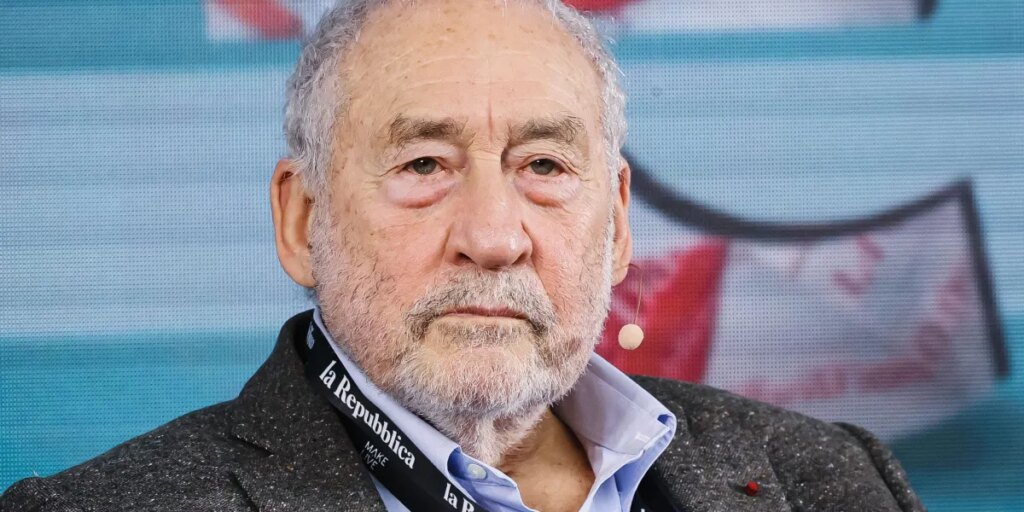
As Professor Joseph Stiglitz sees it, AI is not just another technology wave—it’s a force that can erode jobs and hard‑wire a new era of inequality. That is, unless governments and institutions deliberately push it in a different direction.
AI lets firms strip labor out of production, concentrate profits at the top, and push the risks of transition onto workers and the public—exactly the trajectory the Nobel laureate warns about in his 2024 book, the recently reissued The Road to Freedom: Economics and the Good Society. Now, the economics professor argued in a recent interview with Fortune, AI is emerging as a textbook case of how technology can turbocharge inequality.
“If we don’t do anything about managing AI, there is a threat that it will lead to more inequality,” Stiglitz said. “And since inequality is such a bad, serious problem in our society, that is a great concern to me.”
Stiglitz has spent his career watching capitalism fail the people it was supposed to serve. He’s studied financial crises, globalization’s broken promises, and the slow hollowing out of the American middle class. Now, at 83, he is watching the next chapter unfold in real time—and he is not optimistic.
The ‘tech bros’ are pulling up the ladder
Here’s where the politics get truly combustible: the very people driving AI adoption are simultaneously leading the charge to shrink the governmental institutions that could cushion AI’s disruption. For Stiglitz, this isn’t a contradiction—it’s a strategy.
“Unfortunately, the tech bros, who are obviously advocates of this, are at the same time pushing for smaller government, which will undermine the ability of the government to do exactly what is needed in order to make a successful transition,” he said.
The result, he argued, is a self-fulfilling trap: “If the tech oligarchs continue in their mindset overall of downscaling government, that will impair the ability of government to facilitate the AI transition. And you know, that’s the central boundary that we’re facing—that they are creating the conditions that make it impossible for a successful AI transition.”
The government “needs to to provide support for helping people move from where they’re no longer needed to where they might be more productive,” Stiglitz offered.
However, government regulation stands directly in the way of what most company owners are looking to do: reduce overhead expenses and drive the bottom line. Technology strategist Daniel Miessler recently argued that “the ideal number of human employees inside of any company is zero.” For owners, labor has always been a cost center; AI is the first technology that credibly promises to hollow it out entirely. That is the inequality Stiglitz has been describing for years. Stiglitz’s answer is that, right now, no one with power is listening.
Even those at the top of the financial system are starting to say it out loud. BlackRock CEO Larry Fink, speaking at Davos earlier this year, made a similar observation, noting AI’s “early gains are flowing to the owners of models, owners of data and owners of infrastructure.” Meanwhile, the bottom half of Americans, who own about 1% of stock market wealth, are nowhere near the table. Fink asked plainly: what happens to everyone else if AI does to white-collar workers what globalization did to blue-collar workers? The answer, he implied, could be capitalism’s next big failure.
Stiglitz said this sounded familiar. “In the Great Depression, it was partly a success of agriculture. We increased productivity enormously. We didn’t need as many farmers, but we had no ability to move people out of the rural sector, and we finally did it in World War Two. But it was government intervention as a result of the war that resolved that problem. We don’t have the institutional framework for doing that.”
The numbers already tell the story. Bank of America Institute economists have found that recent productivity gains are piling up as corporate profits, with labor income steadily falling as a share of U.S. GDP—a pattern that mirrors the 19th-century Industrial Revolution, when factory owners grew fabulously wealthy while workers’ wages stagnated for decades.
Gallup found most American workers distrust AI and fear for their jobs, while executives wildly overestimate how enthusiastic their staff actually is about it. The gap between who gains and who loses from AI, in other words, is not a future risk. It is already here.
There is another way
In The Road to Freedom, Stiglitz argues when money dominates politics, policy systematically favors the already powerful, and market “freedom” becomes a cover story for entrenching inequality. Genuine freedom, Stiglitz says, is not simply the absence of government interference—it is the presence of institutions strong enough to check concentrated private power and ensure that economic gains are shared broadly. A society where AI supercharges the wealth of platform owners while stripping opportunity from the middle class is not, by his definition, a free one. It is an oligarchy with better technology.
Stiglitz is not a doomsayer. He uses AI himself to help with research. But he frames it differently, like someone pulling records rather than as a source of judgment. “I view AI as augmenting my abilities. It’s sort of like having a team of research assistants, but faster.”
Stiglitz explained it’s not AI but rather, IA. “IA is intelligence assisting,” he said. “I gave the analogy of the microscope and telescope—it sort of made our eyes see things that we couldn’t otherwise see. So they augmented our capabilities.” In his own research, AI helps him survey the literature, find sources, and stimulate new lines of thinking. “It is an amazing research tool,” he acknowledged, “but it’s not a substitute for thinking.”
The difference between IA—a tool that serves people—and AI as a displacement engine is not technological. It is political. It comes down to who controls the technology, who captures the gains, and whether public institutions are strong enough to insist on a fair distribution. In a country where money shapes politics, Stiglitz is not holding his breath. “Economic inequality can be reinforced into political inequality,” he warned.
The post Nobel laureate Joe Stiglitz says not only can AI take your job, it’ll make the ‘tech bro’ class richer while doing it appeared first on Fortune.