Some concert programs make sense on paper but fall apart in performance. Others look cobbled together at first glance but reveal hidden connections later.
Both scenarios played out at the New York Philharmonic recently under the visiting conductor Mirga Grazinyte-Tyla. Her first program, heard on Tuesday, brought together Vaughan Williams’s “Fantasia on a Theme by Thomas Tallis,” a new piano concerto by John Williams, and Mieczyslaw Weinberg’s Fifth Symphony — a lineup that seemed to share little beyond two of the composers’ names. Yet the result was an emotionally gripping reflection on time, with stellar ensemble playing by the orchestra.
The second program, on Thursday, seemed cohesive, pairing two proponents of songful Romanticism, Elgar and Schumann, but unfolded as a frustrating sequence of fragmentary gestures that never quite gathered into a convincing arc.
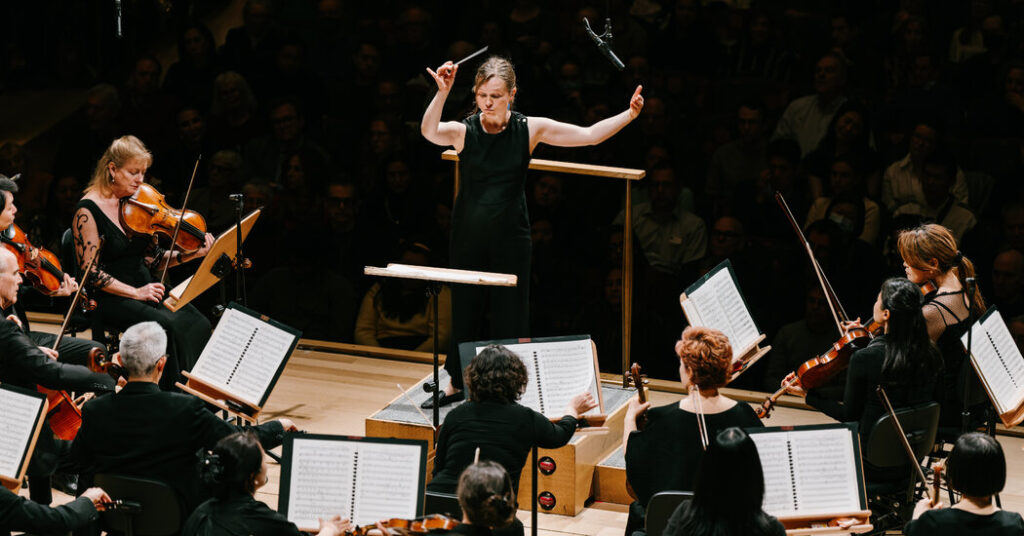
Grazinyte-Tyla commands attention with clarity and grace: Legs firmly anchored, she conducts with fluid arm gestures interspersed, where needed, with decisive, razor-sharp cues. In Vaughan Williams’s “Fantasia,” written for two string orchestras and a string quartet, her relaxed confidence seemed to inspire especially free bow strokes from the players, resulting in an airy sound that surged and settled like breath.
John Williams’s charismatic new piano concerto, written for Emanuel Ax, tips its hat to three jazz legends he had admired in his youth: Art Tatum, Bill Evans and Oscar Peterson. While each movement reflects characteristics of their artistry, the resulting score lacks the conversational spontaneity of jazz. Instead, a retrospective tenderness clings to this work, which Williams premiered last year at age 93. More than once, a churning orchestral texture thins to the kind of music-box tingle of piano, harp and celesta that often evokes childhood in film scores. Suffused with the bonhomie of Ax’s gracious playing, the concerto seemed to idealize the past in much the same way that Vaughan Williams evokes nostalgia for an idealized Elizabethan age. In both works, glowing viola solos, played with soulful tone by Cynthia Phelps, briefly pulled the listener back to a human vantage point.
In the Weinberg, from 1962, the passage of time becomes a source of anxiety. Grazinyte-Tyla has made it her mission to promote the music of this Polish-born composer, whose vast body of work bears the scars of Nazi persecution and Soviet repression. A kinship with Shostakovich, his close friend, is unmistakable both in its panoramic sweep and in certain stylistic details. Chief among them are biting staccato figures that run with obsessive insistence through much of the Fifth Symphony, sometimes sounding like heckling, sometimes like the pitiless ticking of a metronome. When tapped out on a snare drum, the beat casts a militarized shadow over the music that reaches even into its lyrical moments.
Among the more emotive passages is the opening of the second movement, scored largely for strings but without the grounding presence of basses. The cool, lustrous sound developed earlier in the Vaughan Williams here took on a faintly neurotic, unmoored quality. Wistful solos, including one lovingly shaped by the principal flute, Robert Langevin, reach for expressivity but are full of the kinds of flattened intervals that Shostakovich also favored, and which evoke an air of self-censorship.
A rowdy scherzo, sparked by a chirping piccolo set against restless timpani, briefly flirts with folk-like exuberance. Yet even there, the extreme isolation of the piccolo, twirling high above the orchestral texture, spreads nagging unease. In the end, the music returns to that tapping pulse, counting off time before a soft gong cuts the symphony short, almost midsentence.
The strongest element of Thursday’s concert was also its briefest, a 10-minute hinge connecting Elgar’s Violin Concerto and Schumann’s First Symphony: Gyorgy Kurtag’s “Brefs Messages,” a 2010 piece in which a chamber ensemble of principal players assemble in shifting combinations for four vividly etched miniatures. Brevity is Kurtag’s hallmark, along with obsessively sculpted silences. The Philharmonic musicians executed these finicky scores with rhetorical conviction and finely calibrated tone colors.
But elsewhere, fragmentation felt accidental rather than deliberate. The Norwegian violinist Vilde Frang brought simmering intensity to Elgar’s opening statement in the violin’s lower register, yet in later virtuosic passagework, her tone lost color. The piece feels like a poor cousin of Elgar’s dramatic cello concerto; its gestures of Romantic virtuosity struggle to coalesce into a persuasive whole.
Grazinyte-Tyla’s brisk account of Schumann’s First Symphony fared little better. The score is built from small dramatic cells and bursts of syncopation that must accumulate into momentum. Here, they arrived as a succession of episodes, and the music lurched forward in choppy installments.
Paired with Elgar’s Violin Concerto, the symphony might have anchored an evening of sweeping Romantic storytelling. But both works required a stronger sense of unified sound and long-range vision.
It was a stark contrast to Tuesday’s program, where Grazinyte-Tyla brought three seemingly unrelated pieces into conversation with one another about the human relation to time.
The post A Philharmonic Conductor’s Concerts Surprise, for Better and Worse appeared first on New York Times.