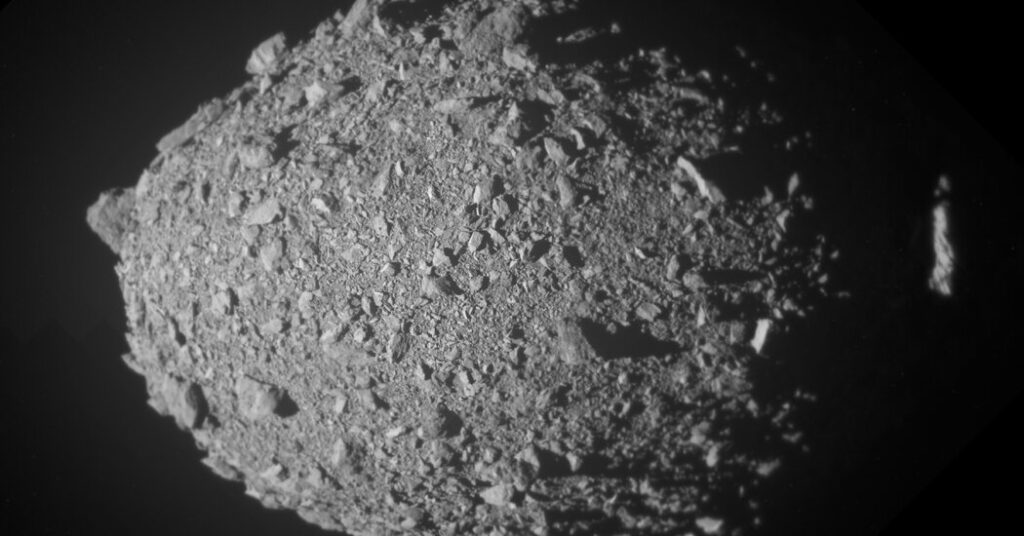
In 2022, NASA deliberately crashed a spacecraft into a small asteroid named Dimorphos. The goal of this interplanetary smashup was to prove that if a killer space rock ever threatened Earth in the future, humans could deflect it and save our world.
The mission, called the Double Asteroid Redirection Test, or DART, worked: The crash shortened Dimorphos’s orbit around a larger asteroid, Didymos, by 32 minutes. It also generated a giant cloud of dust and debris captured by telescopes around the world and in space.
A new study shows that DART achieved more than that. Scientists found that the spacecraft’s impact shifted not only the orbit of Dimorphos around its parent asteroid, Didymos, but also the trajectory of the pair around our sun.
“If we ever find an asteroid that is headed toward the Earth, what we need to do is change its motion around the sun,” said Rahil Makadia, who recently completed his Ph.D. at the University of Illinois Urbana-Champaign and led the study, which was published in the journal Science Advances on Friday. Analysis by Dr. Makadia and his colleagues confirmed that shifting an asteroid’s path around the sun was possible.
“We were able to measure that for the first time ever,” he said.
The shift was tiny — a mere 150 milliseconds per journey around the sun. But according to Dr. Makadia, such small changes could be enough to help humanity avoid catastrophe in the future.
NASA launched DART in 2021, setting the spacecraft on course to collide with Dimorphos, a 525-foot-wide satellite of Didymos, which is about half a mile in diameter. Ten months later, DART smashed into Dimorphos at 14,000 miles per hour, to the awe of scientists watching from the ground.
To measure changes in the two asteroids’ orbit around the sun, Dr. Makadia enlisted the help of dozens of amateur astronomers around the world, including in Australia, Japan and the United States. They precisely measured the asteroid pair as it passed in front of faraway stars at different parts along its orbit. The known positions of the stars helped the team pin down where Didymos and Dimorphos were in space.
They also used radio measurements of the asteroids before their rendezvous with DART, collected with the Goldstone Observatory in California and the Arecibo Observatory in Puerto Rico. Astronomers at Goldstone collected additional data about the two asteroids after DART’s impact.
Piecing this data together allowed the researchers to construct a picture of the asteroids’ orbit around the sun. Before the collision, the asteroids zipped around the sun at more than 76,000 miles per hour. DART quickened that speed by about two inches an hour.
The researchers also found that the shift in solar orbit resulted from more than just DART’s initial impact. The cloud of rubble kicked up by the spacecraft streamed into space, doubling the amount of deflection compared with the initial collision alone.
“It’s a recoil from the ejecta,” said Steve Chesley, a researcher at NASA’s Jet Propulsion Laboratory and a co-author of the study. The asteroid “gets a kick in the opposite direction,” he added.
Later this year, a spacecraft named Hera, launched by the European Space Agency in 2024, will arrive at Didymos and Dimorphos to refine these measurements. Hera’s data will help scientists analyze the aftermath of DART, including how the shape of Dimorphos changed, how much debris got stirred and whether the ejecta resettled on one of the asteroids or left the pair altogether.
Characterizing exactly how DART interacted with the asteroid pair will inform future efforts to protect Earth from dangerous rocks hurtling through space. Still, this is only one data point. “The more we learn about asteroids, sometimes we say, the less we know about asteroids,” Dr. Chesley said.
“They’re all a little different,” he added, but having one point of reference “is a lot better than having none.”
NASA and ESA are both continuing to gather points of reference about other potentially threatening asteroids.
Early in 2025, astronomers said a recently identified asteroid, 2024 YR4, had a small risk of hitting Earth in 2032 with enough power to destroy a city. Within months, they had ruled out any danger from the object to the planet, but said it still had a slight chance of colliding with the moon.
On Thursday, NASA and ESA announced that new observations made with the James Webb Space Telescope showed that the moon was also safe from 2024 YR4. They estimate it will pass about 13,200 miles above the lunar surface.
Katrina Miller is a science reporter for The Times based in Chicago. She earned a Ph.D. in physics from the University of Chicago.
The post Asteroid-Smashing NASA Mission Sped Up Space Rocks’ Journey Around the Sun appeared first on New York Times.