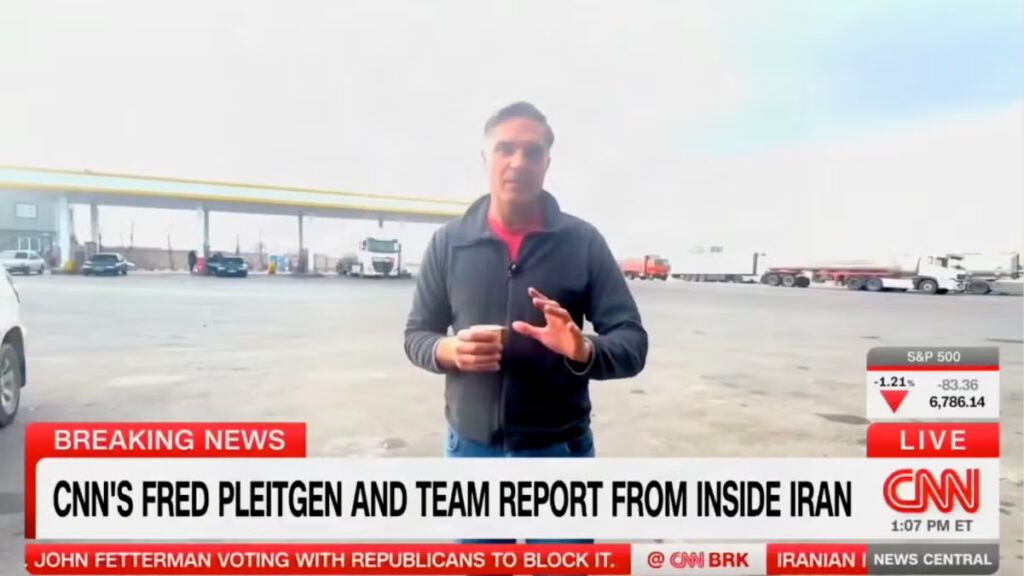
CNN defended correspondent Frederik Pleitgen on Friday after a top State Department official accused him of spreading “pro-Iran regime propaganda.”
The network said that Pleitgen, the first reporter from a U.S.-based outlet to enter Iran, “is providing valuable insight for CNN’s audiences, adding to our wider reporting that features multiple perspectives from civilians, opposition voices, as well as officials, alongside raw photos and video capturing what Iran is like today.”
“Each report also provides full transparent disclosure that the team is reporting from inside Iran with government permission,” CNN added.
On Thursday, Dylan Johnson, the State Department’s Assistant Secretary of State for Global Public Affairs, derided Pleitgen’s report showing how Iranians were still able to purchase coffee and groceries despite the U.S. and Israeli strikes on the nation.
“Someone gave this guy a coffee…” Johnson wrote.
CNN appears to now be doing straight up pro-Iran regime propaganda because someone gave this guy a coffee… pic.twitter.com/3IupIiuOU9
— Dylan Johnson (@ASDylanJohnson) March 5, 2026
A State Department spokesperson did not respond to an immediate request for comment.
An NPR reporter questioned the agency over how Pleitgen’s report amounted to “propaganda,” and the agency told her it encouraged news outlets “to verify information with official U.S. government sources before publication.
Reporters traditionally reach out to government agencies for comment on stories, but are not expected to hold reporting until verified by the government. In this case, Pleitgen reported what he witnessed firsthand.
“The role of journalism is to bear witness to events as they occur, to report out to audiences factually what a reporter is seeing, without agenda and with context,” CNN additionally said Friday in the statement. “Being able to do this from on the ground inside Iran during this conflict is of particular importance.”
Operating with spotty internet service, Pleitgen has used his dispatches to document life within the country as he travels to its capital, Tehran, such as showcasing open gas stations and grocery stores and explaining what he had to eat. “Breakfast was eggs and bread. No lunch as it is Ramadan. Dinner was kebab,” he wrote on X on Friday.
“You just don’t see any sort of degree of panic anywhere,” Pleitgen said in a Thursday report for the network.
Still, Pleitgen has also used his X feed to show explosions hitting Tehran before dawn, in one Friday video noting the “thick black smoke billowing from one location” in southern Tehran.
كاميرا CNN ترصد لحظة تعرض طهران لغارات كثيفة pic.twitter.com/GK9JTtMp0q
— CNN بالعربية (@cnnarabic) March 6, 2026
For a story documenting the challenges of covering the war in Iran, Pleitgen told TheWrap in an email that “personal safety is obviously a challenge with the ongoing air campaign, particularly when very heavy munitions are being used in dense urban areas” and they “try to keep clear of military and police installations when in country.”
Pleitgan said that he, photojournalist Claudia Otto and his producer “are always on high alert for airstrikes, which happen frequently and without warning, making them especially hard to predict,” adding: “We try to keep track of where airstrikes have been hitting and then be sure to avoid those areas.”
Pleitgen responded to Johnson on X: “I bought the coffee.”
The post CNN Defends Reporter in Iran After ‘Propaganda’ Accusation appeared first on TheWrap.