Winters in Minnesota are bitingly cold. But in a network of caves that sprawl beneath the farmland south of Minneapolis, the seasons do not matter much.
The caverns are always cool and clammy, and usually pitch dark, except when Martin Larsen’s headlamp lights them up.
Mr. Larsen, 44, is a farmer. But he is also an expert navigator of the rocky passageways furled deep beneath his neighbors’ fields. He descends there several times a year to collect water droplets that seep from the soil above.
He is looking for nitrates, a type of compound that occurs naturally in plants but is also common in industrial fertilizers, and can pose health risks when too much of it leaks into drinking water.
His data shows that nitrate levels in this corner of the Upper Midwest are too high, Mr. Larsen says, in large part because of the region’s longstanding devotion to America’s two biggest cash crops. “We need to farm corn and soybeans differently,” he said on a recent cave visit, his headlamp slicing a bright line through the gloom.
“Or,” he said, “farm something different than corn and soybeans.”
Mr. Larsen, who works part time for the county’s soil and water conservation district, grows corn and soybeans himself, just like his father and his grandfather did before him. But lately, he’s been experimenting with another crop: oat. His spelunking has convinced him that the little grain can do a lot to keep nitrates under control.
He’s not the only one who thinks so. Mr. Larsen and hundreds of other Minnesota growers have banded together under a scrappy nickname — the Oat Mafia — to fight an uphill battle to change how their region farms.
Oats can do a lot for the land, said Lisa Kushner, a director with the Nature Conservancy, a large environmental nonprofit. They require less fertilizer than corn and can improve the soil, so that other crops do better when planted in rotation.
Oats are good at sopping up nitrates for several reasons, including timing: The grain is planted early enough in the year to capture fertilizers that would otherwise slip beneath the soil during the rains of late spring.
The threat that nitrates pose to drinking water is especially acute in southeastern Minnesota because of its geology: The bedrock has dissolved into a Swiss cheese of caverns, sinkholes and fractures. In that landscape, water can seep underground quickly, carrying nitrates with it. Studies have linked high nitrate concentrations to an increased risk of infant death and an elevated risk of cancer in adults.
Minnesota officials are trying to get a handle on nitrate levels in part by encouraging farmers to sign up for conservation programs. Mr. Larsen is convinced that oats should be part of the solution. The trick is finding a market for them.
American oat brands get most of their grain from Canada, a practice anchored by decades of habit and infrastructure. Mr. Larsen said his efforts to cement a partnership with the big oat brands, like General Mills, Quaker and Oatly, have been unsuccessful.
“I want a meeting,” Mr. Larsen said. “I want this to be beneficial for them and beneficial for us, and the community. They have the power to help.”
General Mills and Oatly said they support domestic sourcing and have worked with farmers to increase oat production. Quaker did not respond to a request for comment.
But Randy Strychar, an oat market analyst in Minnesota, said that American oat brands import most of their grains from Canada because of market forces.
“It’s just simple economics,” he said, adding that American oat producers are “fighting gravity” for various reasons, including low grain prices and an infrastructure adapted to imports.
Nevertheless, the Oat Mafia is growing and looking for new ways to bring its product to market. The group includes more than 200 farmers in Minnesota, Mr. Larsen estimated, and a few more in Wisconsin and Iowa.
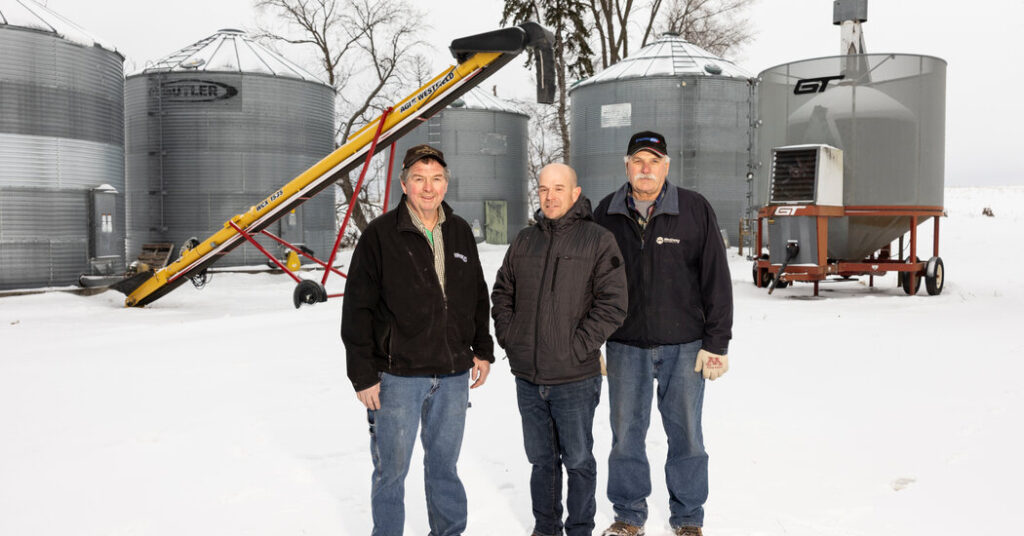
The effort began six years ago with Mr. Larsen and two other farmers: his friends Kevin Connelly, 60, and Tom Pyfferoen, 75. All three men remember growing oats when they were younger, before corn and soybeans gobbled up the landscape. On a frigid afternoon this winter, they gathered at a bar in Byron, Minn., and traded childhood memories of shoveling grains into storage and packing itchy straw into bales.
During the 1960s, about three million acres of oats were harvested for grain in Minnesota annually, government data shows. By 2024, that had shrunk to 140,000 acres, while corn and soybeans claimed a combined 15 million acres.
Historically, Minnesota farmers grew oats for animal feed. But the Oat Mafia is betting on oats for people, which have higher standards for purity and density. “We’re not planting our grandfathers’ oats anymore,” Mr. Connelly said.
They haven’t given up on the big crops. Instead, they fold oats into the rotation. One part of Mr. Larsen’s 1,400-acre farm may see oats one year, he said, soybean the next and corn the year after. That boosts the harvest for all three crops.
But the oats are the hardest to sell. This winter, some members of the Oat Mafia, including Mr. Larsen, are sitting on tens of thousands of bushels of oats, unsold and in storage. “Bushels sitting in bins is tied-up money,” Mr. Larsen said.
All kinds of American farms are struggling this year, no matter what they grow. Prices for most major crops are so low, because of high global productivity and other factors, that they do not even cover the costs of growing them, and many farmers are leaning heavily on federal assistance to stay solvent.
Corn and soybeans are considered essential to the U.S. economy and are buttressed by well-funded support systems, from crop insurance to federal subsidies to research grants. Oats don’t get the same protection.
Rob Tate, a corn and soybean farmer who is the treasurer of the Minnesota Corn Growers Association, said he liked what the Oat Mafia was doing and remembered seeing oats on his own family farm decades ago. But the economic incentives just aren’t enough to tempt him, he said.
“The guys doing the oats probably have a little more appetite for risk than some,” he added.
Without backing from big corporations, more than 130 farmers in the region have invested in their own solution: their own mill that is expected to open this summer.
At 124 feet, the $68 million facility, Green Acres Milling, is already the tallest building in Albert Lea, Minn. Landon Plagge, the Iowa farmer behind it, said that its oat products would be gluten and allergen free and that his customers will include small oat brands that are interested in sustainability. The mill will be able to process about four million bushels annually.
Mr. Strychar, the analyst, said that the timing for success was not ideal, in part because the United States has more milling capacity than it needs.
But Mr. Larsen, who invested $50,000 in the facility, said more capacity was necessary to make oats viable for small farmers who are trying make their land more fruitful and their water more safe.
“We’re making this work, out of the passion of our own hearts,” he said.
Jacey Fortin covers a wide range of subjects for The Times, including extreme weather, court cases and state politics across the country.
The post Where Corn and Soybeans Rule, the ‘Oat Mafia’ Fights for Turf appeared first on New York Times.