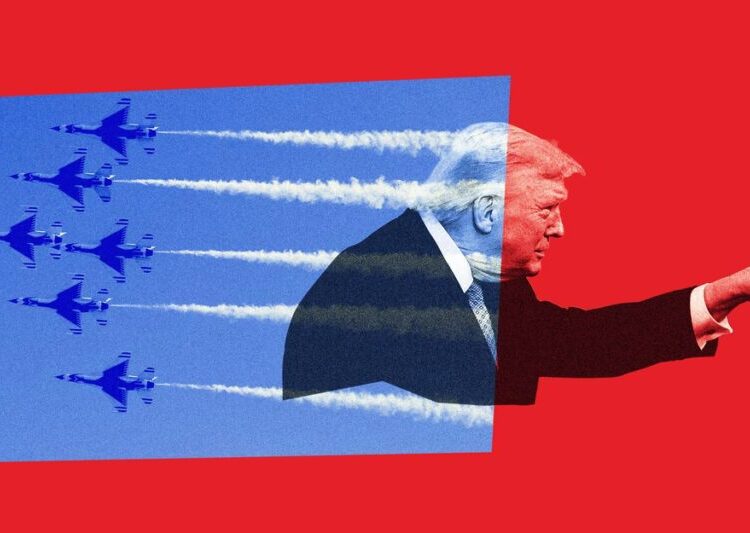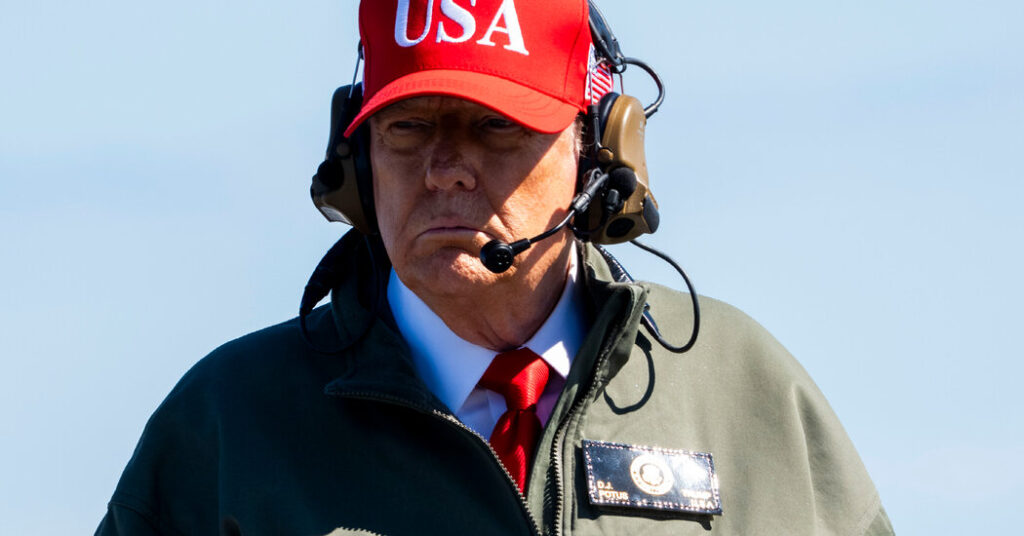
President Trump likes to assert that he has accomplished things no other president has. With the opening of his military assault against Iran, he has achieved another distinction: He is the first president in the era of modern polling to take the United States to war without the support of the public.
Traditionally, Americans stand behind their president when he first orders troops into battle, generally sticking with him unless it drags on, casualties mount and victory seems increasingly elusive. With Mr. Trump’s war against Iran, the public has skipped the rally-around-the-president phase.
Support for his ferocious bombardment of Iran has ranged from 27 percent in a Reuters/Ipsos poll to 41 percent in a CNN survey, far below the level of public backing that Mr. Trump’s predecessors initially enjoyed when they used force overseas. Given that wars tend to grow less popular over time, the initial negative response portends political challenges for Mr. Trump and his fellow Republicans the longer the fighting drags on.
The opposition is revealing about this particular moment in American history. A country already tired of decades of combat in the Middle East has shown little appetite for yet another adventure abroad. And the deep polarization of American politics only makes it harder to build support across lines. Even some Americans sympathetic to the goal of toppling the repressive, terrorist-sponsoring government in Tehran find it difficult to embrace Mr. Trump as commander in chief.
Moreover, unlike his predecessors, Mr. Trump has not done much to bring the public along, forgoing the usual tools of his office to explain to Americans what he is doing, why he is doing it and how it will end. Instead, he and his administration have offered contradictory accounts of what drove this decision and what victory would look like.
“As he has in many other areas, President Trump is pioneering a new approach,” said Peter D. Feaver, a national security aide under President George W. Bush during the wars in Iraq and Afghanistan. “He has enjoyed considerable success in doing other things that previous presidents thought couldn’t or shouldn’t be done, but this is one of the biggest political gambles he has taken.”
The consequences are enormous for Mr. Trump’s presidency, for the success of the war and for the upcoming midterm elections, with Republicans already facing ominous signs that they could lose one if not both houses of Congress. The war power votes in the Senate and the House over the past two days, in which Republicans backed Mr. Trump, may be featured in Democratic campaign ads this fall.
“This war starts underwater, and it’s only going to grow more so, which is going to hurt Republicans on the ballot,” said Cornell Belcher, who was President Barack Obama’s pollster. “Perhaps one could inoculate some of that if they had a central message that resonated, but they have a new rationale every other day — way too many mixed messages, which only adds to voters’ confusion and suspicions.”
Mr. Trump has brushed off the public opposition. “I think that the polling is very good, but I don’t care about polling,” he told The New York Post. “I have to do the right thing. I have to do the right thing. This should have been done a long time ago.”
Karoline Leavitt, the White House press secretary, said the president believed the public supported his actions against Iran. “I think he does,” she told reporters on Wednesday. “And I think the president knows the country is smart enough to read past many of the fake news headlines produced by people in this room that this action was unjustifiable.”
Since World War II, presidents have enjoyed public support at the start of wars, including the beginning of military operations in Korea, Vietnam, Grenada, Kuwait, Somalia, Bosnia, Haiti, Kosovo, Afghanistan, Iraq, Libya and Syria. Support in Gallup polling has ranged from 51 percent for Bill Clinton’s intervention in Kosovo in 1999 and 53 percent for Ronald Reagan’s mission to Grenada in 1983 to 83 percent for George H.W. Bush’s war with Iraq in 1991 and 90 percent for George W. Bush’s war in Afghanistan in 2001.
The only instance in modern times that a major military operation drew less than majority support at the start of the conflict was Barack Obama’s air war in Libya in 2011 to prevent the threatened slaughter of civilians. But even then more Americans supported it than opposed it, 47 percent to 37 percent, according to Gallup.
Presidents traditionally gain support during moments of crisis and war, too. John F. Kennedy gained 13 percentage points after the Cuban Missile Crisis in 1962. Lyndon B. Johnson gained eight points after bombing Hanoi in 1966.
George H.W. Bush gained nine points after invading Panama in 1989 and 18 points after going to war to expel Iraqi invaders from Kuwait in 1991. The younger Mr. Bush gained eight points after the capture of Saddam Hussein in 2003, and Mr. Obama gained 11 points after the raid that killed Osama bin Laden in 2011.
By contrast, Mr. Trump, already historically unpopular according to polls, has so far gained not a bit of support.
Public support for war is a key ingredient in success in the long run, if history is any guide. “It strengthens the president’s hand because there will inevitably be setbacks, people will lose the lives of their children and their relatives,” said Michael Beschloss, the author of “Presidents of War,” a history of commanders in chief during times of combat. “And a president has to be able to be in a position to say, ‘This is what your son or daughter died for.’”
Mr. Feaver, a professor at Duke University who has studied the role of public opinion during wartime, said “the largest rallies go to leaders who are going to war to avenge an attack on the United States — Roosevelt after Pearl Harbor or Bush after 9/11.” In other cases, presidents can generate support by making the public case that war is needed to avoid an urgent threat, as with the first Mr. Bush before the gulf war.
“Leaders waging pop-up wars that don’t really meet either of those conditions — Reagan in Grenada 1983, Clinton in Kosovo 1999, Obama in Libya in 2011 and Syria 2014 — rolled the dice that the intervention would be low-cost, quickly resolved and with minimal second- and third-order consequences,” Mr. Feaver said.
“What is striking about Iran 2026 is that it doesn’t seem to fit any of those categories,” he added.
Even in the case of Pearl Harbor, Mr. Beschloss pointed out that Franklin D. Roosevelt had been preparing the country for two years for the possibility that it might have to enter World War II. But Harry S. Truman and Johnson never really were able to do that with Korea or Vietnam, and support eroded over time.
“Presidents have this power, and if they use it and they don’t educate the public, the public gets very angry and disenchanted and turns against the government,” Mr. Beschloss said. “One reason the public has so little faith in government right now is the number of presidents who failed to convince Americans in advance why they needed to go to war.”
Karl Rove, who as deputy White House chief of staff under the second Mr. Bush saw support for the Iraq war slide over time, wrote in The Wall Street Journal that Mr. Trump still had the opportunity to win converts. He pointed to a CBS/You Gov poll taken just before the start of the airstrikes that found 51 percent support for military action against Iran when framed as an effort “to stop them from making nuclear weapons.”
That meant, Mr. Rove said, that Mr. Trump needed to do more to make the case to the public: “This can’t be just left to the eight-minute Truth Social video the president posted early Saturday morning or to a few brief calls by him to journalists.”
But these are cynical and divisive times. Americans have been sour on the direction of the country for more than two decades, polls show, while losing trust in presidents of both parties as well as institutions like Congress, the Supreme Court, business and the news media.
“The country is different,” Mr. Beschloss said. “People are more suspicious of what an American government says.” And overcoming that distrust poses an enormous challenge amid an escalating war being waged without a clear end game.
Peter Baker is the chief White House correspondent for The Times. He is covering his sixth presidency and sometimes writes analytical pieces that place presidents and their administrations in a larger context and historical framework.
The post Wars Often Lose Public Support Over Time. Trump Started This One Without Much. appeared first on New York Times.