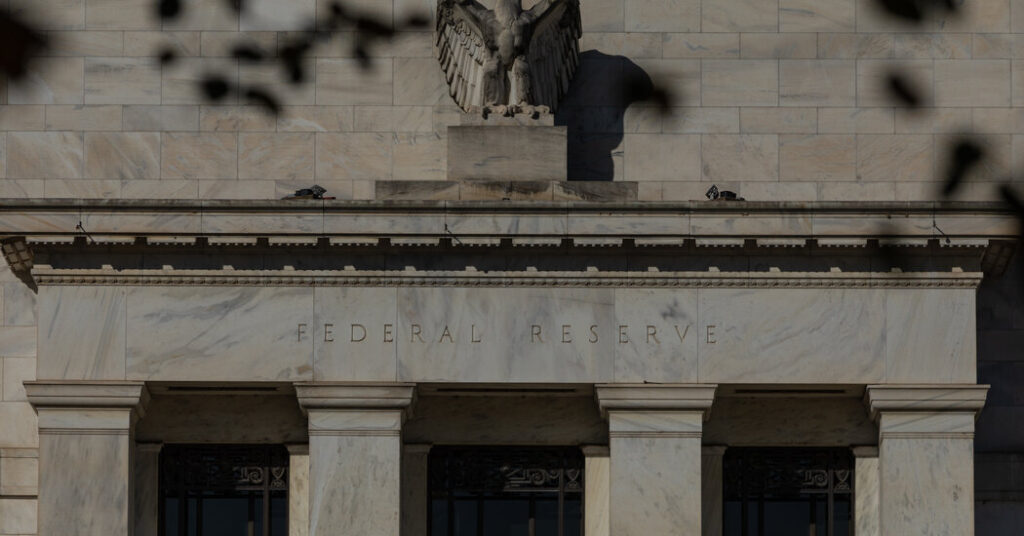
New data on Friday showing a sharp decline in monthly jobs growth has put the Federal Reserve in a tough position as it simultaneously grapples with heightened concerns about inflation amid the widening Middle East conflict.
February’s jobs report showed employers shedding 92,000 positions for the month as the unemployment rate ticked slightly higher to 4.4 percent. In another warning sign, December and January jobs growth was revised down by 69,000.
The data comes just before a scheduled communications blackout ahead of the Fed’s next policy meeting on March 17-18. Officials are still widely expected to hold rates steady at a range of 3.5 percent to 3.75 percent, extending a pause that began in January. But according to federal funds futures markets, some investors have begun to pull forward their expectations about the timing of the next cut to July from September.
In an interview on Friday, Austan D. Goolsbee, president of the Federal Reserve Bank of Chicago, described February’s report as a “tough” one, although he cautioned against reading too much into one month’s data. He stressed that bad weather and strikes likely weighed on hiring, and pointed out that at 4.4 percent, the unemployment rate is right around the same level as this time last year.
“If you start to see that number rising the way it does traditionally at the beginning of recession, that would be a bad sign,” he conceded, however.
That concern was echoed by Mary C. Daly, president of the San Francisco Fed, who told CNBC on Friday that the labor market remained vulnerable.
“The hopes that the labor market was steadying, maybe that was too much, and we really have to keep our eye on the labor market,” Ms. Daly said.
Officials at the Fed are chiefly concerned about the combination of a weakening labor market and elevated inflation, which would pit the Fed’s goals against each other. That worry first arose when President Trump unleashed a barrage of tariffs against the country’s trading partners soon after returning to the White House last year. Officials braced for higher inflation and slower growth as a result, with panned out but not as badly as initially feared.
“If the job market is getting worse and inflation is getting worse at the same time, it’s not obvious to me what the immediate response should be,” Mr. Goolsbee said on Friday.
He said the Fed would likely not react to the Middle East conflict and the recent surge in energy prices if the supply shock ended up being temporary and the war short-lived. But a longer-lived conflict could prove problematic, he said, especially given that inflation has been above the Fed’s 2 percent target for roughly five years.
“The longer you’re at 3 percent or above on inflation, the more dangerous it is,” he said.
Before policymakers meet next month, they will have in hand two new inflation reports: February’s Consumer Price Index report to be released next Wednesday; and next Friday, the Fed’s preferred gauge, the Personal Consumption Expenditures Price Index, for January. Job openings data for January will also be released that day.
Until this point, officials have broadly argued that they do not need to be in a rush to lower rates again after delivering three quarter-point cuts between September and December. Those moves brought rates down to the upper range of what most officials consider to be a “neutral” setting that neither speeds up nor slows down growth. While most policymakers have signaled that the next move for the Fed is likely to be another rate cut, a cohort of officials have indicated that they do not want to rule out the possibility of rate increases.
Beth M. Hammack, president of the Federal Reserve Bank of Cleveland, confirmed in an interview this week that she falls into that camp. She said that if there are no longer signs that inflation is moving toward the 2 percent target, “it could mean that we need to put more restriction on the economy.”
For the time being, however, she said the Fed “could be on hold for quite some time.”
Colby Smith covers the Federal Reserve and the U.S. economy for The Times.
The post Weak Jobs Data Underscores Fed’s Dilemma as War Stokes Inflation Risk appeared first on New York Times.