For much of the past year, Lebanon’s government has walked a tightrope in its dealings with the Iranian-backed armed group Hezbollah as it has moved to disarm the militants and curb their influence in Lebanese politics.
Now, as Lebanon faces a rapidly escalating conflict between Hezbollah and Israel, the country is waiting to see if the government seizes on this moment to take decisive action against Hezbollah — and how the group will respond.
Overnight, the Israeli military pounded Hezbollah in the southern edge of the Lebanese capital with explosions that could be heard across the city. The bombardment displaced thousands of people from the densely packed area who spent the night on the streets of downtown Beirut.
“This is the tipping point,” said Sami Nader, the director of the Institute of Political Science at Saint Joseph University of Beirut. “Either we have the dark scenario where the army clashes with Hezbollah and there is civil strife, or Hezbollah abides by the government decision and they disarm.”
When it comes to Hezbollah, Lebanese officials have had to strike a delicate balance over the past year: appeasing demands from the United States and other allies to act quickly and decisively against the group while proceeding cautiously to avoid clashes between Lebanese soldiers and Hezbollah militants, a scenario that many fear could unleash civil conflict in Lebanon.
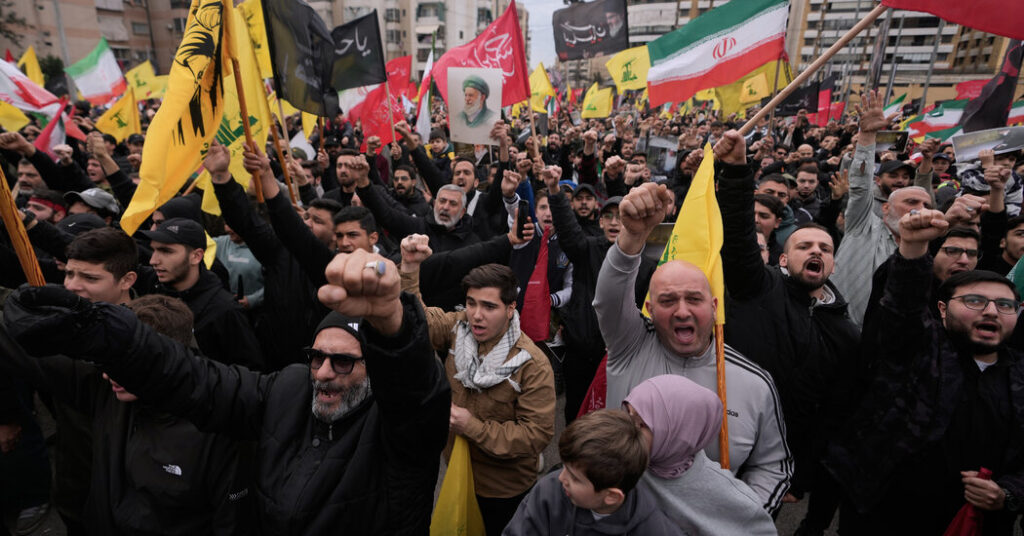
But when Hezbollah began firing at Israel this week in retaliation for the killing of Iran’s supreme leader, Ayatollah Ali Khamenei, setting off more deadly fighting with Israel, that calculation appeared to unravel.
On Monday, the Lebanese government lashed out at Hezbollah, declaring its military activities illegal and effectively designating what was once the country’s most powerful force as an outlaw. Hezbollah retorted with a veiled warning that if the government stuck to its decision, it could ignite internal strife.
A weak government “should refrain from creating additional internal problems that could further inflame the state of tension and unrest,” a senior Hezbollah official, Mohammad Raad, said in a statement.
In response, government officials have doubled down, in what appeared to be an effort to root out all Iranian military influence in the country. The government announced on Thursday that it would crack down on any Islamic Revolutionary Guards Corps members in Lebanon and deport them.
A yearlong war between Hezbollah and Israel erupted when the militants launched rockets at Israeli positions in October 2023 in solidarity with Hamas, another Iranian-backed group, which led a deadly attack against Israel that same month.
The Hezbollah assault prompted Israel to respond with a barrage of attacks that ended in a cease-fire November 2024 and left much of Lebanon and Hezbollah battered. Many analysts say that after thatwar, Revolutionary Guards members filled Hezbollah’s depleted ranks in Lebanon and took over much of the group’s military decision making.
The Lebanese Armed Forces also announced this week that they had detained 26 Lebanese nationals at army checkpoints “for illegally possessing weapons and ammunition.” While the army statement did not mention Hezbollah by name, it suggested that the army was moving forward with carrying out the government’s decision.
The showdown is a pivotal moment for the country, and it comes as it is engulfed in a rapidly escalating war between Hezbollah and Israel. Since Hezbollah first fired at Israel on Monday, Israel has unleashed a relentless barrage of airstrikes across southern and eastern Lebanon and in the southern edge of Beirut, known as the Dahiya, where Hezbollah holds sway.
Israeli forces have also invaded and seized parts of southern Lebanon, where Hezbollah militants have engaged them in clashes over the past two days. On Wednesday and Thursday, the Israeli military announced evacuation warnings for a huge section of southern Lebanon — raising fears of a large-scale invasion of the south — as well as the entire Dahiya.
Amid the new battles with Israel, political tension within Lebanon is also erupting.
Lebanon’s fractious political and social mix includes Shiite and Sunni Muslims, Christians of various denominations and Druse, who once all battled one another in a blood-soaked, 15-year civil war. Within the Lebanese state, those factions and sects have long jockeyed for power and influence. But for most of the past two decades, Hezbollah has prevailed above all as the country’s dominant military and political force.
After Hezbollah’s previous escalation with Israel ended with the fragile cease-fire, the political sands in Lebanon began to shift. That conflict cost the group much of its arsenal and wiped out its military ranks. Frustration brewed among its largely Shiite Muslim support base, many of whom were displaced during the war.
The Lebanese state used that moment as an opportunity. With Hezbollah on the back foot, Lebanon’s Parliament overcame years of political gridlock that critics had attributed to Hezbollah and formed a new government. Momentum built to disarm Hezbollah and remake the power balance in a country where many believed that the government had been effectively hijacked by the Iranian-backed militant group.
In the year since, the government and the Lebanese Army have come under fire for moving too slowly in those efforts. Military leaders have argued that their cautious approach reflects the military might still held by Hezbollah and concerns that a more aggressive crackdown could prompt clashes between soldiers and Hezbollah fighters, potentially spreading into broader domestic unrest.
The last time the Lebanese government moved against Hezbollah, in 2008, the confrontation quickly turned deadly. After the government led by Prime Minister Fouad Siniora attempted to dismantle Hezbollah’s private communications network, clashes erupted in Beirut between pro-government supporters and Hezbollah fighters.
But Hezbollah’s decision to engage Israel militarily after the killing of Ayatollah Khamenei appears to have altered that calculation, analysts say.
Hezbollah’s attack on Israel also highlighted the shortfalls of the government’s efforts to disarm the group. Over the past week, as Hezbollah has continued to launch rockets at Israel and clash with Israeli ground forces, the group has demonstrated that it still retains some military capabilities.
Still, compared to the height of Hezbollah’s military and political influence, the group is in many ways weaker than it has ever been. Its arsenal has been depleted and destroyed after its previous confrontation with Israel, and it is also more politically isolated than ever before, analysts say.
On Monday, Hezbollah lost its main political ally, the Amal Movement, Lebanon’s other powerful Shiite political party, whose parliamentary and ministerial blocs sided with the government in the decision to ban Hezbollah’s military activity.
Frustration among its supporters has also swelled as the renewed Israeli bombardment causes more deaths and displacement. Whether Hezbollah can maintain its base of support has now been thrown into question.
The government’s decision on Monday “clearly shows how much ground they have lost and how much of the support they used to have they have lost,” said Paul Salem, a senior fellow at the Middle East Institute, based in Washington. “It is a very important line in the sand for the state,” he added.
Still, it remains unclear how the government’s decision to declare Hezbollah’s military activities illegal amounts to political posturing or will lead the Lebanese Armed Forces to take more aggressive action against Hezbollah.
Over the past year, Hezbollah has allowed the government to move forward with its disarmament plans “and not used its military force to clash with them,” Mr. Salem said.
“The question now is, if cornered between Israel and the Lebanese government, would that strategy change?” he said. “Would they say to hell with it and foment some serious internal trouble, which is a scenario everyone has been afraid of.”
Christina Goldbaum is The Times’s bureau chief in Beirut, leading coverage of Lebanon and Syria.
The post Lebanon at ‘Tipping Point’ as It Seeks to Curb Hezbollah’s Influence appeared first on New York Times.