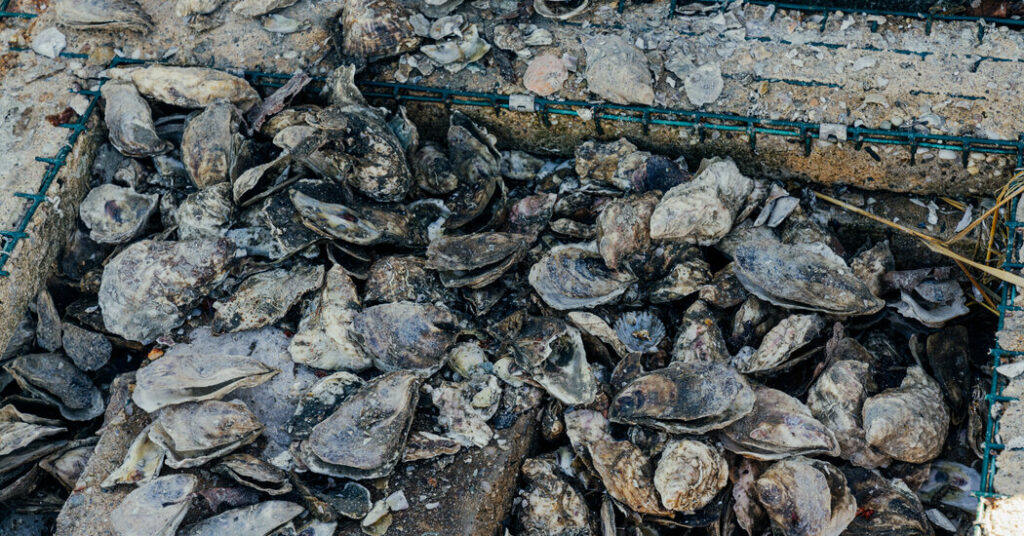
Peter Stein stood on a dock on Peconic Bay and stared at the wreckage. After weeks of being seized in ice off the East End of Long Island, hundreds of his oyster cages were now broken and scattered all over the bay.
A month earlier, the cages were full of oysters that can cost more than $4 apiece at Manhattan restaurants like Balthazar, Gramercy Tavern and Oceana.
But Mr. Stein said that most of his floating farm system — more than 2,000 cages, each holding up to 250 oysters — had been ripped apart by ice that was “by far the worst” he’d seen since he founded Peeko Oysters a decade ago.
The thaw from one of the harshest cold snaps in memory strewed Mr. Stein’s cultivation gear far and wide. Parts of cages, lines and floats were left drifting around the bay, stranded on shorelines and even tangled around the propeller shaft of a Shelter Island ferry.
Since then, he and his crew have been looking for them using sonar, drones and word of mouth, enlisting other oyster farmers and locals.
“It’s a search-and-retrieval effort at this point,” he said.
Nearly 40 miles to the west, in the Great South Bay off Fire Island, another oyster grower, Ray Smith, said the ice decimated his farm and those of a dozen others nearby.
“Everyone got hammered,” said Mr. Smith, who co-owns Toasted Oysters, known for its prized Blue Point oysters.
“Two-thirds of our farm was gone,” he said. “We don’t know where it is.” The cages that he could locate were damaged and contained oysters that had most likely frozen to death after so long in the ice.
Long Island growers were not the only ones battered by the freeze. The harsh winter affected nearly all of the oyster production up and down the Eastern Seaboard, from the Chesapeake Bay of Virginia to Maine’s rocky Midcoast and farther north.
Dale Parsons, a grower in South Jersey, called it “the worst ice we have had in close to 30 years.” In Maine, Abby Barrows, who owns Deer Isle Oyster Company in Stonington, used a chain saw to cut through the ice to access her farm. And the Nauti Sisters Sea Farm in Yarmouth chronicled a “recovery mission” in which fellow farmers, lobstermen and drone videographers helped locate and retrieve displaced gear.
Though Long Island produces only a fraction of the oysters of these regions, its varieties have a certain prestige among oyster aficionados. Now, after a decade-long resurgence, the Long Island oyster faces a serious challenge to keep its place on the menu at seafood restaurants in Manhattan and the Hamptons.
According to Eric Koepele, president of the Long Island Oyster Growers Association, most of the group’s roughly 50 commercial farmers suffered damage to their gear and crop losses. Many farmers said it would take months to re-establish their farms and years to regrow the oysters that had died.
“This is a monstrous event caused by an unprecedented freeze,” said Mr. Koepele, whose family-owned company, North Fork Big Oyster, lost more than 300 cages, each costing around $300 and holding up to 2,000 oysters. Since the ice began melting, his son, Grady Koepele, has been hunting for the cages. Last Friday, he spent the morning navigating between remaining ice floes in the Peconic Bay.
A congressman representing eastern Long Island, Nick LaLota, has asked the National Oceanic and Atmospheric Administration to declare a “fishery disaster” for Long Island waters.
Long Island was once a leading oyster producer nationally, but stocks declined in the early 20th century because of pollution, over-harvesting and disease outbreaks. The industry has seen a kind of rebirth in the past decade, fueled by an unlikely pairing of salty baymen and entrepreneurs who have left city careers for lives on the water. For the newcomers, the ice damage has been a bracing shock.
Mr. Smith, of Toasted Oysters, is a former paramedic who started his farm three years ago with Mike Miezianka, a retired New York City police detective. Before the cold snap, they were working hard to establish their brand and cultivate relationships with restaurants, and were approaching a return of almost a dollar per oyster to retail customers. They had been hoping to sell 500,000 oysters this year.
“After our first two years, this was going to be our big year,” Mr. Smith said, “and now it’s not.” Including the oyster seed, he said that most of their 2.6 million oysters had been lost. “I wouldn’t be surprised if we’re only left with 20 percent of our oysters.”
Typically, Long Island farmers grow their product in cages or bags that either float on the surface of the water or rest on bay bottoms. Many surface farmers avoid the risk of winter ice by sinking their farms to the bottom during the coldest months, a process that is arduous and time-consuming. Others, emboldened by the rarity of bays freezing solid, leave their cages bobbing all winter.
But the massive ice floes that formed last month spared neither method.
Driven by currents and wind, the ice plowed through floating gear on numerous farms, wrenching them and their mooring lines free and scattering them sometimes miles away, sometimes dragging 500-pound mushroom anchors with them.
Even some oyster farmers who sunk their cages found they were not safe from the deep-reaching ice.
Matt Ketcham, 37, who started Peconic Gold Oysters in 2013, said he had spent weeks submerging his cages at least 12 feet beneath the surface. They were still crushed and dragged by the ice.
“There’s nothing stopping these things when they come through,” he said on a recent afternoon. Most of the ice had thawed, and he was on the bay using sonar and a grappling hook to recover lost lines and stray cages that had been tossed around his 10-acre lease and beyond.
Using a hydraulic hoist mounted to the bow of his boat, he lifted heavy, kelp-covered cages from the cold, clear water. On board, he could assess the damage and untangle fouled lines.
The owners of Little Ram Oyster Company on the North Fork said they had lost roughly a third of their crop, and that the damage to their equipment had amounted to tens of thousands of dollars.
“We take every precaution we can to be as safe as possible, but this just happened to be the winter of 2026 that we’re all going to talk about,” said Stefanie Bassett, who co-owns the company with Elizabeth Peeples.
The company also started a fund-raiser entreating the public to “adopt” Little Ram oyster cages and “stand with us through this rebuild.”
In less than a week, Ms. Bassett said, more than 120 people had donated.
For Mr. Stein of Peeko Oysters, the loss was particularly keen because he had just installed a new type of floating system last year called FlipFarm. The floating cages were tethered by strong lines anchored by long helix anchors drilled into the bay bottom. The system was not designed to be sunk but seemed secure, he said.
“There’s a certain point,” he said, “where you say, I’ve done everything I can do and it’s up to Mother Nature now.”
Corey Kilgannon is a Times reporter who writes about crime and criminal justice in and around New York City, as well as breaking news and other feature stories.
The post After a Brutal Winter, Worse News for Oyster Farmers appeared first on New York Times.