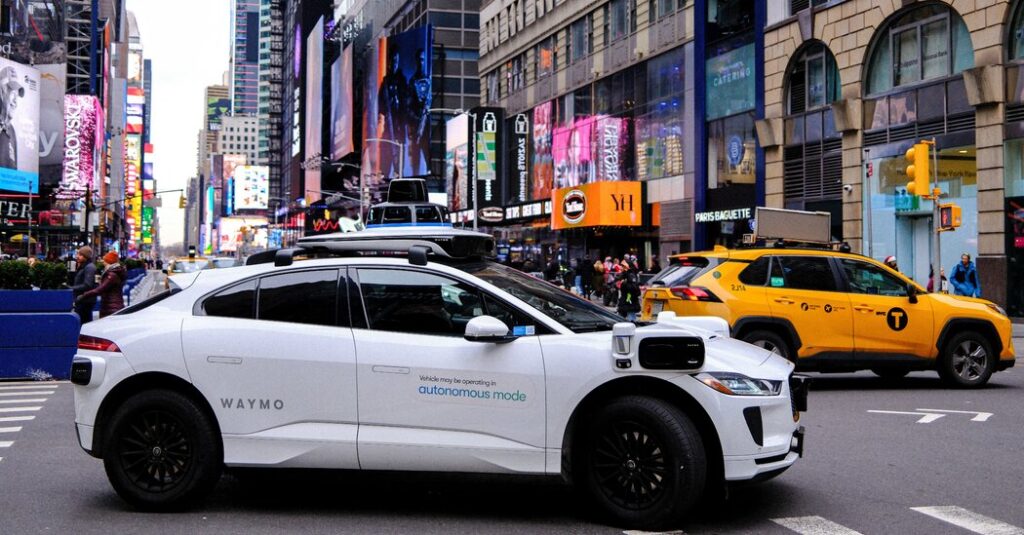
Gov. Kathy Hochul made waves in January, when she said she would let tech companies start picking up passengers with driverless cars outside of New York City. The planned pilot program would have been a big leap forward for the so-called robotaxi industry, which has already expanded rapidly in some other states.
A month later, the proposal was gone, stripped from the executive budget with little explanation besides that of a lack of “stakeholder” support.
But the reversal had little to do with the merits of robotaxis, three people familiar with the discussions said, and more to do with one of Ms. Hochul’s signature priorities for the year: trying to tame New York’s runaway car insurance costs.
The two seemingly unrelated policies have become tangled in a behind-the-scenes squabble that could stall the spread of robotaxi companies like Waymo, since the governor is seeking support for her auto insurance reforms from labor unions that detest driverless cars, those people said.
Pulling in that union support could help Ms. Hochul as she faces off with a powerful group of trial lawyers, street-safety advocates and state lawmakers, all of whom are either skeptical of the governor’s claims that the changes would save the average driver money or worried about depriving crash victims of compensation for their injuries.
She is hoping labor groups can serve as a potent counterweight to opponents of the changes and use their lobbying muscle to help get them passed in the Legislature.
Facing re-election this year, Ms. Hochul is framing the insurance reforms as part of a broader campaign to rein in costs for regular New Yorkers. Drivers in the state pay some of the highest premiums in the country, according to the Citizens Budget Commission, a fiscal watchdog group, and climbed to an average $1,896 a year in 2023, 32 percent higher than the national average.
The governor says the premiums have soared, in part, because of fraudulent claims and legal loopholes that incentivize frivolous lawsuits. Supporters of her plan say reforms are necessary to crack down on a spate of staged car crashes, in which fraudsters cause collisions in order to collect insurance payouts, thus raising coverage costs for other drivers.
Ms. Hochul’s plan would cap damages for victims of car crashes who were either uninsured, impaired or committing a felony, limiting what they are allowed to receive for pain, suffering and emotional distress to $100,000. She is also seeking to narrow the categories that allow a victim to meet the legal definition of “serious injury.”
The changes would also include a rule that drivers in car crashes who are found to be more than 51 percent at fault cannot seek compensation at trial beyond the $50,000 offered under no-fault coverage.
The Citizens Budget Commission estimated that the reforms could shrink drivers’ premiums by 10 percent, or about $200 a year.
“These common-sense proposals will not only crack down on fraudulent claims that drive up the cost of car insurance, they’ll put money back into the pockets of hard-working New Yorkers,” Ms. Hochul said last month.
Lining up behind the governor is the ride-share company Uber, which has so far plowed $5 million into a new independent expenditure committee called Citizens for Affordable Rates PAC, which is leading a lobbying push.
Josh Gold, a spokesman for Uber, said the governor’s actions would help bring costs down for their drivers. “Premium spikes make it harder for them to keep driving and harder for New Yorkers to afford rides,” he said.
The Metropolitan Transportation Authority has also backed the insurance proposals, noting that they could help reduce its own legal costs. Other supporters include the Trucking Association of New York, which has said insurance costs are among its members’ largest expenses.
But a broad array of opponents, led by the influential New York State Trial Lawyers Association, has argued that the plan’s benefits are overstated.
Andrew Finkelstein, the president of the trade group, which represents clients who often sue insurance companies, said the savings were not likely to be passed onto the average car owner.
“There’s no direct correlation between the change in the law and a reduction in policy premiums,” Mr. Finkelstein said. “It is hope. It is not policy.”
Advocates for safer streets have also come out against Ms. Hochul’s proposals, saying they will unfairly reduce compensation for crash victims.
“The focus should be on reducing crash frequency and injury severity,” said Peter Beadle, a personal injury lawyer in Queens who believes street redesigns and lower speed limits would do more to reduce auto insurance costs.
“This is about saving insurance companies money,” he said.
Kristin Devoe, a spokeswoman for the governor, dismissed the criticism as coming from “special interests” who were “worried about lining their own pockets.”
“The governor’s plan will enhance safety on our roads, drive down the exorbitant costs of auto insurance and stop bad actors from cashing in on a flawed system that rewards dangerous driving and fraud,” she said.
Hoping to counter the opposition she was facing by enlisting the support of powerful unions, the governor pulled back on the autonomous vehicle pilot, which would have allowed a limited number of driverless cars to pick up passengers outside of New York City, according to the people familiar with the discussions.
Some of the labor groups she has courted have expressed grave concerns about how the growth of driverless vehicles could affect their members’ jobs.
The New York Taxi Workers Alliance, which represents more than 28,000 cab, Uber and Lyft drivers in the city, and strongly opposes driverless cars, is “still vetting the proposals” on insurance, said Bhairavi Desai, the group’s executive director. She said the governor’s office had not asked her to support the insurance reforms in exchange for anything.
Another is the Transport Workers Union, which organizes a broad swath of transit workers and has not yet weighed in on the insurance plans.
But its leaders have described robotaxis as an existential threat. The union was also furious when Ms. Hochul vetoed a bill in December that would have protected the jobs of subway conductors from the prospect of train automation.
“The autonomous vehicles are an immediate, slippery slope toward freaking Armageddon for mass transit,” John Samuelsen, the union’s international president, said. “The job impact in New York would be astronomical.”
Some labor leaders fear that the governor’s reversal on robotaxis could be only temporary, as the industry expands elsewhere.
City and state officials have already granted Waymo, which is expected to benefit most from an expansion of driverless vehicles, permission to test a small number of supervised autonomous taxis in New York City, at least through the end of March. And the Port Authority of New York and New Jersey plans to test a driverless shuttle bus program at Newark Liberty International Airport this spring.
Ethan Teicher, a spokesman for Waymo, declined to comment on the insurance proposals.
A lack of assurances from the governor on the future of driverless cars in the state has given some labor unions pause, Mr. Samuelsen said.
“She is going to get through her election and try to come out and stick it to everybody,” he said about the likelihood of the governor restarting a push for driverless vehicles. “I don’t have any doubt in the world — I wish I could bet it in Vegas.”
David McCabe contributed reporting.
Benjamin Oreskes is a reporter covering New York State politics and government for The Times.
The post Robotaxis Put on Hold as Hochul Seeks Support for Car Insurance Reforms appeared first on New York Times.