This week in Newly Reviewed, Seph Rodney covers Deborah Roberts’s collages, Ursula von Rydingsvard’s wood outcroppings and Noel W Anderson’s superstars.
Chelsea
Deborah Roberts
Through April 25. The Flag Art Foundation, 545 West 25th Street; 212-206-0220, flagartfoundation.org.
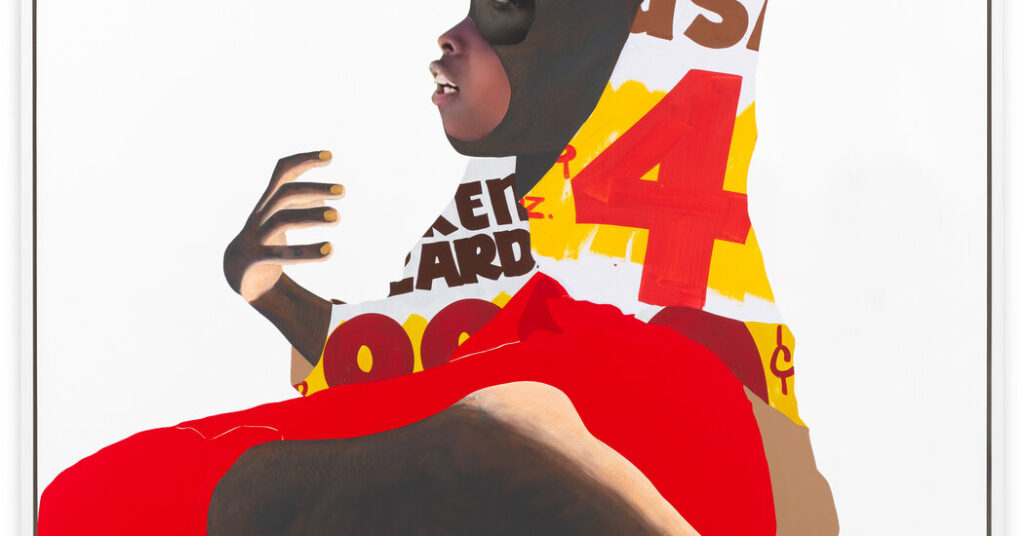
“Consequences of being,” an exhibition of new work by Deborah Roberts, 63, investigates the history of German, Dutch and South African colonization of Africa. These collages, which feature Black children, convey some grisly meaning.
“Many Thousands Gone” (2025) features an image repeated throughout the exhibition of a young girl who happily gazes back at the viewer as spectator, her smile wide and her plaited hair decorated with ribbons. But her clothing is stamped with the label “USDA CERTIFIED TENDER” and “USDA SELECT,” thus marking her body as something that is available to be consumed by those in the market.
Roberts, who lives in Austin, Texas, has been making collages since 2008 and has had an outsize influence on photographic collage in the past decade. (Frankly, I have seen too many artists reuse the visual motif of the cut-and-pasted exaggerated eye and mouth in her wake.) It’s wonderful that she has had this effect, but the rote repetition, and associated idea that we humans are always hybrid — a pastiche of textures, colors and experiences — can become a cliché.
Fortunately, much of the work here moves beyond that. “Market value,” for example, shows a boy on his side, legs folded, his feet the closest to the viewer. Though his shirt features truncated letters and numbers again suggesting some kind of food for sale, his hands gesture defensively. He has tumbled to the ground, but his eyes are on not us; rather, they gaze at something threatening that is outside the frame. This seems critical: to train his attention on whatever it is that may do him harm.
Chelsea
Ursula von Rydingsvard
Through March 28. Galerie Lelong, 528 West 26th Street; 212-315-0470, galerielelong.com.
For about five decades, Ursula von Rydingsvard, 83, has been making wood totems that resemble ancient stone megaliths or cairns, and still every time I encounter her work it astounds me.
She uses a circular saw to make myriad cuts into standardized, industrial beams of cedar she then assembles to resemble outcroppings of rock, stony archways or monuments to a pantheon of gods passed out of memory.
They are confounding works in that they are large — many pieces in this show measure between eight and 11 feet high — and so contorted and gnarled that it seems that only the earth could have hatched them into being. But the surfaces are so jagged and grooved that they read as untouched by the leveling frictions of wind and rain. These works could only emerge from human fabrication.
Part of the wonder she conjures up has to do with scale — occasionally monumental. But she doesn’t depend on this tactic in the way that artists such as Richard Serra did, making objects so enormous that they overwhelm our capacity to hold them in the mind’s eye, and thus induce feelings of our own fragility. Von Rydingsvard isn’t trying to engulf the viewer in an experience some might call the sublime.
One of several pieces named “Untitled” (2024-25) consists of a low, circular structure of mostly sand-colored cedar. There are rose highlights too, with a pattern of dark indentations incised throughout the sculpture’s circumference, like runic symbols meant to charm the water and protect the source. This is where the work of hands becomes more than just industry; this is art that aspires to the spiritual.
Chelsea
Noel W Anderson
Through March 21. Harper’s Chelsea 512, 512 West 22nd Street; 917-677-0057, harpersgallery.com.
You will likely recognize many of the faces of the Black men and women depicted in Noel W Anderson’s exhibition “Courtside Sermon,” among them Paul Pierce, LeBron James, Michael Jordan, Magic Johnson, Nina Simone and James Brown.
The inclusion of Simone and Brown, along with the show’s title, suggests that Anderson regards all of these figures not just as superstars, but also more significantly as performers within similar fields of play. The basketball court, the bandstand, and the preacher’s lectern are all arenas in which a kind of spectacular kind of Blackness gets put on display.
Anderson, 44, works primarily with images taken from media archives, digitally manipulating them before a machine weaves them into cotton tapestries. The textiles are then further manipulated by his hand: He abrades the fabric with wire brushes and picks out individual threads. This process can be seen in “Deep in Thought at?” (2022-26), a rendering of Magic Johnson’s head in which a rainbow of underlying threads pock his face to the extent that he seems to be wearing a mask. In this way the artist makes literal what he sees as the warping effects of sports and entertainment media on the public perception of Black people.
In “Black Joy: Curry Caught Spirit” (2024-26) several images of the basketball player Stephen Curry overlap, making him seem like a wraith moving in and out of states of corporeality as fans clamor to capture images of him with their devices.
The astronomic sums paid to athletes and performers, for playing games that are simply meant to entertain, occasionally stoke public outrage. But it’s through these performances that we catch glimpses of how we too might learn to fly.
See the February gallery shows here.
The post Art Gallery Shows to See in March appeared first on New York Times.