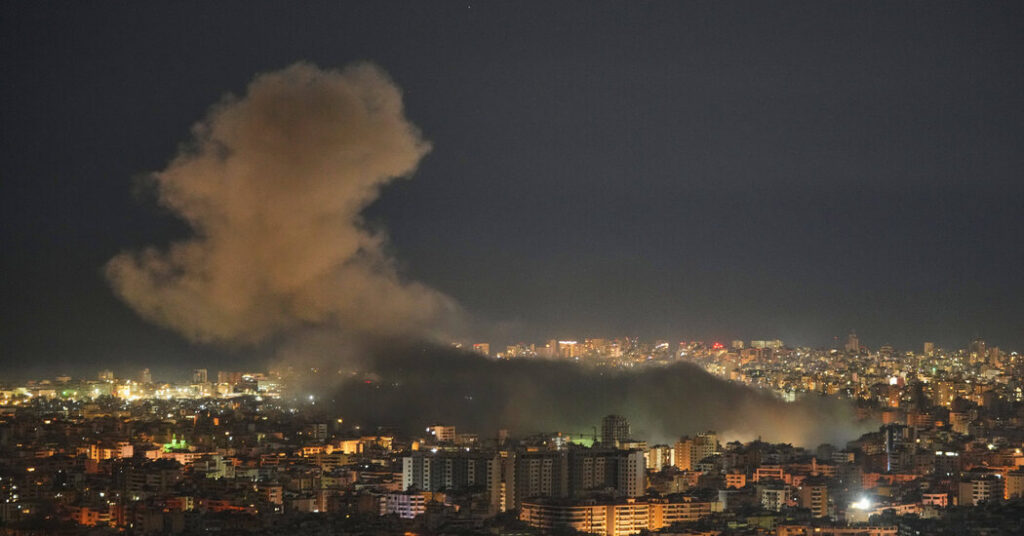
An Israeli order for residents to “save your lives and evacuate your homes immediately” brought chaos to the suburbs of Beirut on Thursday and was punctuated hours later with a bombing campaign by Israeli warplanes that raised fears of a new front in the metastasizing Middle East war.
The Israeli bombings, which rolled across the city like thunder, began just before midnight in a densely populated area outside the capital where Hezbollah, the Lebanese militant group, holds sway. The group has received weapons and financial support from Iran for decades and has engaged in multiple wars with Israel.
The strikes in Lebanon were the latest proliferating effects of the nearly weeklong war recently launched by the United States and Israel, a conflict that the United Nations said on Thursday had affected 16 countries.
As questions swirled about possible end games for the war, President Trump earlier told two news outlets on Thursday that he wanted to be involved in picking a new leader for Iran, in his most explicit statement yet about his vision of the U.S. role in creating a new government in Tehran.
In an interview with Axios, Mr. Trump said that Mojtaba Khamenei, a son of the former leader, Ayatollah Ali Khamenei, who appeared to be the top candidate to succeed his father, was an “unacceptable” choice.
Mr. Trump won a victory in the House on Thursday when lawmakers voted down an effort to halt the battle in Iran. A small bloc of Democrats joined nearly all Republicans in delivering an early sign of support for the war.
European governments, meanwhile, on Thursday accelerated their deployment of military assets in the Middle East as they found themselves drawn into a conflict that many leaders initially said they opposed.
Prime Minister Keir Starmer of Britain said four fighter jets were being sent to Qatar to strengthen “defensive operations” across the region, and military helicopters with counter-drone capabilities were scheduled to arrive in Cyprus on Friday. Italy said that it was sending air-defense support to Persian Gulf countries, which have taken the brunt of Iran’s retaliatory strikes.
“Iran is exporting the war, trying to expand it to as many countries as they can to sow chaos,” Kaja Kallas, the European Union’s top diplomat, said on Thursday in Brussels, where E.U. foreign ministers met with officials from Gulf countries by videoconference.
Also Thursday, one day after NATO forces shot down a ballistic missile headed toward Turkey, Mark Rutte, NATO’s secretary general, told Reuters that Iran was “close to becoming a threat to Europe, as well.” But he said the alliance did not need to activate its mutual defense clause. Iran has denied firing the missile.
On the sixth day of the war, Azerbaijan, Israel, Qatar and the United Arab Emirates were among the countries that said they had detected Iranian drones or missiles on their territory.
The defense ministry of the United Arab Emirates said in a statement said that since the start of the war, it had detected 196 ballistic missiles within its borders, with all but two destroyed or falling in the sea. It also said that it had intercepted more than 1,000 Iranian drones.
Iranian strikes have hit American diplomatic facilities in the region, energy installations, airports and hotels.
Tensions were also high along the Iran-Iraq border, where Iraqi officials and senior members of Kurdish forces say they are preparing Kurdish armed units that could enter Iran.
Mr. Trump told Reuters in a telephone interview on Thursday that he would be “all for” the Kurds launching an Iran offensive. “I think it’s wonderful that they want to do that,” he said.
Inside Iran, attacks continued unabated. State media said three sports centers in Tehran had been bombed, including Azadi stadium, a cultural touchstone in the country that over the years had hosted Frank Sinatra concerts and historic soccer matches. U.S. and Iranian officials did not immediately comment on the reason for those strikes.
The U.S. military said on Wednesday that it was “finding and destroying” Iran’s mobile missile launchers, accompanying a statement on social media with images of trucks being blown up.
Fatemeh Mohajerani, a spokeswoman for Iran’s government, accused the United States and Israel of violating international law with many of their strike targets, according to a statement cited by the state news outlet IRNA. Among civilian targets that had been hit, she said, were 20 educational centers, 25 medical facilities and six emergency centers. The U.S. torpedoing of an Iranian Navy ship off the coast of India on Wednesday, she said, had targeted 130 Iranian sailors “in international waters” without “any warning.”
Global stock markets slipped further on Thursday after days of intense volatility, and the price of oil rose, but more modestly than in recent days.
In the United States, gasoline prices continued to climb, rising 5 more cents per gallon on Thursday, according to the AAA motor club. The average price of unleaded gasoline hit $3.25 a gallon, the highest level since last April. It began the week at $3 per gallon.
In Lebanon, the Israeli attacks tested Lebanon’s fragile, multiethnic government, which has lurched from crisis to crisis. But the weakness of Hezbollah after two years of fighting with Israel has emboldened a civilian government long overshadowed by the Iranian-backed militia.
On Thursday, Lebanon’s information minister, Paul Morcos, told the country’s state news agency, NNA, that the government was taking measures to “prevent any military or security activities by members of the Iranian Revolutionary Guards inside Lebanon, in preparation for their deportation.” He did not specify what those measures would be, and it was unclear what the nature of the Islamic Revolutionary Guards Corps’ presence was in Lebanon.
Soon after Israel issued its order to evacuate, roads in Beirut were clogged with honking cars as panicked residents sought to flee the Dahiya, a densely populated cluster of neighborhoods that are a Hezbollah stronghold.
Israel has been striking parts of the Dahiya since Monday, but one senior Israeli minister, in a video released on Thursday on social media, threatened widespread destruction of the area.
“The Dahiya will look like Khan Younis,” said Israel’s far-right finance minister, Bezalel Smotrich, referring to a city in Gaza that was decimated during Israel’s bombing campaign against Hamas, another Iran-backed militant group. “You wanted to give us hell, but you’ve brought hell upon yourself.”
The Israeli military said people should head to the north or east of Beirut, but should not move to the south, as doing so could “endanger your lives.” In recent days, the Israeli military has issued broad evacuation warnings across southern Lebanon, raising concerns that it may be about to launch a ground invasion.
Hezbollah fired rockets into northern Israel earlier this week, igniting the most recent round of fighting. At least 102 people have been killed in Lebanon since Monday, according to the Lebanese Health Ministry. The Israeli military has pushed farther into Lebanon to fight Hezbollah than it previously disclosed, according to two Israeli military officials, and it was massing armored vehicles along the border for a potentially much larger ground incursion.
Many Beirut residents took refuge in government buildings and schools that the authorities had converted into makeshift shelters, but with limited space, some were sleeping in their cars or on the street.
“There’s no safe place in Lebanon anymore,” said Fatima Ibrahim, who had been preparing lunch at one shelter when the evacuation order was issued. She said she had dropped everything and fled, joining the crowds thronging the streets as people ran in every direction.
“We are afraid,” Ms. Ibrahim said. “Where shall we go?”
Reporting was contributed by Ephrat Livni, Leily Nikounazar, Dayana Iwaza, Cassandra Vinograd, Elisabetta Povoledo, Lizzie Dearden, Raja Abdulrahim, Rania Khaled, Aaron Boxerman, Ivan Nechepurenko, Sanjana Varghese, Ismaeel Naar, Hwaida Saad, Rawan Sheikh Ahmad, Jeanna Smialek, Lara Jakes, Michael D. Shear, Anushka Patil Johnatan Reiss and Joe Rennison.
Euan Ward is a Times reporter covering Lebanon and Syria. He is based in Beirut.
The post Israel Begins Assault in Southern Beirut, Raising Fears of Wider Incursion appeared first on New York Times.